
Livraison le jour même ou le lendemain

Qualité garantie

Débloquez vos offres de bienvenue: Livraison GRATUITE | Jusqu'à -80 % | 30 jours d'essai gratuits à JoyPlus
Téléchargez l'application
Getting around the city can quickly become a nightmare: crowded public transport, endless traffic jams, and the constant search for a parking spot. The folding bike has emerged as a uniquely flexible mobility solution. The problem? The market is flooded with unfulfilled promises. One wrong choice guarantees disappointment: a bike that's too heavy, a finicky folding mechanism, or mediocre performance will condemn it to gather dust in the back of the garage.
As the Head of Product Recommendations at Joybuy, my mission is to help you gain some clarity. In this guide, we'll break down the essential criteria for choosing a high-performance, durable urban folding bike, using the DAHON K9 folding bike as our benchmark. The goal is to help you avoid the common pitfalls so that your investment truly meets your daily mobility needs.
Before you even start comparing models, it's crucial to know how to spot the seemingly good ideas that backfire and the overrated features that can make a folding bike unusable for daily life.
To avoid falling into these traps, simply focus on a few key technical specifications that define the quality and suitability of a folding bike for a commuter's use.
The number one criterion for a commuter bike is its portability. Always check the total weight and the dimensions once the bike is folded. A model like the DAHON K9, with its 10.4?kg weight and folded dimensions of 72?x?40?x?61?cm, sets an excellent standard. Such a footprint allows it to be easily slipped under a desk, into a car boot, or in the luggage space of a high-speed train without ever being in the way. This is the very definition of a compact folding bike.
The urban landscape is rarely flat. A versatile drivetrain is therefore essential for adapting to gradual inclines as well as steeper hills. A 9-speed folding bike, for example, offers a sufficient gear range to tackle most situations without getting exhausted. While the number of gears is a good indicator, the quality of the derailleur and shifters is just as important for ensuring smooth and reliable gear changes.
On an urban folding bike, safety is paramount. The two competing technologies are rim brakes (V-brakes) and disc brakes. While V-brakes are simpler to maintain, folding bikes with disc brakes offer superior and more consistent stopping power, especially on wet roads. This increased reliability is a significant advantage for daily commutes, where emergency stops are not uncommon.
Because every cyclist has specific needs, here are a few models that cater to different uses, always keeping in mind the quality criteria we've just discussed.

Why it's the right choice: Ideal for the daily commuter seeking the perfect balance of lightness, performance, and compactness for intensive multimodal use (train, metro, bus).
At 10.4 kg, it falls into the featherweight category. Its folding system is renowned for its reliability, and its performance is not sacrificed thanks to its 9-speed drivetrain and disc brakes.
The combination of a featherlight weight, a record-breaking compact design, and high-performance components (model DAHON KAA693) for a dynamic and secure riding experience.
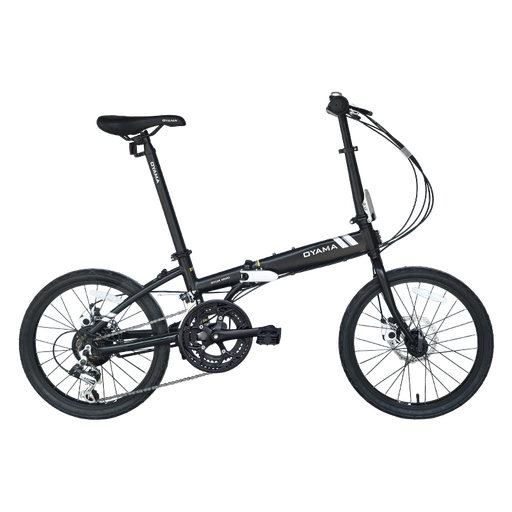
Why it's the right choice: For those who prioritise riding comfort over slightly longer distances, without sacrificing the convenience of a folding bike for storage.
It avoids the trap of subpar performance with a reliable Shimano 7-speed drivetrain and a sturdy aluminium frame. Its folding mechanism is built to last.
Its 20-inch wheels and front suspension fork offer enhanced comfort and stability, approaching the feel of a full-sized bike.

Why it's the right choice: Perfect for longer or hilly commutes, for those who want to arrive at their destination feeling fresh while still enjoying the compactness of a folding bike.
It bypasses the limited performance trap by integrating a 250W motor. While inevitably heavier due to the battery, it perfectly fulfils its primary mission: providing assistance.
Electric assistance in a compact, folding format. Its 36V 10Ah battery provides a comfortable range for daily commutes.
We have compiled a complete and up-to-date selection of bikes that meet our strict selection criteria and current regulations.
The longevity of a folding bike depends on the quality of its components and, of course, its maintenance. For a model like the DAHON K9, which features an aluminium frame and brand-name components, several years of use is entirely realistic. Regular maintenance is key: keep the chain clean and lubricated, check tyre pressure and brake pad wear, and ensure the folding mechanism's hinges remain clean and operate smoothly.
Folding bikes with small wheels (16-inch, for example) are often more agile and responsive, a real asset for weaving through traffic. They accelerate faster but can be perceived as less stable at high speeds than bikes with 20-inch or larger wheels. The choice therefore depends on your priorities: maximum agility and compactness (16-inch) or better comfort and increased stability on rough pavement (20-inch).
Yes, and that's one of the major advantages of this model: it arrives ready to use. According to the manufacturer's information, no assembly is required. You just need to unfold it, adjust the seat height to your size, and you're ready to ride. This saves you the usual hassle of assembly.