
Livraison le jour même ou le lendemain

Qualité garantie

Débloquez vos offres de bienvenue: Livraison GRATUITE | Jusqu'à -80 % | 30 jours d'essai gratuits à JoyPlus
Téléchargez l'application
Whether for hauling groceries, gardening supplies, camping gear, or professional packages, a foldable trolley seems like the perfect solution. Yet, the market is saturated with models that promise the world but quickly disappoint. A frame that bends, wheels that jam on the first bit of gravel, or a folding mechanism that gives out after just a few uses—these frustrations are unfortunately all too common.
My job at Joybuy is to find and vet the best products for you. My goal? To help you cut through the noise. Let's forget the marketing jargon and focus on the facts. This guide breaks down the 3 critical design flaws and gives you the keys to investing in a model that will truly go the distance—both literally and figuratively.
To avoid buyer's remorse, you must look beyond mere appearances. Three technical points make all the difference between a good trolley and a bad one.
The load capacity (in kg) is often highlighted, but it can be misleading. A trolley might support a heavy load of 150 kg when stationary, but buckle under an 80 kg load while moving on uneven terrain. Ensure the frame is made of robust steel or reinforced aluminium.
But be aware, a high maximum load is useless if the volume (in litres) is too small for your needs. For a camping trolley or a garden cart, a volume of at least 100 litres is recommended for carrying bulky equipment. For a hand truck intended for boxes, the height of the base plate and handle is a much more relevant criterion.
This is the Achilles' heel of many entry-level models. Unsuitable wheels can turn a valuable assistant into a real burden.
The main appeal of a foldable trolley is its easy storage. A complex, fragile, or tool-dependent mechanism is a very bad sign. One-touch or centralised folding systems are preferable.
The quality of the materials is just as crucial. An alloy steel frame is very durable but heavier, while an aluminium frame offers an excellent compromise between lightness and strength. For the fabric, 600D Oxford cloth is a reliable choice for its resistance to wear and water.
To put theory into practice, here are a few models that tick all the right boxes, each suited for a specific use case.
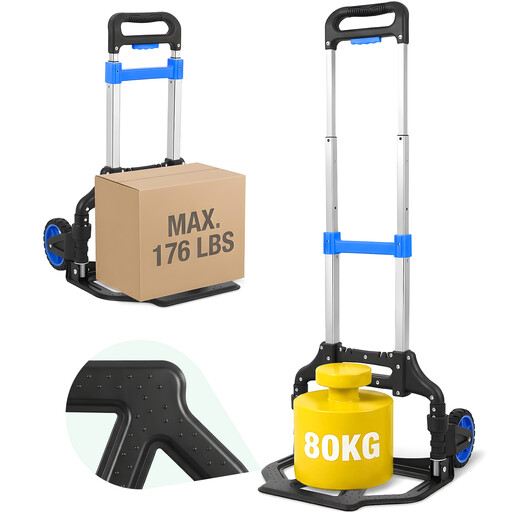
Why we recommend it: Weighing just 3.5 kg, it's perfect for occasional help carrying water packs, small parcels, or shopping bags. Its ultra-compact folded size (5.7 cm thick) allows it to be stored in a cupboard or the boot of a city car without taking up space.
Its quality aluminium frame provides sufficient rigidity for its 80 kg capacity, preventing the twisting effect seen in low-end hand trucks whose chassis deforms under load.
One-second folding mechanism and a 3-level adjustable telescopic handle provide user comfort for all heights.
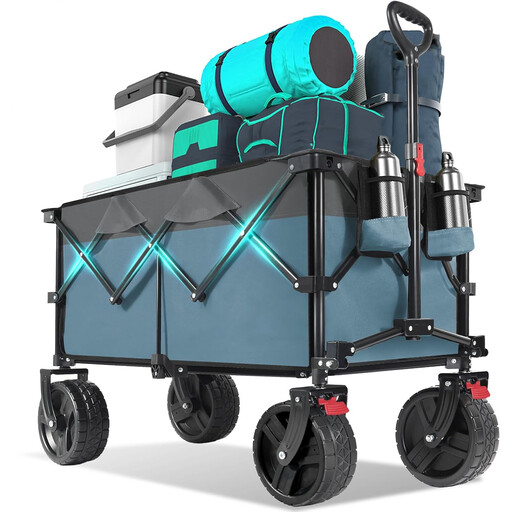
Why we recommend it: Its large 200 L and 200 kg capacity is designed for families and outdoor enthusiasts. It allows you to effortlessly transport tents, chairs, coolers, and bags of soil from the car park to the campsite or the back of the garden.
It is equipped with wide 7-inch all-terrain wheels that won't sink into grass, sand, or mud, unlike the thin wheels on standard trolleys that get stuck at the first obstacle.
Robust alloy steel frame, waterproof 600D Oxford fabric, and an ingenious tool-free folding mechanism for compact storage.
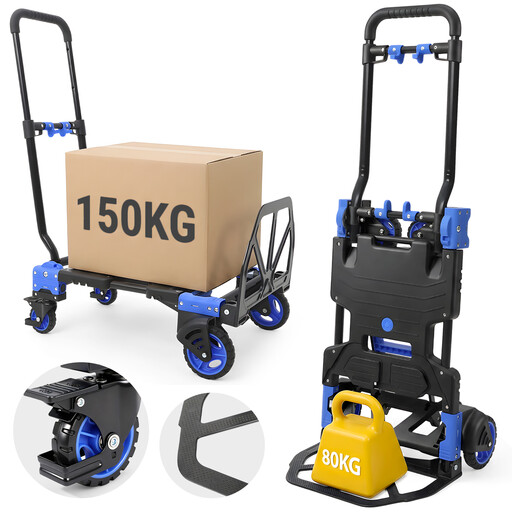
Why we recommend it: This is the Swiss Army knife of transport trolleys. It converts in seconds from a hand truck (80 kg capacity) for boxes and crates to a platform cart (150 kg capacity) for bulkier or unstable items. Ideal for moving, deliveries, or DIY projects.
Its convertible design saves you from buying two separate pieces of equipment. The reinforced aluminium frame is engineered to support heavy loads in platform mode, ensuring stability.
2-in-1 versatility, high load capacity (150 kg), and 360° wheels with an integrated parking brake for added safety on slopes.
A folding hand truck is an upright, two-wheeled cart designed primarily for transporting stackable items like boxes, crates, or appliances. A folding trolley of the wagon type has four wheels and a cargo bed, making it better suited for carrying loose or irregularly shaped items, such as camping gear, garden tools, or your groceries.
A few simple steps can significantly extend your trolley's lifespan. After each use on muddy or sandy ground, clean the wheels to prevent debris from damaging the bearings. If the fabric gets wet, let it dry completely before folding and storing the trolley to prevent mould growth. Finally, always respect the maximum load capacity specified by the manufacturer.
All-terrain wheels, which are wider and often made of rubber, can be slightly noisier on asphalt than small, hard plastic wheels. However, quality models are equipped with bearings that minimise noise. For mixed-use, the gain in stability and versatility across all terrains far outweighs this minor inconvenience.