
Livraison le jour même ou le lendemain

Qualité garantie

Débloquez vos offres de bienvenue: Livraison GRATUITE | Jusqu'à -80 % | 30 jours d'essai gratuits à JoyPlus
Téléchargez l'application
At home, foam climbing blocks for babies and toddlers can be used to create a movement course, a compact climbing area or a soft construction game. But not all models offer the same level of quality. Foam that is too soft, a cover that is difficult to clean or pieces that slide at the first movement can quickly send an otherwise appealing purchase to the back of a cupboard.
Before choosing a colour or counting the number of pieces, it is therefore worth focusing on safety, maintenance, stability and the recommended age of use specified by the manufacturer.
The term “XXL foam construction blocks” is certainly eye-catching, but size alone does not guarantee stability. A substantial module can still slide across a wooden or smooth floor if its base does not provide sufficient grip.
Check for a non-slip surface, the weight of the pieces and, where the system allows it, the option to connect modules with hook-and-loop fasteners. These details make it easier to create a child-friendly obstacle course or a compact indoor climbing ramp.
A Montessori play area should allow children to handle, stack, overcome obstacles and start again at their own pace. The term, often used as a marketing claim, is no substitute for a precise product description. Some items are designed primarily for babies’ grasping and sensory development, while others are intended for children who want to climb, crawl or build.
For a toy intended for babies from 3 months, prioritise easy-to-grip surfaces, the absence of small detachable parts and use on a flat floor under adult supervision.
Washable foam blocks are particularly practical in homes with young children, especially when the cover is removable and machine washable. Also consider vacuum packaging: the modules may need 24 to 48 hours to regain their shape before use.
A concealed zip, durable cover and neatly finished seams reduce the risk of tampering and make everyday care much easier.
The EN71 designation covers several aspects of toy safety in Europe. The manufacturer’s product information should specify the relevant sections, including:
The BanaSuper models featured below are described by their manufacturer as complying with EN71-1, EN71-2, EN71-3 and European Directive 2009/48/EC on toy safety. Before purchasing, always review the information available on the product page and the age-related warnings. Compliance with a standard does not replace checking the toy’s condition or supervising the child.
High-density, resilient foam will generally retain its shape better than loosely structured padding. However, the product page remains the best source for the model’s exact specifications. A soft, durable and removable cover also makes cleaning considerably easier.
Hook-and-loop fasteners can help keep certain configurations in place, while a non-slip base improves grip on a suitable surface. Set up the modules away from furniture corners, in a clear and sufficiently spacious area where the child can move without encountering nearby hard obstacles.
A five-piece set can be perfectly suitable for an apartment or a child’s bedroom. With seven modules, the possibilities expand: tunnels, steps, ramps and obstacle courses can be reconfigured whenever inspiration strikes. Measure the available space before ordering, and also plan where the blocks will be stored.
In a nursery or preschool, it is best to prioritise washable covers, versatile configurations and regular inspections of seams, fasteners and attachments.
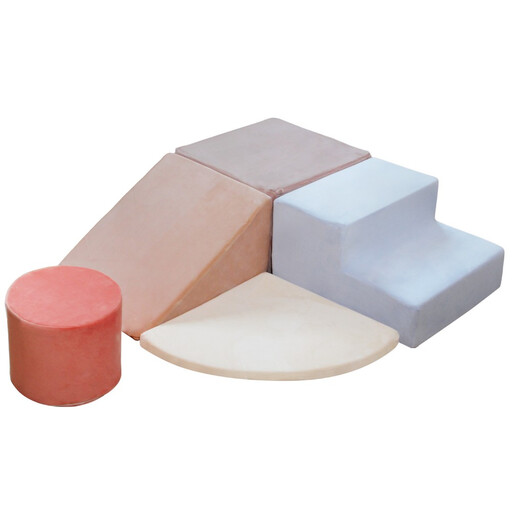
Why this model fits the profile: A five-block set for gradually creating an indoor play area in a bedroom or living room.
The product page mentions a non-slip base on certain pieces, hook-and-loop fasteners and concealed zips. The removable cover is described as machine washable.
Five foam shapes, vacuum-packed delivery and manufacturer-declared compliance with EN71-1, EN71-2 and EN71-3.
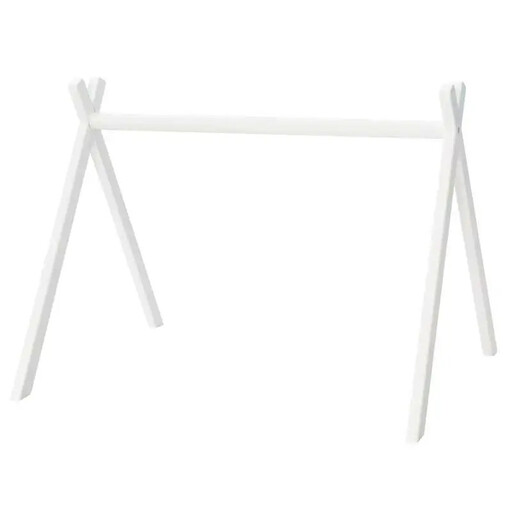
Why this model fits the profile: An option for babies who are beginning by observing, touching and grasping, well before they are ready for climbing activities.
The product page specifies that the item must be used on a flat surface, that the surfaces can be wiped clean and that adult supervision is recommended. This is not a climbing module.
White lacquered wood, dimensions of 52 × 70 × 50.5 cm and surfaces that can be cleaned with a damp cloth.
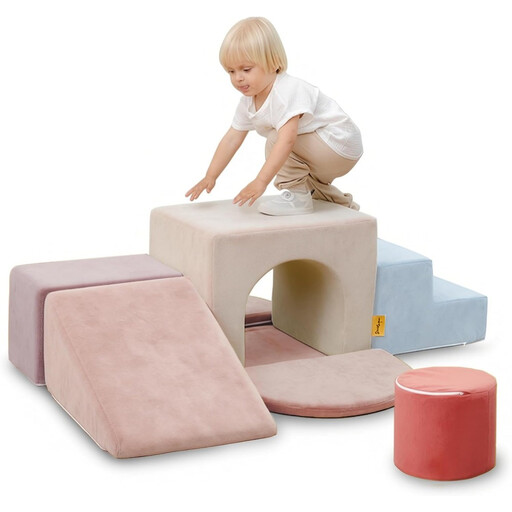
Why this model fits the profile: Seven modules make it possible to refresh the course more often in a family playroom, nursery or preschool classroom.
The description mentions a non-slip base, sturdy fasteners and removable, washable covers—all valuable features for frequent use.
Seven foam blocks, machine-washable covers and a stated recovery of their full volume within 48 hours of unpacking.
We have brought together an up-to-date selection of products that meet these purchasing criteria and European toy-safety requirements.
Place the foam movement modules on a sufficiently grippy mat in a clear room. Avoid damp surfaces and areas near stairs. For babies and young children alike, an adult should remain present during climbing, obstacle-course and construction activities.
When a vacuum-packed model arrives, carefully remove the packaging and allow the blocks to regain their volume for the period specified. Before first use, inspect the shape of every piece, along with the seams, zips and fasteners. A washable cover does not mean that the inner foam can be submerged.
Lifespan depends on frequency of use, the weight supported, storage conditions and maintenance. Replace any component showing a tear, an accessible zip or significant deformation.
It depends entirely on the product’s design and the manufacturer’s recommendations. A developmental play arch may be suitable from 3 months when used on a flat surface under supervision. Foam climbing blocks and movement courses are generally more appropriate once a child can move around with sufficient independence. Always refer to the labelling and safety warnings.
When the product page specifies this, the cover can be removed and machine washed according to the manufacturer’s instructions. Remove the foam before washing and allow the cover to dry completely. The foam itself should not be cleaned in the same way unless specific instructions say otherwise.
Allow for the footprint of the modules, a clear area around the course and storage space. For a reconfigurable setup, measure the room before purchasing and avoid placing the blocks against furniture with sharp corners. If space is limited, a more compact configuration will often be the better choice.