
Livraison le jour même ou le lendemain

Qualité garantie

Débloquez vos offres de bienvenue: Livraison GRATUITE | Jusqu'à -80 % | 30 jours d'essai gratuits à JoyPlus
Téléchargez l'application
An indoor motor skills course for children can turn a living room, nursery or preschool classroom into a real play zone. But between foam blocks, climbing triangles and multi-function structures, marketing claims alone aren’t enough to make the right choice.
Price, the number of activities or the colours don’t always tell you much about day-to-day quality. Here are the main pitfalls to avoid, the technical criteria to examine and a selection of models suited to different needs.
The EN71 mark is a good starting point, but it’s worth looking into the details. The EN71-1, EN71-2 and EN71-3 parts cover mechanical and physical properties, flammability and the migration of certain elements. A product page that simply says “certified” without specifying the references should therefore be checked more carefully.
Compliance with the European Toy Safety Directive 2009/48/EC does not remove the need for supervision appropriate to the child’s age, installation on a clear floor, and adherence to the usage limits set by the manufacturer.
An indoor play area always takes up more room than its own dimensions suggest. You need to allow a circulation zone around the structure, especially if it includes a slope, ramp or climbing module.
In a small room, foam motor skills blocks are generally the easiest to move and reconfigure. A foldable climbing triangle can be stored against a wall, but you also need to measure the space required once the structure is set up.
A non-removable cover can quickly become a hassle in a family home, nursery or school. Between sticky fingers, spilled drinks and floor play, a washable cover makes a real difference day to day.
Another detail often forgotten: some foam sets are delivered vacuum-compressed. They may need 24 to 48 hours to regain their shape before use. It’s best to factor this in at the time of delivery.
Non-slip elements, hook-and-loop fasteners and properly fixed handles all contribute to the overall stability. However, they do not replace installation on a suitable floor. A play mat can improve comfort and help prevent some elements from shifting, but it does not turn a slippery floor into a perfectly safe surface.
For a climbing course for ages 3 to 7, also check the recommended age, maximum weight, number of permitted users and whether there are any small parts. These details are more meaningful than a very broad age range.
A removable, machine-washable cover makes daily cleaning much easier. For foam elements, regularly check the firmness, seams, zips and fasteners. For wood and metal, inspect the screws, handles and contact points.
The lifespan depends on how often it’s played with, the weight it supports, storage conditions and maintenance. No material should be considered indestructible: regular checks are essential, especially in a group setting.
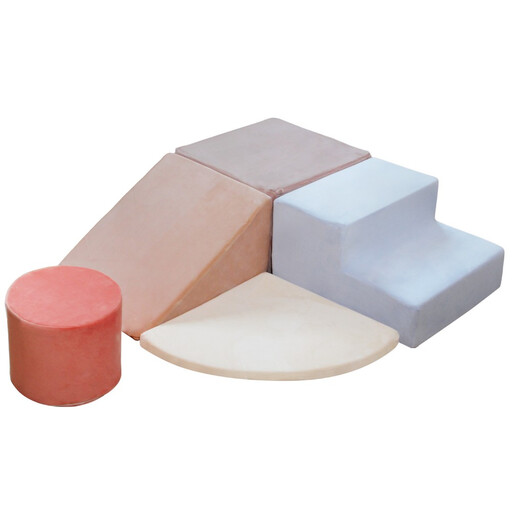
Why this might suit you: This compact set is aimed at families who want to offer motor development play without installing a fixed structure in the room.
The five blocks can be moved and combined without permanent installation. The listing mentions high-density foam, non-slip bases and hook-and-loop fasteners.
Removable, machine-washable covers and compliance with EN71-1, EN71-2 and EN71-3 are stated in the manufacturer’s details.
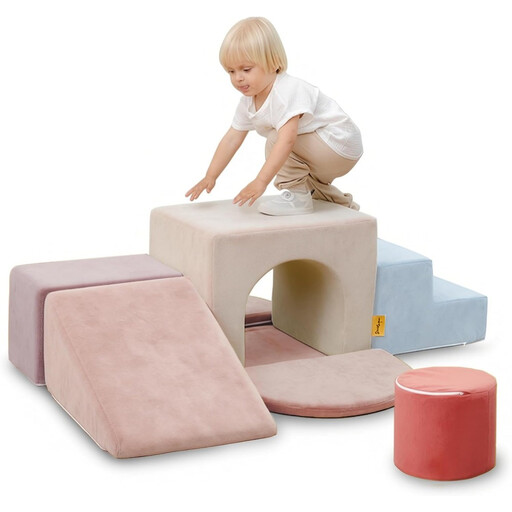
Why this might suit you: With seven pieces, this set offers many configurations to create a tunnel, a small course or a climbing structure at home.
The listing mentions a non-slip base, sturdy fasteners and concealed zips – so the product doesn’t rely on looks alone.
High-density polyurethane foam, washable covers and an expansion time of up to 48 hours after unpacking.
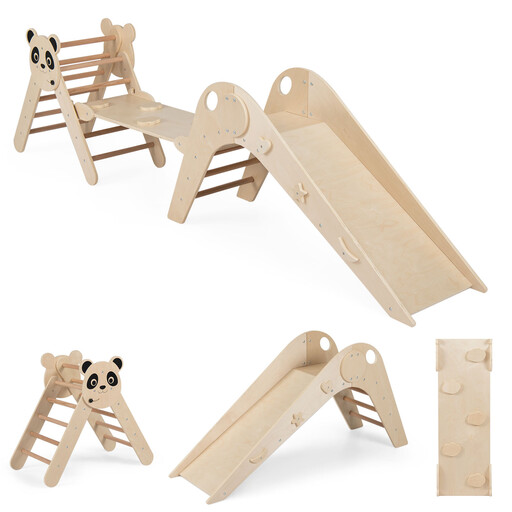
Why this might suit you: This climbing toy combines a triangle, ramp, balance bridge and tunnel. Once folded, it can be stored against a wall, according to the product listing.
The manufacturer states a recommended age of 3 years and over, the need for assembly and a stated weight capacity of 50 kg per component – three points to check before buying.
The description mentions beech wood and plywood, side handles, smooth edges and a foldable design.
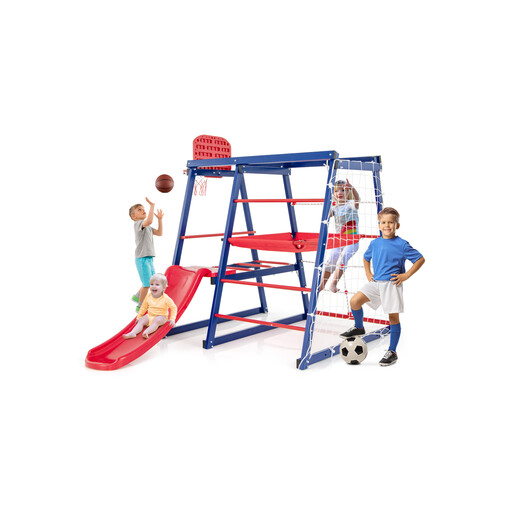
Why this might suit you: Designed for children aged 3 to 7 according to the listing, this frame includes a slide, ladder, net, rope and basketball hoop to vary the activities.
With stated dimensions of 150 × 142 × 146 cm, it’s essential to check the available space carefully. This step is vital to avoid ending up with a structure that’s too large for a family room.
Metal frame described as rust-resistant, thick cotton ropes and a stated maximum weight capacity of 100 kg.
Discover a regularly updated selection of products that meet these criteria and the applicable European toy safety requirements.
It all depends on the design of the course. Soft blocks can support early movement, always under supervision, while a wooden triangle or a structure with a ladder is generally recommended from age 3. The manufacturer’s recommended age should always take priority over a general estimate.
Choose a flat, clear and non-slip surface. Move furniture with sharp corners away, and check the fasteners, screws, handles and seams before each play session. Adult supervision is essential, especially with young children and during first use.
Dust the blocks regularly and follow the washing instructions for the cover. When it’s removable and machine-washable, cleaning is much easier. Let each piece dry completely before putting it back, and replace any part that shows a tear or significant deformation.