
Livraison le jour même ou le lendemain

Qualité garantie

Débloquez vos offres de bienvenue: Livraison GRATUITE | Jusqu'à -80 % | 30 jours d'essai gratuits à JoyPlus
Téléchargez l'application
Hanging a picture frame, putting up a shelf, sealing a parcel or redoing a bathroom seal doesn't necessarily require a drill. But you do need to choose the right fixing adhesive: a poorly suited product can leave marks, peel off in damp conditions or damage the surface. To avoid nasty surprises, match the formula, the surface and the load to your intended use.
A product may stick straight away without being able to support its stated weight over time. Some adhesives need a setting period before they can take their maximum load. A no-nails, no-screws fixing glue can hold an object quickly, yet may require up to 24 hours before reaching full load capacity, depending on the manufacturer's instructions.
Paint, wallpaper, porous wood, glazed tiles, glass and plastic all react differently. A formula designed for a non-porous surface won't necessarily work on a painted wall or a flexible material. A "multi-surface" claim doesn't let you off checking the list of compatible and incompatible surfaces.
The actual load a fixing can bear depends on the number of fixing points, the object's dimensions, temperature, humidity and surface preparation. A double-sided tape intended for a static object should not be used to secure a moving load, something suspended above a walkway, or anything that could cause injury if it falls.
Before application, the surface should generally be clean, dry, degreased and dust-free. On a painted wall, check that the paint is well adhered and test on an inconspicuous area. Adhesive strips for picture frames are usually designed for smooth, stable surfaces, while a fixing glue for porous materials can suit wood, plaster, brick or stone.
Wallpaper, freshly painted surfaces, friable substrates and absorbent materials need extra care. With white Patafix, in particular, avoid wallpaper and recently painted surfaces: a greasy mark or some peeling is still possible.
Compare the stated load with the actual weight of your object and keep a safety margin. Depending on their size, Command picture hanging strips indicate a capacity of up to 5 kg for medium strips and 7 kg for large ones, with compatible frame dimensions specified on the packaging. For heavier loads, some outdoor adhesive tapes claim up to 10 or 13 kg, but these values depend on surface preparation and the geometry of the fixing.
Removal deserves as much attention as application. A removable strip is taken off by slowly pulling the tab downwards. A demountable glue may require a spatula. Conversely, a permanent adhesive should be reserved for installations that are not intended to be moved.
For a bathroom, kitchen or sheltered outdoor area, look for a clearly stated water resistance. A silicone anti-mould sealant is suitable for renewing sanitary seals, but does not replace a mounting adhesive. On stairs, around a pool or in a walkway area, an anti-slip tape must be applied to a stable, clean, dry surface.
For parcels, don't confuse parcel tape with clear office tape. A wide parcel tape, supplied with a dispenser, makes sealing cardboard boxes easier and avoids uneven cuts. Masking tape, on the other hand, protects an area during painting work and should be removed within the stated time to minimise residue.
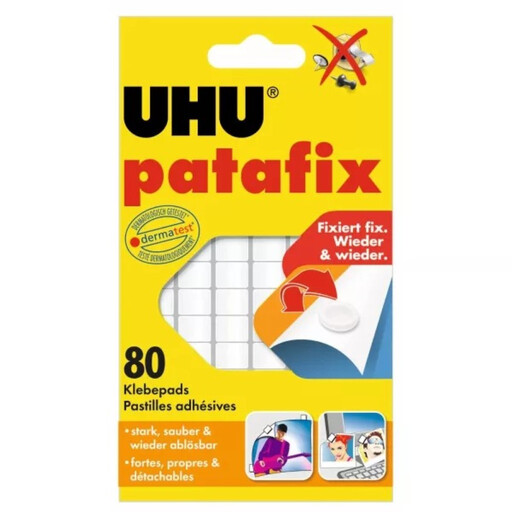
Why this choice suits this profile: The 80 pre-cut tablets are ideal for photos, notes, posters and small repositionable decorations, with no tools or complicated preparation needed.
The instructions clearly state the usage limits, including the exclusion of wallpaper and freshly painted surfaces. A test on a small area is still recommended.
Solvent-free formula, malleable tablets and repositionable fixing on several non-porous surfaces.
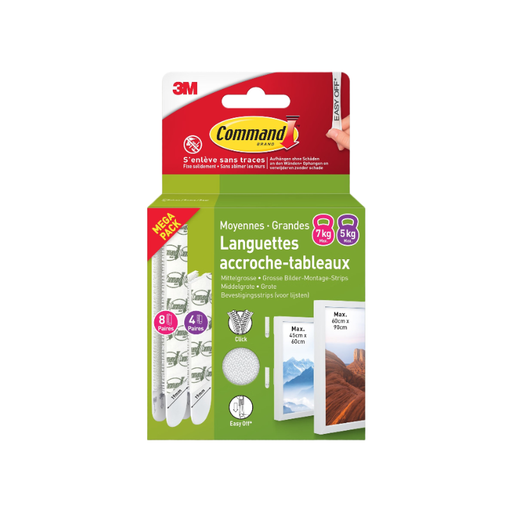
Why this choice suits this profile: The multipack lets you choose the right size for frames, mirrors, clocks or whiteboards, while keeping your walls drill-free.
Compatible surfaces and weight limits are detailed for each size. Removal is done by slowly pulling the tab down, with no nails or screws needed.
4 medium pairs and 8 large pairs, with stated compatibility for painted walls, laminate, glass, metal and tiles.
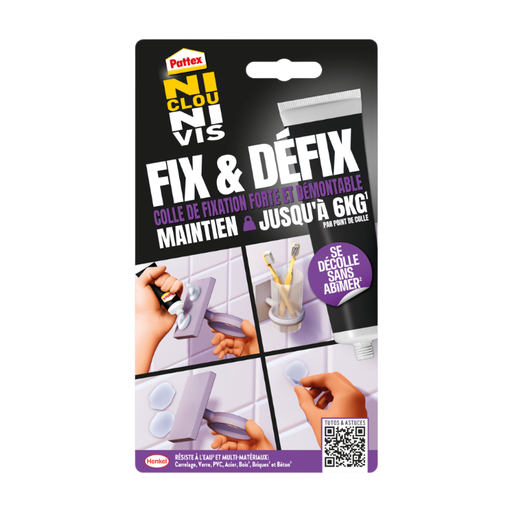
Why this choice suits this profile: This demountable glue is designed for installations on glossy tiles, glass, PVC, aluminium or stainless steel, particularly in a kitchen or bathroom.
Incompatible surfaces are clearly listed, including wallpaper, painted walls, copper, brass, natural stone and several plastics.
Water resistant, removable with a spatula and a stated load of up to 6 kg per point, with a 24-hour wait before full load.
For sanitary work, Rubson bath and kitchen silicone anti-mould sealant is a different solution from a fixing adhesive: it is used to create or redo seals around a sink, shower or basin. The pre-cut nozzle makes application easier, but surfaces must be cleaned and perfectly dry before use.
Packaging needs can be covered by the PP Packaging x2 + Dispenser set, which includes two 50 m x 48 mm rolls and a dispenser. For larger volumes, TAPEBEAR tape in multiple rolls uses a clear BOPP film and is claimed to be quiet during application. Those who paint can compare Scotch Classic masking tape, designed for removal within two days, with ScotchBlue, which is claimed to be removable without leaving residue for up to 14 days under the stated conditions.
We have compiled a comprehensive, real-time updated list of products that meet these demanding selection criteria and European safety regulations.
A denture adhesive cream is not chosen like a DIY glue. The Fixodent products shown are designed for full or partial dentures. Follow the quantity stated on the packaging and stop using if irritation occurs. If the problem is serious or persists, seek advice from a dentist or doctor. A DIY adhesive must never be misused for body contact.
Waterproof adhesive plasters, on the other hand, are intended to protect superficial wounds externally, in line with their instructions. The Mercurochrome model offered measures 10 x 7 cm, has a non-stick pad and adhesive on all four sides. It is for external use only and is single-use. Do not use it on an infected or deep wound, a bite or a serious burn without medical advice.
Dust, degrease and then dry the area completely. Avoid friable, damp or freshly painted surfaces. With a removable product, test on a small part of the wall and respect the waiting time before hanging the object.
The duration varies depending on the formula, exposure to UV light, humidity, heat and load. A permanent outdoor tape may be designed for long-term installation, while a picture hanging strip is intended to be removed. Check the edges regularly and replace the product if the adhesion starts to weaken.
No. Some glues are suitable for porous materials like wood, plaster or brick, while others are intended for non-porous surfaces like glass or tiles. Always check the exclusions listed on the product page and do not use an adhesive fixing for a load whose fall could cause damage or injury.