
Livraison le jour même ou le lendemain

Qualité garantie

Débloquez vos offres de bienvenue: Livraison GRATUITE | Jusqu'à -80 % | 30 jours d'essai gratuits à JoyPlus
Téléchargez l'application
A cookware set with a detachable handle has become the go-to solution for modern kitchens, especially in apartments where every square inch counts. The promise is alluring: a stackable cookware set that moves from the hob to the oven, then to the table, and finally into the fridge, all while freeing up a huge amount of space in your cupboards.
But be warned: behind this attractive promise lie pitfalls that can turn a smart investment into a real headache. Before you make a purchase, it's essential to know how to spot the design flaws that only become apparent with use.
Here are the 3 most common pitfalls to avoid:
Knowing how to spot these flaws is the first step toward a smart and long-lasting purchase.
To avoid falling into these traps, focus on a few objective technical points. These are the true guarantors of the quality and longevity of your future space-saving cookware set.
The safety of a pan with a detachable handle rests entirely on its attachment system. A quality mechanism must offer:
The choice of material is crucial, both for cooking performance and for your health.
The real advantage of a stackable cookware set is its versatility. Check that the items (without their handle and lid) are designed to be:
The goal isn't to find the perfect product, but the one that truly matches your cooking style. Here is a selection of products tailored to specific needs.
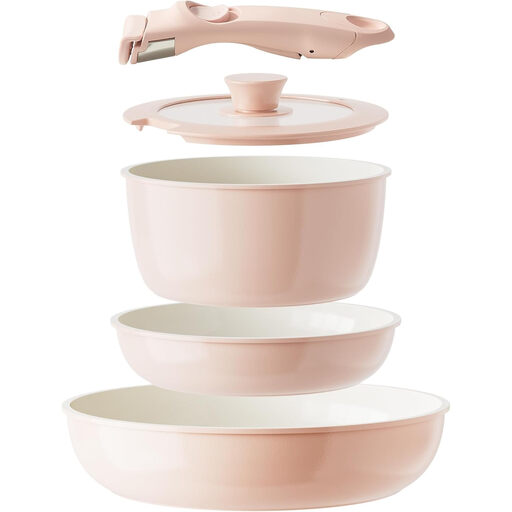
Why we love it: This set is an excellent entry point. It covers the essential needs (two pans, one pot with a lid) for a single person or a couple in a studio or small apartment, without cluttering the cupboards.
The manufacturer is transparent: the coating is natural ceramic, free of PTFE, PFOA, and PFAS. The detachable handle is designed for a smooth transition between uses (hob, oven, table).
The manufacturer claims a space saving of up to 75% thanks to its stackable design. Its versatility is a real plus: compatible with all hobs (including induction) and oven-safe up to 450°C (840°F) (without the handle).
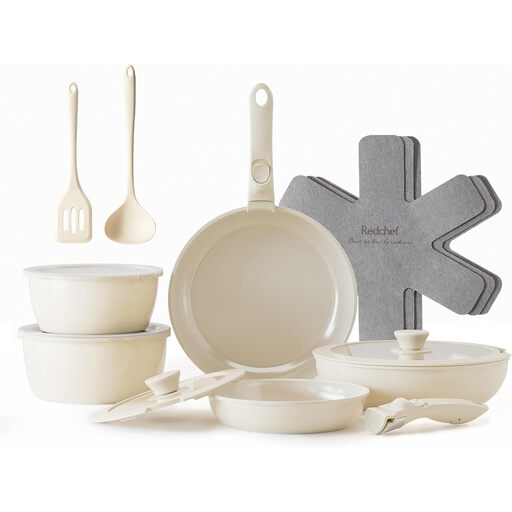
Why we love it: For those who cook every day and are looking for a complete set. This 16-piece collection offers a wide variety of sizes while retaining the advantage of optimised storage.
You get the same guarantees as the more compact set: a triple-layer ceramic coating that is PFAS-free and a sturdy detachable handle. The brand's patented technology aims for enhanced durability for intensive use.
The completeness of the set. With multiple handles, lids, and a wide range of containers, it can replace an entire mismatched and bulky cookware collection with a single, cohesive, and perfectly stackable system.
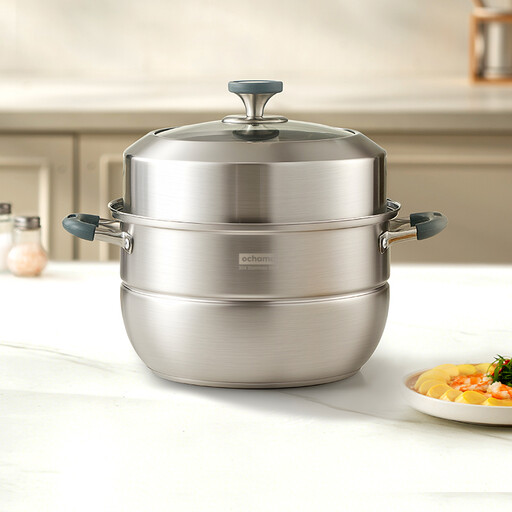
Why we love it: An alternative for those who prioritise healthy cooking and seek a vertical storage solution. It's not a detachable handle system, but it addresses the problem of clutter with its stackable design.
No coating pitfalls here: this is 304 stainless steel, a durable, stable, and chemical-free material. Its vertical, stackable design is another smart approach to saving space.
Tiered cooking. It allows you to simultaneously cook different foods (vegetables, fish, rice), optimising time and energy. Compatible with all hobs, including induction.
Explore our full selection of products that meet our quality and safety criteria.
The lifespan of a detachable handle depends directly on the quality of its mechanism and materials. A well-designed model with robust metal components and a precise clipping system can last for many years. To preserve it, it is advisable to handle it with care, avoid dropping it, and never leave it on the pan during oven cooking.
Ceramic coatings are made from inorganic materials (sand and clay) and generally do not contain PTFE or PFOA. As a precaution, choose brands that explicitly guarantee they are manufactured PFAS-free. And as with any coating, follow the golden rules: do not overheat when empty and use wooden or silicone utensils to preserve it.
Yes, provided its base is compatible. For this, it must be flat and contain a ferromagnetic material. Manufacturers clearly indicate this with a coil-shaped pictogram. For optimal performance, a thick base is preferable, as it ensures better heat distribution and prevents warping over the long term.