
Livraison le jour même ou le lendemain

Qualité garantie

Débloquez vos offres de bienvenue: Livraison GRATUITE | Jusqu'à -80 % | 30 jours d'essai gratuits à JoyPlus
Téléchargez l'application
Looking for healthier cooking and effortless cleanup? That's often what inspires us to upgrade our cookware. Sets with non-stick ceramic coating are all the rage, but be warned: the market is flooded with marketing promises that don't always deliver. To avoid disappointment and make a truly smart purchase, it's crucial to know how to decode the labels.
As a Product Expert at Joybuy, my role is to guide you. Let's break down the key points to check and the criteria that really matter, so you can choose cookware that won't let you down.
The excitement for new gear can fade quickly. Here are the three most common disappointments:
To avoid falling into these traps, focus on verifiable technical specifications. Here are the three key points to inspect closely.
The term "ceramic" almost always refers to a coating applied to a metal body. The quality of this pairing determines the performance and lifespan of your cookware.
For a piece of cookware to work effectively on an induction hob, its base must contain a ferromagnetic material. A simple label isn't enough; look for a thick, encapsulated base or a "composite" base. This design not only ensures compatibility but also guarantees perfect heat distribution, preventing hot spots that can damage the coating and burn your food.
Handles, lids, oven-safe features... these design details make all the difference in daily use:
To put theory into practice, here are a few products that meet these criteria, designed for different needs.
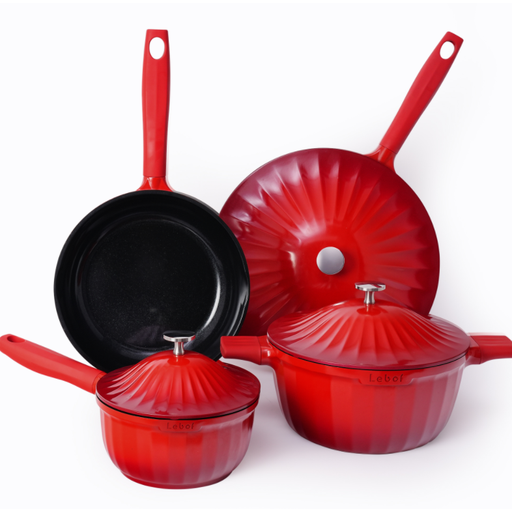
Why it's a great choice: This pan and pot set is perfect for getting fully equipped to handle daily family meals, from a slow-cooked dish in the stockpot to a quick omelette.
Its die-cast aluminium body ensures fast, even heating, solving the problem of poor induction performance. Its Ti-Ceramic coating is designed for enhanced durability, addressing the challenge of non-stick longevity.
Complete and versatile set (pans, saucepans, stockpot). Certified PFAS-free coating. Compatible with all hobs, including induction.
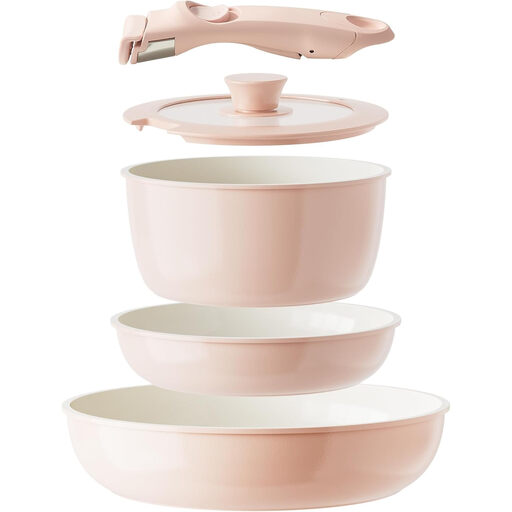
Why it's a great choice: Perfect for small kitchens, studio apartments, or anyone who loves a well-organised cupboard. The removable handle and stackable design free up a ton of space.
This set tackles a major problem: clutter. It also clears up any ambiguity around the "healthy" claim by guaranteeing a composition free of PFAS, PTFE, and PFOA. Its versatility (hob, oven, fridge) makes it a true Swiss Army knife.
Stackable design saves up to 75% more space. Removable handle to go from hob to oven in one click. Compatible with all hobs.
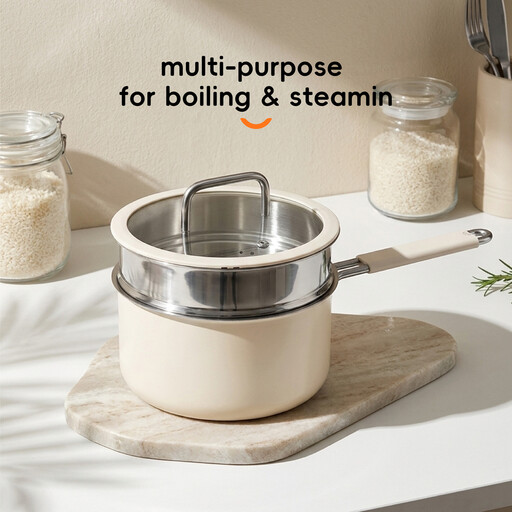
Why it's a great choice: Ideal for those who demand the best materials for their delicate dishes: sauces, porridges, baby food, or steamed meals. 316 stainless steel is a benchmark for its high chemical inertness.
This product doesn't just make vague "healthy" claims: it features an interior made of 316 stainless steel, a surgical-grade material known for its superior corrosion resistance. The ceramic exterior makes cleanup easy, without compromising on quality.
316 stainless steel interior for maximum durability and food safety. Steamer basket included for healthy, versatile cooking.
We have curated a full range of products that meet our quality criteria and current safety standards.
What is the lifespan of a non-stick ceramic coating? It all depends on the quality of the coating and how you care for it. A well-made model, used with wooden or silicone utensils, hand-washed without abrasive sponges, and protected from thermal shock (the infamous sudden shift from hot to cold), can retain its properties for several years. In contrast, entry-level models often show signs of wear in less than a year.
Can you use metal utensils on a ceramic pan? It is strongly discouraged. Even if some coatings claim to be "scratch-resistant," repeated use of a metal fork or spatula will eventually create micro-scratches. These will degrade the non-stick properties and shorten your pan's lifespan. Always opt for wood, bamboo, nylon, or silicone.
Is ceramic cookware really healthier? Yes, provided it's high-quality. Its main health benefit is being made without PFAS (and therefore without PFOA or PTFE). In practical terms, this means none of these controversial chemicals are at risk of migrating into your food, even in cases of accidental overheating or scratching. This is its major advantage over some older non-stick coatings.