
Livraison le jour même ou le lendemain

Qualité garantie

Débloquez vos offres de bienvenue: Livraison GRATUITE | Jusqu'à -80 % | 30 jours d'essai gratuits à JoyPlus
Téléchargez l'application
There's nothing quite like the simple pleasure of perfect, golden, crispy homemade fries. But choosing the right deep fryer can quickly become a headache. Between marketing promises and confusing spec sheets, the risk of ending up with a disappointing appliance is very real. As a product expert for Joybuy, my mission is to help you make sense of it all. Let's break down the pitfalls to avoid and the essential criteria for finding the deep fryer that will truly meet your expectations.
The market is flooded with models, but not all are created equal. Here are three classic mistakes that could ruin your fun... and your investment.
To make the right choice, focus on these three criteria that make all the difference in performance and convenience.
The choice comes down to two main families:
Capacity, expressed in litres of oil or kilograms of food, should match the size of your household.
Power (in watts) is just as crucial. High wattage (over 2000?W for a standard model) ensures rapid heat-up and, most importantly, stable heat retention when you add cold food. This is the secret to getting crispy, non-greasy fries.
The material of the bowl or pan has a direct impact on durability and maintenance.
To help you put theory into practice, here are a few models that suit different user profiles, selected based on the criteria we've just discussed.
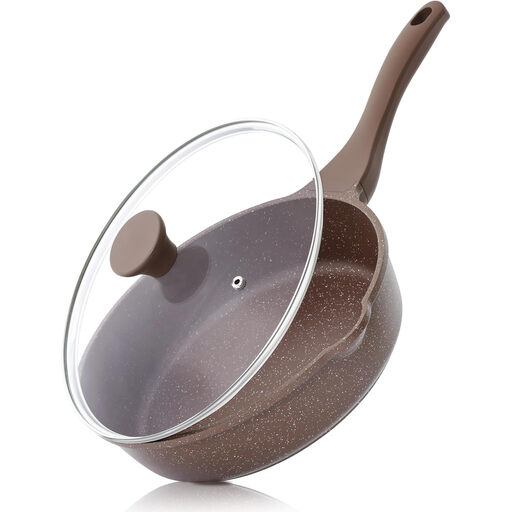
Why we love it: Perfect for those looking for an all-in-one tool. Its high sides are ideal for deep frying, but it also excels at sautéing, simmering, and pan-frying. Unlike a dedicated appliance, it won't monopolise your countertop space.
This sauté pan avoids the "difficult to clean" pitfall thanks to its smooth, rivet-free non-stick surface, which wipes clean with a simple sponge.
Its coating is guaranteed free of PFOA, PFOS, lead, and cadmium. Compatible with all hobs, including induction, it's a safe and ultra-versatile choice.
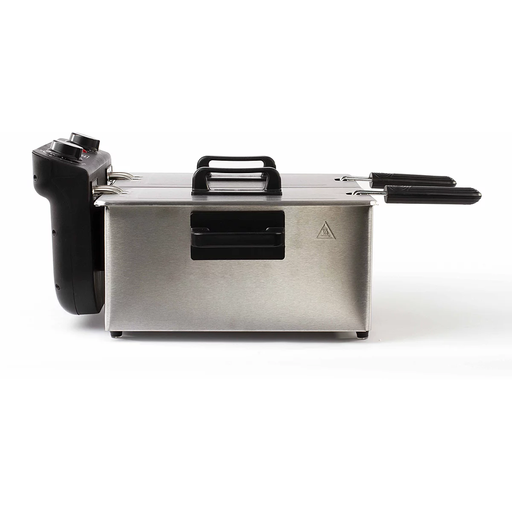
Why we love it: Built for efficiency and large quantities. With its two 3-litre tanks, it can prepare up to 1.6 kg of fries or cook fries and doughnuts at the same time without mixing flavours.
It tackles the dual challenge of capacity and cleaning. The appliance is fully detachable, and its removable tanks radically simplify maintenance.
Its two independent thermostats allow you to set each tank separately up to 190 °C. Its 3300 W power ensures express heat-up times.
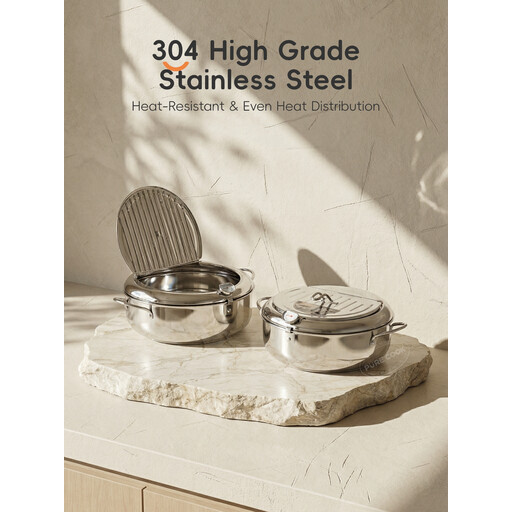
Why we love it: For cooks who love precision control and premium materials. This food-grade stainless steel utensil is a guarantee of durability and hygiene, while its built-in thermometer allows for degree-perfect control of the oil temperature.
It sidesteps the pitfall of fragile coatings. Its solid 304 stainless steel construction resists both corrosion and scratches, ensuring a very long lifespan.
Its multi-layer composite base ensures fast and even heat distribution, making it compatible with gas, induction, and vitroceramic hobs.
If these models don't quite meet your needs, don't worry. Explore our full range of cookware dedicated to frying.
The easiest way is to choose a fully detachable model where the components (bowl, basket, lid) are dishwasher-safe. For others, wait for the oil to cool down completely. Drain it (filter it if you plan to reuse it), then wipe away excess grease with a paper towel. Fill the bowl with hot water and a few drops of washing-up liquid and let it soak. All that's left is to gently scrub with a non-abrasive sponge, rinse, and dry meticulously.
Opt for vegetable oils with a high smoke point, such as peanut, sunflower, or rapeseed oil. Conversely, avoid extra-virgin olive oil, which does not handle high temperatures well. It is advisable to filter the oil after each use to remove residues. As a general rule, the same oil can be used 8 to 10 times. Change it without hesitation as soon as it darkens, becomes viscous, foams abnormally, or gives off a rancid smell.
A traditional deep fryer immerses food in a bath of hot oil to give it that inimitable crispiness and golden colour. An oil-free fryer, or air fryer, is actually a mini convection oven that cooks food using a flow of very hot air. The result is more akin to oven-baking than classic frying, with a different texture and a very low, or even zero, amount of fat.