Households looking for more fibre
You’d like to replace some or all of the white flour in your crêpes. Manger Bouger presents wholemeal and semi-wholemeal flours as ways to choose cereals that are naturally higher in fibre.


For crêpes made with wholemeal flour, choose T150 flour if a high wholemeal content is your priority: Mon Fournil’s Carrefour product page lists crêpes among its suggested uses. If you’re looking for a softer texture, try semi-wholemeal flour or a blend of T150 and a finer flour. Auchan suggests this blend for a lighter result, although this isn’t guaranteed for every recipe.
You’d like to replace some or all of the white flour in your crêpes. Manger Bouger presents wholemeal and semi-wholemeal flours as ways to choose cereals that are naturally higher in fibre.
You want to include some wholemeal flour without giving up the texture you’re after. Auchan’s product page for Naturaline flour suggests blending it with a finer flour for a lighter result.
Check the ingredients before choosing a flour: the Directorate General for Competition Policy, Consumer Affairs and Fraud Control (DGCCRF) points out that wheat contains gluten. Wholemeal wheat flour is therefore not a gluten-free option.
If you want to include some wholemeal flour in your crêpes, first decide whether flour composition, texture or finding it locally matters most to you.
| What matters | What to check | Who is this for? |
|---|---|---|
| Wholemeal content | Look for « wholemeal flour » or « T150 » in the product name and ingredients. Compare the fibre content per 100 g where nutritional information is available. | For my homemade crêpes, I want to choose wholemeal wheat flour first, rather than judge by its colour. Around 33% of consumers prioritise this composition. |
| Softness of the crêpes | Consider semi-wholemeal flour or a blend of T150 and a finer flour. Try the recipe before making a large batch. | If I’m making crêpes for several people, texture matters more than using T150 throughout. This is the priority for around 42% of consumers. |
| Availability in shops | Check the product and pack size with the shop where you plan to buy it, then confirm the product name. | Before preparing food for a local market, I want to find a flour nearby whose type I can check. This is the main consideration for around 25% of consumers. |
Seeing « wheat » on the label doesn’t tell you that the flour is wholemeal. The T150 products listed by Carrefour and Auchan are clearly labelled so you can tell them apart.
Check the product name and ingredients rather than relying on the look of the pack.
The proportion of wholemeal flour is one factor that affects texture. Auchan suggests blending its Naturaline T150 flour with a finer flour for a lighter result, but doesn’t describe how every crêpe recipe will turn out.
Try a small batch before settling on quantities for a larger one.
Here, « wholemeal » describes the type of flour, not the absence of gluten. The DGCCRF states that wheat contains gluten.
If you need to avoid gluten, check the labelling of a product suited to your needs instead of choosing T150 wheat flour.
Carrefour and Auchan list Francine T150 wholemeal wheat flour for cooking and baking.
Mon Fournil’s organic T150 wholemeal wheat flour product page on Carrefour explicitly lists crêpes among its possible uses.
Auchan lists Naturaline organic T150 wholemeal wheat flour and suggests blending it with a finer flour for a lighter result.
This product is a wholemeal T150 wheat flour option for trying crêpes made with some wholegrain flour.
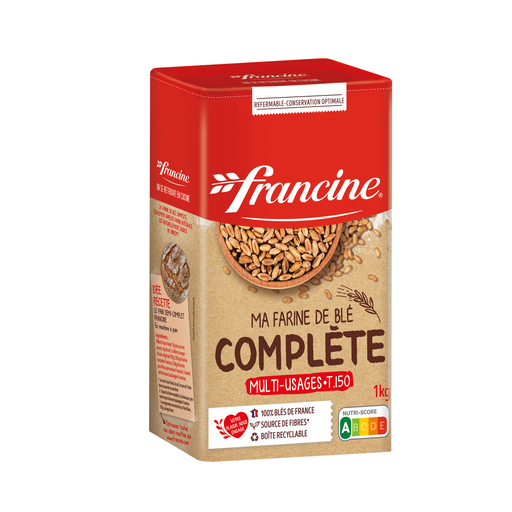 Image unavailable
If wholemeal flour is your priority, this 1 kg pack of T150 wheat flour is a good option for your first crêpe-making attempt. Adjust your recipe to get the texture you’re looking for. Wheat contains gluten.
Yes. Mon Fournil’s organic T150 wholemeal wheat flour product page on Carrefour lists crêpes among its suggested uses. For another product, check the instructions and try the recipe before making a large batch.
You could try semi-wholemeal flour or blend T150 with a finer flour. Auchan suggests blending for a lighter result; adjust the proportions to suit your recipe.
No. The DGCCRF states that wheat contains gluten. If you need to avoid it, check the ingredients and labelling of a product suited to your needs.
First, read the product name and ingredients to distinguish wholemeal flour from wheat flour whose type isn’t specified. Check the nutritional information too if you want to compare fibre per 100 g; the DGCCRF points out that allergenic ingredients must be clearly highlighted.