What should you compare on the label?
Start by checking the recipe, then compare the nutritional information on a like-for-like basis before working out what it means for your portion. A value per 100 g won’t necessarily describe a whole tin or 100 g of drained sweetcorn, so check the basis shown.
| Criterion |
What to check |
Who is it for? |
| Carbohydrates in your portion |
The “carbohydrate” value per 100 g, the basis it’s given on and the drained weight for the portion served. |
If I count the carbohydrates in my meal, the amount I serve matters just as much as the value on the label. Around 36% of shoppers concerned put this calculation first. |
| Added sugar |
The ingredients list, followed by the separate “carbohydrate” and “of which sugars” values. |
I want to avoid added sugar without assuming that sweetcorn contains no sugars or carbohydrates. This is the main priority for around 29% of shoppers concerned. |
| Added salt |
The “salt” value per 100 g and whether salt is included in the ingredients of this product. |
If I’m also watching my salt intake, a “no added sugar” claim isn’t enough to make a decision. Around 21% of shoppers concerned put this criterion first. |
| Product and pack size |
The exact product, its drained weight and the information on the packaging being offered. |
I want to identify the right variety and plan my portions before buying several tins. This ease of choice comes first for around 14% of shoppers concerned. |
Brands and products to compare
These examples relate to specific products. The values and ingredients for one product range won’t necessarily apply to every product from the same brand.
Bonduelle
Bonduelle describes its sweetcorn with no added sugar as containing sweetcorn, water and salt.
- For the product shown by Bonduelle and Auchan: 11 g of carbohydrates, including 5.1 g of sugars, 3 g of fibre and 0.28 g of salt per 100 g.
- The “no added sugar” claim doesn’t remove naturally occurring sugars; this recipe also contains salt.
Auchan Bio
Auchan offers organic sweetcorn with no added sugar in a jar, suitable for salads and bowls.
- Auchan’s listing gives 9.6 g of carbohydrates, including 3.8 g of sugars, 3.1 g of fibre and 0.46 g of salt per 100 g.
- Auchan says the composition may vary depending on the delivery service and purchase date, so check the label on the jar you choose.
Bio Village
E.Leclerc offers an organic sweetcorn product with no added sugar in two 140 g drained portions, containing organic sweetcorn, water and salt.
- Its listing gives 12 g of carbohydrates, including 4.9 g of sugars, 3.8 g of fibre and 0.4 g of salt per 100 g drained.
- Portion-sized packaging doesn’t replace calculating based on the amount you actually serve.
Géant Vert
Carrefour describes an organic sweetcorn product with no added salt or sugar, listing sweetcorn and water as its ingredients.
- This makes it easy to identify a recipe with no salt in the ingredients list published by Carrefour.
- Check the carbohydrates and nutritional information on the packaging of the product you choose. Don’t assume the same ingredients apply to another Géant Vert variety.
Canned sweetcorn available on Joybuy
These sweetcorn products give you a choice of pack sizes and recipes to compare. For each one, base your choice on the label of the variety you buy, paying particular attention to the ingredients, the basis for the nutritional values and the drained weight.
 Image unavailable
Bonduelle sweetcorn kernels, 285 g
This pack is a good option if you’d like to compare a tin of sweetcorn with the other recipes available. To assess added sugar and the carbohydrates in your portion, check the ingredients, the basis for the values per 100 g and the drained weight on this tin.
View on Joybuy
 Image unavailable
Bonduelle organic sweetcorn kernels, 2 × 140 g
This pack of two may suit shoppers who want to split their purchase into separate portions. Check the ingredients list and nutritional values for this variety; the stated weight alone isn’t enough to work out the carbohydrates in your drained portion.
View on Joybuy
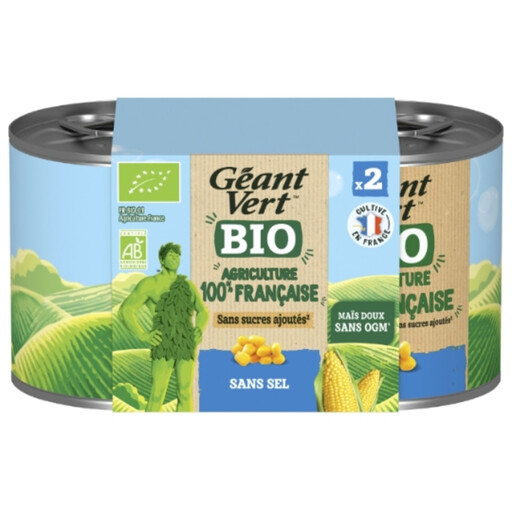 Image unavailable
Géant Vert organic sweetcorn, 2 × 1/4 kg, 300 g stated
You can compare this product with other sweetcorn options for its recipe and pack size. Check the pack details against the packaging, and look at the ingredients and “salt” value before choosing it if you’re looking for sweetcorn with no added salt.
View on Joybuy
Frequently asked questions
Does “no added sugar” mean sweetcorn is low in carbohydrates?
No. This claim means no sugar has been added; it doesn’t tell you the total carbohydrate content. The Bonduelle product described by the brand and Auchan contains 11 g of carbohydrates, including 5.1 g of sugars, per 100 g. Check the “carbohydrate” value and the portion you plan to serve.
Which figures should I compare between two tins of sweetcorn?
Compare carbohydrates, “of which sugars”, fibre and salt on a like-for-like basis, then check the drained weight and your portion size. The French Federation of Diabetics reminds shoppers that nutritional information is given per 100 g and sometimes per portion too, so check what the 100 g refers to on each label.
Is a tin with no added salt useful if I’m also comparing sugar?
It lets you consider both criteria separately, but you’ll still need to compare carbohydrates. Carrefour describes a Géant Vert product with no added salt or sugar, made with organic sweetcorn and water. Check that these details apply to the variety you buy.
How should I store sweetcorn after opening?
Follow the instructions on the product you buy. For its jar of organic sweetcorn, Auchan recommends keeping it in its juice in the fridge and eating it within two days of opening. Don’t assume the same guidance applies to other canned products.


