For anyone who wants to control how much is served
If you’re sharing a bowl, you may prefer to decide how many almonds to put out. The energy values per 100 g make it easier to compare bags, but they don’t tell you how much each person will take.


For Friday drinks, choosing almonds with no added salt may suit you if you’re looking to cut down on salt, but it doesn’t guarantee a lower energy value: E.Leclerc lists 636 kcal per 100 g for Bio Village with no added salt, compared with 626 kcal per 100 g for salted Tokapi. If you want to control how much you serve, put some in a bowl rather than leaving the bag open. To compare the recipes, check the energy, salt and ingredients for each product.
If you’re sharing a bowl, you may prefer to decide how many almonds to put out. The energy values per 100 g make it easier to compare bags, but they don’t tell you how much each person will take.
You’d like to serve almonds with drinks while keeping an eye on salt. The words ‘no added salt’ can help guide your choice, while the ‘salt’ line on the label lets you compare specific products.
You’re prioritising flavour and convenience. Whether you choose plain almonds or a salted, roasted recipe, check whether oil has been added, along with the salt content and bag size.
For Friday drinks, first decide what matters most to you — how much you’ll serve, salt content or ready-to-serve flavour — then compare labels on the same per-100 g basis.
| What matters | What to check | Who is it for? |
|---|---|---|
| How much you serve | Compare the energy per 100 g and decide how much to put in the bowl. | When a bag is left within easy reach, some people prefer to decide in advance what to serve; around 45% would put portion control first. |
| Salt | Check the ‘salt’ line per 100 g and the ingredients list for the product you’re considering. | If the other snacks are already salty, some people may prefer almonds with no added salt; around 33% would prioritise reducing salt. |
| Ready-to-serve flavour | Check the ingredients and salt content of a salted, roasted recipe before serving. | If you want to open a bag and serve salty almonds straight away, convenience may come first; around 22% would make this their top priority for a drinks snack. |
On the E.Leclerc and Monoprix product pages, Bio Village with no added salt contains 636 kcal per 100 g, while Daco Bello with no salt contains 629 kcal per 100 g. In this case, the difference you’re looking for is salt, not necessarily energy.
Choose based on salt content if that’s your priority, and decide separately how many almonds to serve.
Retailer product pages show that recipes and salt content can vary. A claim highlighted on the front of the pack is no substitute for checking the specific product.
Check the ingredients, energy and salt per 100 g on the bag you’re planning to buy.
Almonds are tree nuts. To find out about other ingredients and any precautionary allergen statements, check the packaging of the product you’re actually serving.
Keep the bag where guests can see it so they can check the information for themselves.
The size of a bag doesn’t tell you how much to serve each person. Once the bowl is on the table, it can be harder to tell how much you planned to serve and how much is still in the bag.
Prepare the bowl before your guests arrive and put the rest away for another time.
The Carrefour Classic’ product reviewed is a 200 g bag of roasted, salted almonds.
The Tokapi and Bio Village product pages let you compare a salted, roasted recipe with a roasted recipe that has no added salt.
The Wonderful and Le Vieux Bistrot products featured by Auchan show why it’s worth comparing products individually.
The Daco Bello product page features a 250 g bag of roasted almonds with no salt.
This selection features a flavoured almond snack in a 30 g bag. If you’re serving it with drinks, compare its label with those of any plain or roasted almonds you’re considering.
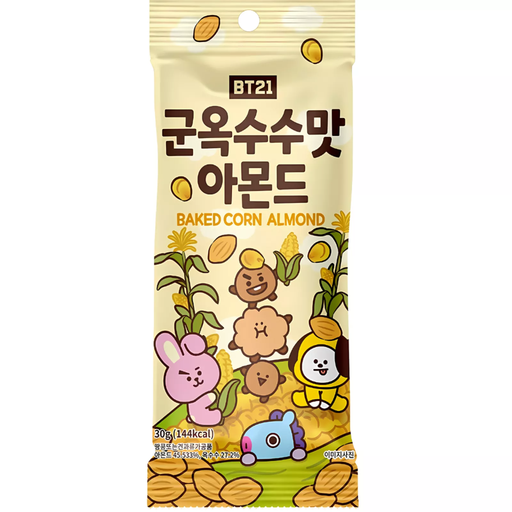 Image unavailable
The 30 g bag is worth considering if you want to limit how much is available to serve with drinks. Its roasted corn flavour sets it apart from plain almonds. Check the ingredients, nutrition information and allergens on the packaging before serving. The bag’s weight alone doesn’t indicate an individual portion size.
Not necessarily. E.Leclerc lists 636 kcal per 100 g for Bio Village with no added salt and 626 kcal per 100 g for salted Tokapi. If energy value is an important factor in your choice, compare the figures for each bag.
Compare the ‘salt’ line per 100 g rather than relying on the recipe name alone. E.Leclerc lists 0.0 g for Bio Village and 1.0 g for Tokapi; Monoprix lists 0.03 g for Daco Bello. Check the ingredients on the bag you choose, too.
No. When comparing almonds to serve with drinks, also check the energy, salt, ingredients and how much you plan to serve. The DGCCRF notes that nutrition information on prepacked foods includes energy, fat, sugars, protein and salt, among other details.
Check the ingredients and allergen information on the packaging of the product you’ve actually bought, and keep it available while you’re serving drinks. Don’t assume one bag has the same ingredients as another product.
Follow the storage instructions on the bag you’ve chosen. The Seeberger product page featured by Auchan says to keep its almonds away from heat and moisture after opening.