Parents looking for a simple snack
Plain yoghurt or fromage frais gives you a starting point with ingredients and nutritional information you can check before choosing a flavour or a different format.


For a late-night snack, start by comparing plain yoghurt or fromage frais with flavoured varieties, and don’t confuse either with a dairy dessert. Then check the ingredients, sugars and pack size. For children under 3, Manger Bouger advises against 0%, skimmed and semi-skimmed products.
Plain yoghurt or fromage frais gives you a starting point with ingredients and nutritional information you can check before choosing a flavour or a different format.
If your child enjoys mild flavours, compare the “of which sugars” line and the ingredients rather than automatically choosing a flavoured variety or a dairy dessert. Manger Bouger points out that dairy desserts are often high in sugar.
Your child’s age affects what you need to check. Manger Bouger advises that 0%, skimmed and semi-skimmed products are not suitable for children under 3. For this age group, choose a plain, unflavoured product and check its exact ingredients.
For a late-night snack for a child, first distinguish between yoghurt, fromage frais and dairy desserts. Your child’s age, followed by the recipe and storage instructions, will help you compare products.
| Criteria | What to check | Who is this for? |
|---|---|---|
| Recipe and sugars | Compare the product name, ingredients and the “of which sugars” line per 100 g across similar products. | I’m looking for a mild flavour without immediately opting for a flavoured variety or dairy dessert. The recipe would be the top priority for around 37% of consumers. |
| Child’s age | Check the age guidance and fat content. For children under 3, avoid 0%, skimmed and semi-skimmed products, as advised by Manger Bouger. | If my child is under 3, I want to make sure that a product marketed for children also meets the guidance for their age. Around 27% of consumers would put this suitability first. |
| Texture and format | Choose a texture and portion that suit the way your child has their snack, then check the recipe. | For a small late-night snack, I mainly need a texture my child will enjoy and a format that’s easy to serve. This would be the main concern for around 18% of consumers. |
| Labelling and storage | Check highlighted allergens, the use-by date and the storage temperature shown on the packaging. | If the snack needs to wait before it’s served, I want to be able to follow the storage instructions and identify ingredients to avoid. These checks would come first for around 18% of consumers. |
According to Manger Bouger, dairy desserts generally contain little milk and calcium and are often high in sugar. So the product name matters just as much as how it’s presented on the shelf.
Read the product name before comparing a dairy dessert with yoghurt, fromage frais or plain petit-suisse cheese.
Manger Bouger’s guidance for children under 3 rules out 0%, skimmed and semi-skimmed products. A claim suggesting that a product is “light” doesn’t make it suitable for this age group.
Check your child’s age and the ingredients of the specific product. This guidance for young children shouldn’t be applied to every age group.
Packaging aimed at children or a nutrition claim doesn’t tell you everything about the recipe or its sugar and fat content.
Compare the ingredients and nutritional information of products in the same category, taking the portion you’ll serve into account.
Storage instructions apply to the specific product you buy; you can’t work them out from its drinkable format or packaging.
Follow the storage temperature, use-by date and instructions for after opening shown on the packaging.
Carrefour lists Danone plain petit-suisse cheese in its children’s range: a product to distinguish from fruit varieties and desserts.
Yoplait describes Petits Filous as a range for children and says it has been formulated for children over 3.
Carrefour’s ranges include plain yoghurt, 0% varieties and products aimed at children.
Auchan’s product page for plain yoghurt in 125 g pots describes a recipe made with semi-skimmed milk.
Lidl’s range includes yoghurts, including Yoplait Perle de lait plain varieties.
This plain fromage frais product is presented as a dairy dessert to eat with a spoon. If you’re specifically looking for yoghurt for a snack, check this difference in product category before choosing it.
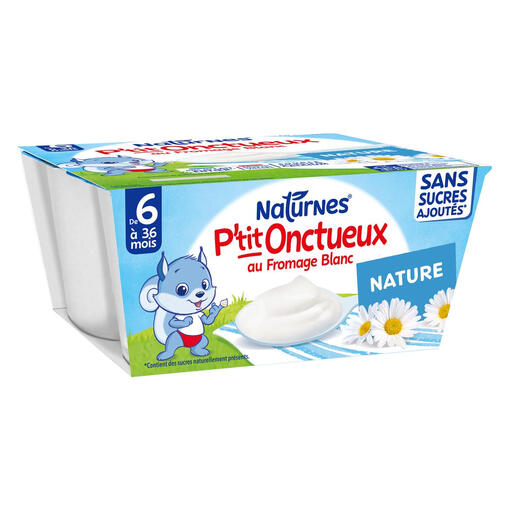 Image unavailable
The pots are handy for a snack served with a spoon, but this product is presented as a dairy dessert, not as yoghurt.
For a child under 3, check the fat content of the product as a whole: the recipe lists skimmed fromage frais, while Manger Bouger’s guidance advises against skimmed products at this age. Also check the total sugars and storage instructions on the packaging.
No, they’re different product categories. Manger Bouger says dairy desserts generally contain little milk and calcium and are often high in sugar. Check the product name and recipe of the one you’re considering.
First, check the age guidance and the product’s ingredients. Manger Bouger’s guidance favours plain, unflavoured products for young children and states that 0%, skimmed and semi-skimmed products aren’t suitable for children under 3.
No. According to Santé publique France, displaying it is voluntary. If it appears on the packaging, also check the product name, ingredients, nutritional values and portion size.
Check the ingredients list on the product you’ve bought. The French Directorate-General for Competition, Consumer Affairs and Fraud Control states that allergenic ingredients must be highlighted in the list. Don’t assume that a different flavour has the same ingredients.
Follow the storage instructions for the product you’ve chosen. Check its packaging for the required temperature, use-by date and instructions for after opening. A drinkable or portable format doesn’t, by itself, tell you how long it can be kept out of the fridge.