Parents of a child who often refuses meals
You’re looking for a dairy product they might be willing to try, without turning it into a reward. For young children, Manger Bouger advises offering a very small amount and not pressuring them to eat more.


For a fussy eater, start with a texture and flavour they’re willing to try, without using yoghurt to make up for a meal they’ve refused. For children under 3, Manger Bouger recommends plain, unflavoured dairy products as a guide. If you’re considering a fruity recipe or a drink, compare the product description, ingredients and sugar content shown on the packaging. If your child has a milk allergy, check every product and follow the medical advice that applies to them.
You’re looking for a dairy product they might be willing to try, without turning it into a reward. For young children, Manger Bouger advises offering a very small amount and not pressuring them to eat more.
With plain, fruit-flavoured, flavoured and dairy dessert options to choose from, you want to check the ingredients and sugar content of the specific product rather than relying on the word ‘mild’.
Check the ingredients list for milk. For a pupil with a food allergy, the French Ministry of National Education says that an individual care plan can arrange adjustments at school.
First, choose a product your child is willing to try, without putting them under pressure. Then check the exact recipe and any allergy or transport requirements. Plain yoghurt, a fruity product and a milk drink shouldn’t be chosen on flavour alone.
| Criteria | What to check | Who is it for? |
|---|---|---|
| Taste and texture | Plain or flavoured, with a texture and format your child is willing to try; offer it without rewards or pressure. | If my child refuses their meal, I want to be able to offer a small amount without bargaining over dessert; around 36% of consumers put this pressure-free approach first. |
| Ingredients and sugars | The product description, ingredients list and ‘of which sugars’ value per 100 g, taking note of the unit shown. | I want to tell a plain recipe apart from a sweetened or flavoured one before choosing; around 29% of consumers prioritise ingredients. |
| Milk allergen | The ingredients of each product and any instructions that apply to your child, particularly for school meals. | If my child has a diagnosed milk allergy, I need to check the product I’m giving them and follow their dietary arrangements; nearly 21% of consumers put this safety consideration first. |
| Format and storage | Pot, pouch or drink, number of portions and storage instructions for the product you’re buying. | For meals away from home, I’m mainly looking for an easy-to-carry format that can still be stored as instructed; around 14% of consumers prioritise this practical need. |
A mild flavour doesn’t tell you about nutritional values. The information published for Yoplait Nature Sucré and a Grands Filous vanilla product relates to different recipes and measures, so it can’t be used to judge every product in either range.
Compare the sugar values in the nutrition information and read the ingredients list for the exact product. Don’t rely on the flavour or child-friendly packaging alone.
For a young child who refuses to eat, Manger Bouger advises against making up for it with extra dessert or a large snack.
You can offer a small amount to try in a calm setting, without forcing them or presenting the yoghurt as a reward.
The packaging doesn’t tell you whether a product is suitable for a child with an allergy. In France, the DGCCRF states that allergens in prepacked food must be clearly highlighted in the ingredients list.
Check the label every time you buy the product and follow your child’s medical advice and individual care plan, if they have one.
A pouch or drink that’s easy to carry won’t necessarily keep all day unrefrigerated. For some Petits Filous products, Yoplait sets a limit of 8 hours out of the fridge, after which the product should be thrown away.
Read the storage instructions for the product you’re buying, including what to do after opening, and plan how to transport it accordingly.
These brands offer examples to help you compare product types and labels. Their inclusion here doesn’t tell you anything about the ingredients of every product they make.
The range shown by Auchan includes a Danone plain yoghurt and Velouté products made with blended fruit.
The Petits Filous and Grands Filous ranges include different flavours and formats for children.
Carrefour’s children’s range includes fromage frais pots, fruit fromage frais and flavoured products.
The Marque Repère range shown by E.Leclerc includes plain yoghurts and other dairy recipes.
Auchan’s children’s range includes yoghurts, petits-suisses, desserts and drinks, including pouches.
Lidl France presents Envia as a dairy brand.
These products include a plain fromage frais to eat with a spoon and two small-format flavoured milk drinks. Check the category shown on each pack: a milk drink isn’t necessarily a substitute for a pot of yoghurt.
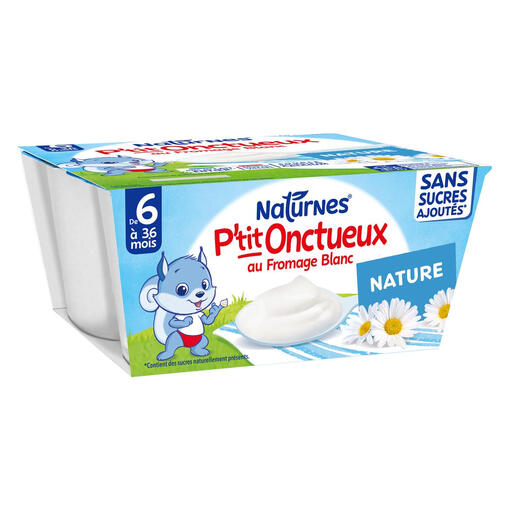 Image unavailable
A plain, spoon-fed option if your child likes this texture. The pack contains four 90 g pots and is marked ‘from 6 months’. For children under 3, check the fat content on the packaging before choosing this product. It contains milk, so follow your child’s specific advice if they have an allergy.
 Image unavailable
A drink format to consider if your child prefers it to a spoon-fed pot. The pack contains four 125 ml units. To compare this flavoured milk drink with a pot product, take note of the units used for the nutritional values and check the instructions for after opening. It contains milk.
 Image unavailable
A flavoured milk drink to consider if your child prefers strawberry and a drink format. The pack contains four 125 ml units. Read the ingredients, nutritional values and their units, and the instructions for after opening on the packaging you buy. The product contains milk.
No. Yoghurt shouldn’t routinely be used to make up for a meal your child has refused. For young children, Manger Bouger advises against giving extra dessert or a large snack in response to a refusal. You can offer a very small amount to try, without forcing them.
Manger Bouger’s guidance on introducing solid foods lists plain, unflavoured yoghurts, fromage blanc and petits-suisses. It also states that 0%, skimmed and semi-skimmed products aren’t suitable for children under 3. If your child has specific medical needs, follow the advice of their healthcare professional.
For prepacked food sold in France, check the ingredients list: the DGCCRF states that allergens must be clearly highlighted. Don’t rely on the product name, flavour or packaging image alone, and follow your child’s medical advice.
In France, an individual care plan, or PAI, can arrange adjustments for a pupil with a food allergy, including changes to their diet. According to the French Ministry of National Education, the family can request one; the school can also suggest one, with the family’s agreement and involvement.
Not without checking the instructions for that specific product. For some Petits Filous products, Yoplait sets a maximum of 8 hours out of the fridge and says to throw the product away after that. Follow the instructions on the packaging you buy, including after opening.