Who are these options for?

Parents of children who prefer creamy textures

If your child eats from a spoon but isn’t keen on set yoghurt, you can compare stirred and creamy textures. Carrefour offers a plain stirred yoghurt, while Yoplait describes Perle de Lait Nature as creamy. These descriptions don’t necessarily reflect what every child will prefer.

Parents of children under 3

At this age, texture isn’t the only thing to consider when choosing between recipes. Manger Bouger states that 0%, skimmed and semi-skimmed dairy products aren’t suitable for children under 3. Check the ingredients of the product you’re considering before choosing a low-fat option.

Families looking to compare plain varieties

To compare two pots, check the ingredients, the milk allergen information and the nutritional values per 100 g, particularly sugars and fat. Also check the use-by date and storage instructions on the packaging you buy.

What should you look for first?

For an easy-to-eat meal, start with the texture your child will accept from a spoon, then check that the recipe is suitable for their age. Fromage frais and skyr can also be compared for this purpose, but they are different options from plain yoghurt.

Criteria What to check Who is it for?
Spoonable texture Compare the descriptions “stirred”, “creamy” and “set”, then see what your child will accept. If my child prefers a creamy spoonful to yoghurt that holds its shape in the pot, texture comes before other differences in the recipe. Around 40% of consumers would make this preference their main consideration.
Child’s age Under the age of 3, check the fat content: Manger Bouger advises against 0%, skimmed and semi-skimmed products for this age group. For my child under 3, I want to avoid choosing a low-fat option just because it seems lighter. This would be the top priority for around 30% of consumers.
Ingredients and allergens Read the ingredients, check for any added sugar and look for the milk allergen; compare sugars per 100 g. When two pots are labelled “plain”, I want to compare their ingredients and find out whether either contains added sugar. Around 20% of consumers would make checking the recipe their main consideration.
Protein and thickness Compare protein per 100 g and the texture, without treating skyr, fromage frais and yoghurt as the same thing. For an older child, I might want to compare a thicker product with yoghurt, without assuming it will be more enjoyable to eat from a spoon. This would be the first consideration for around 10% of consumers.

Mistakes to avoid

  • Assuming “plain” means “no added sugar”

    These labels don’t mean the same thing: Yoplait states that Nature Sucré contains 8.2% cane sugar and has 10.8 g of sugars per 100 g.

    Read the ingredients to check for added sugar, then compare the “of which sugars” figure per 100 g.

  • Choosing a 0% option for a child under 3

    Manger Bouger states that 0%, skimmed and semi-skimmed dairy products aren’t suitable before the age of 3. So even if your child likes the texture, you still need to check the ingredients.

    Check the age the product is intended for and its fat content before choosing a low-fat option.

  • Assuming a thick texture will be easier to eat

    The terms “set”, “stirred” and “creamy” describe different textures, but on their own they can’t tell you what your child will accept from a spoon.

    See how they get on with a small portion. If you suspect they’re having difficulty swallowing, ask a medical professional for advice rather than choosing a texture based on a product description.

  • Overlooking milk and storage instructions

    The products described by Carrefour and Auchan contain milk or milk-derived ingredients. These products aren’t suitable for anyone with a milk protein allergy.

    Look for the allergen in the ingredients list, then follow the use-by date and storage instructions on the pot you buy.

Brands to compare

Yoplait

The brand offers several different categories: Perle de Lait Nature, Petit Yoplait Nature fromage frais and Yoplait Skyr Nature.

  • Yoplait describes Perle de Lait Nature as creamy and smooth. The brand lists 9.0 g of protein per 100 g for Petit Yoplait Nature and 9.3 g per 100 g for its plain skyr.
  • According to Yoplait, the skyr contains less than 0.5 g of fat per 100 g. Its texture or protein content alone doesn’t make it the best choice for a child under 3.

Carrefour

Carrefour Classic' and Carrefour Bio offer plain stirred yoghurts with ingredients lists you can compare.

  • Carrefour lists whole milk in both recipes mentioned here; the Classic' product contains 3.4 g of fat per 100 g.
  • The Bio recipe mentioned also includes organic skimmed milk powder: “plain stirred” doesn’t mean every pot has the same ingredients.

Auchan

The plain yoghurt described by Auchan is incubated in the pot, has a firm texture and is made with partially skimmed milk.

  • For this product, Auchan lists 1.1 g of fat, 4.3 g of sugars and 4 g of protein per 100 g.
  • If you’re choosing for a child under 3, bear in mind that it’s made with partially skimmed milk: Manger Bouger states that semi-skimmed products aren’t suitable for this age group.

Danone

HiPRO Nature is a plain dairy product in a pot, distinct from a family yoghurt chosen primarily for its smooth texture.

  • HiPRO Danone France states that each 160 g pot contains 15 g of protein and 0% fat.
  • Under Manger Bouger’s guidance, this 0% recipe isn’t suitable for a child under 3.

A spoonable option on Joybuy

To compare with plain yoghurt, here’s a fromage frais dairy dessert for young children, served in portions to eat with a spoon. It’s a different type of product, so check the ingredients and label to make sure it’s suitable for your child’s age.
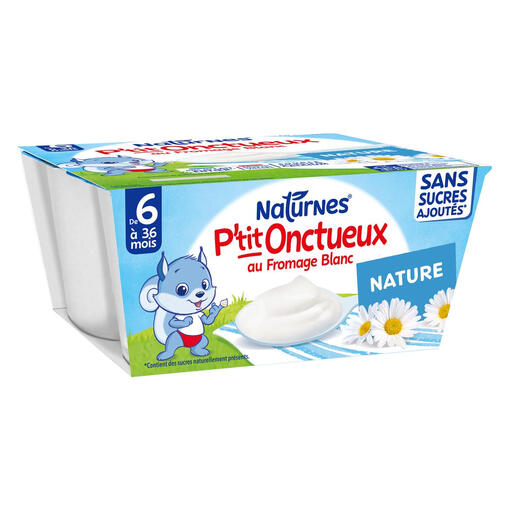
Nestlé P'Tit Smooth with plain fromage frais, from 6 months, 4 x 90 g

Nestlé P'Tit Smooth with plain fromage frais, from 6 months, 4 x 90 g

A fromage frais option to consider for a child who eats from a spoon: this dairy dessert isn’t a classic plain yoghurt.

Pack of 4 x 90 g portions, suitable from 6 months. Check the ingredients, fat content and storage instructions on the packaging, particularly if your child is under 3.

View on Joybuy

Frequently asked questions

Can you give plain yoghurt to a child under 3?

Yes. Manger Bouger includes yoghurt among the dairy products to alternate for young children, recommending plain, unflavoured varieties. However, its guidance states that 0%, skimmed and semi-skimmed products aren’t suitable before the age of 3.

Is stirred yoghurt always easier to eat than set yoghurt?

No. If your child eats normally from a spoon, choose a texture they’ll accept rather than assuming the same rule applies to every child. If you suspect they’re having difficulty swallowing, ask a medical professional for advice on the right texture.

How can you tell plain yoghurt from sweetened plain yoghurt?

First, read the ingredients to check for any added sugar, then compare the sugars per 100 g in the nutritional information. For example, Yoplait Nature Sucré lists cane sugar, so the word “plain” on its own isn’t enough to tell you.

Where can you check for milk?

Look for milk and milk derivatives in the ingredients list: the DGCCRF states that allergens in prepacked foods must be highlighted there. The milk-based yoghurts mentioned here aren’t suitable for anyone with a milk protein allergy.

How should you store the pot you choose?

Follow the use-by date and storage instructions on the packaging. For the firm plain yoghurt mentioned here, Auchan advises storing it between 0 °C and +6 °C; don’t assume the same guidance applies to another product.