
Livraison le jour même ou le lendemain

Qualité garantie

Débloquez vos offres de bienvenue: Livraison GRATUITE | Jusqu'à -80 % | 30 jours d'essai gratuits à JoyPlus
Téléchargez l'application
Choosing a yoga mat? It seems easy. In reality, the market is saturated with marketing promises that too often lead to disappointing purchases. A mat that slips, crumbles after a few sessions, or offers no comfort can not only ruin your practice but also be a complete waste of money. As the head of buyer's guides at Joybuy, my mission is to help you see clearly and find THE mat that truly fits your needs.
Before you start, here are the three most common pitfalls to avoid:
To avoid these setbacks, it's best to focus on objective technical criteria. These are the true indicators of a fitness mat's quality and suitability for your practice.
Thickness is the first criterion to consider, as it directly affects the comfort of your joints.
The choice of material will define your mat's grip, durability, weight, and texture.
A good non-slip fitness mat is non-negotiable. Grip depends not only on the material but also on its surface texture. Look for raised patterns (waves, textured designs...) designed to improve hand and foot grip, even when you sweat.
As for dimensions, the standard size is around 173 x 61?cm. If you are tall or if your practice includes wide-ranging movements, a large yoga mat (180?cm long and 80?cm wide, or more) will offer you a much more comfortable practice space.
Rather than searching for a "perfect" mat, it's wiser to find the one that matches your user profile. Here are a few recommended options.

Why this choice? Perfect for beginners or for a varied practice (yoga, fitness, Pilates) without breaking the bank. Its 6 mm thickness is the sweet spot between comfort and stability, making it suitable for most floor exercises.
Its durable PVC construction resists crumbling and avoids the low-longevity trap. The raised texture surface provides a reliable basic grip for dry workouts.
An excellent durability-to-price ratio, thanks to its PVC material and versatile 6 mm thickness.
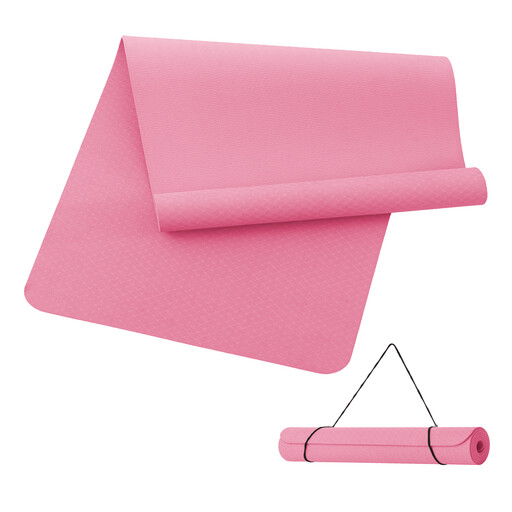
Why this choice? For anyone who feels cramped on a standard mat. Its XXL dimensions offer complete freedom of movement, whether for wide sun salutations or floor-based fitness exercises.
Its dual-sided TPE design (leaf and wave patterns) directly tackles the slippery mat pitfall, ensuring excellent stability even with sweat.
Generous dimensions (190 x 100 cm) and superior grip thanks to its dual-sided texture.

Why this choice? Perfect for people with sensitive knees or wrists, as well as for gentle practices (Yin Yoga, Pilates) where comfort is the top priority.
Its 10 mm thickness in high-density TPE solves the problem of insufficient cushioning, effectively protecting joints on hard floors.
Superior cushioning for maximum joint comfort, combined with a reliable non-slip surface.
If your practice is mainly focused on strength training and floor exercises, our complete selection of dedicated mats might be a better fit for you.
It all depends on the material, frequency of use, and maintenance. A good quality PVC mat can last for years. A well-maintained TPE mat has a similar lifespan, although it may show signs of wear a bit faster with very intensive use. It's time to replace your mat when you notice a significant loss of grip or when pieces start to crumble off.
For most TPE and PVC mats, regular cleaning with a damp cloth and a little mild soap is sufficient. Wipe it down, then let it air dry completely before rolling it up. Avoid exposing it to direct sunlight, as UV rays can degrade the materials. Never put it in a washing machine unless explicitly stated by the manufacturer.
The choice depends on your priorities: