
Livraison le jour même ou le lendemain

Qualité garantie

Débloquez vos offres de bienvenue: Livraison GRATUITE | Jusqu'à -80 % | 30 jours d'essai gratuits à JoyPlus
Téléchargez l'application
An XXL cat tree is about more than impressive height. For an active cat, a larger-bodied pet or several cats sharing a home, stability, platform width and the distribution of different spaces make all the difference. A striking tower may look great in photos yet prove cumbersome, difficult to clean or unstable after just a few weeks.
Here are the key factors to assess before buying, along with a selection of models suited to different needs.
A very tall tower is not necessarily suitable for large cats. Narrow platforms, closely spaced levels or a shallow cubby can quickly limit its usefulness. Check the dimensions of the sleeping areas, not just the overall height.
A cat tree designed for large cats should give them enough room to turn around, stretch out and climb down without having to jump straight from a high level to the floor.
A 170 or 206 cm structure is subjected to considerable stress when a cat leaps towards the top. A widened base, reinforced panels and a wall-mounting system therefore deserve careful consideration.
Wall mounting does not replace careful assembly: the floor must be level, the screws properly tightened and the tower installed in accordance with the manufacturer’s instructions.
The number of posts is not everything. To encourage scratching and prevent your cat from turning to the furniture, look for a cat tree with sisal scratching posts distributed across the main routes. Also check the post diameter, the density of the covering and whether worn components can be replaced.
Measure the available space, taking walkways and door clearance into account. A large cat tree may have a relatively compact floor footprint while still requiring significant clearance above it.
Here is the information to review in the product specifications:
Stated load capacities are not an absolute guarantee. They depend on assembly quality, the type of flooring and the conditions of use.
A stable cat tree needs a base that is sufficiently wide in proportion to its height. Vertical models over 2 m tall are often designed to be secured to a load-bearing wall using an anti-tip kit.
After assembly, check that:
An indoor cat tree should be installed away from heat sources, open windows and furniture that could serve as a landing point.
A multi-level cat tower generally combines platforms, cubbies, a bed and a hammock. These spaces are particularly useful when several cats want to rest separately. Choose removable cushions, surfaces that are easy to reach with a vacuum cleaner and washable components.
Hammocks and cubbies provide genuine comfort, but they should not narrow the passageways. If your cat scratches frequently, also compare the amount of sisal with the areas covered in fabric or plush material.
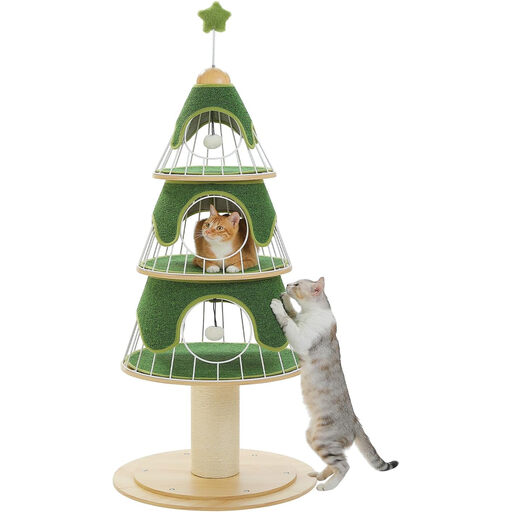
Why this model is a good fit: With a 60 × 60 cm base and a height of 130 cm, this model is well suited to homes where vertical space is limited. Its Christmas-tree silhouette also adds a distinctive decorative touch during the festive season.
The widened base limits lateral movement compared with a tall, narrow structure. The central posts, listed at 12.5 cm in diameter, provide a generous scratching surface.
Three levels, three listed cubbies and dimensions of 60 × 60 × 130 cm. A practical indoor model that does not overwhelm the room.
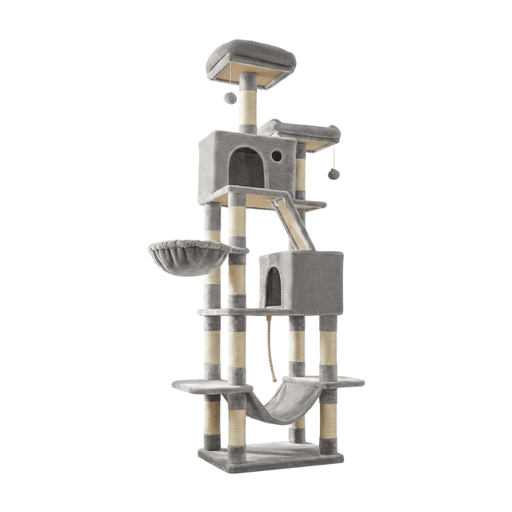
Why this model is a good fit: Its five levels, two cubbies, bed and hammock are designed for households that want to distribute resting and play areas among several cats.
The product specifications mention a reinforced base, an anti-tip kit and 13 scratching posts. The wall mount must be installed before the tower is put into use.
A height of 206 cm, 13 sisal posts and a stated capacity of up to six cats weighing 7 kg each, provided the tower is assembled correctly.
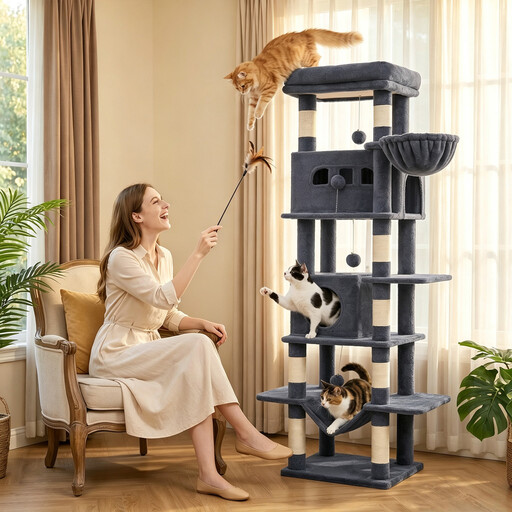
Why this model is a good fit: Its vertical design suits cats that love to climb and survey their surroundings, particularly in apartments where every square metre matters.
The listed design includes eight sisal posts, a reinforced base and anti-tip devices. Secure anchoring and regular checks remain essential.
A 60 × 40 cm top platform with a removable cushion, two cubbies and a hammock. The manufacturer specifies 400 g/m² fabric.
We have brought together an up-to-date selection of products chosen for their practical comfort, stability and suitability for indoor cats.
Before letting your cat take possession of its new XXL cat tree:
Sisal naturally wears down under repeated scratching. A monthly inspection helps identify a loose post or frayed rope before the issue worsens. Removable fabric components are easier to clean, especially in a home with several cats.
The ideal height depends on the available space, your cats’ agility and whether the structure can be secured to the wall. A 130 cm model may be sufficient for moderate everyday use, while a 170 to 212.5 cm tower offers more climbing opportunities. However, it still requires a suitable base and secure anchoring.
Yes, provided the structure offers several distinct areas: wide platforms, cubbies, a hammock and scratching zones. Compare the stated load capacity, the number of sleeping areas and the width of each level. Even when several spaces are available, two cats may still want to settle on the same platform at the same time.
Retighten the screws regularly, clean the surfaces and monitor the condition of the sisal. Avoid moving the tower while a cat is using it, and never exceed the stated load capacity. For a tall model, also inspect the wall-mounting system and the strength of its supporting surface.