
Livraison le jour même ou le lendemain

Qualité garantie

Débloquez vos offres de bienvenue: Livraison GRATUITE | Jusqu'à -80 % | 30 jours d'essai gratuits à JoyPlus
Téléchargez l'application
An XXL cat tree isn’t just about height or the number of platforms. For multiple cats, a poorly sized model can become noisy, unstable, or quickly uncomfortable. In a flat, a structure that’s too deep can also clutter the room without offering enough genuinely usable space.
Before you buy, three common pitfalls keep cropping up:
The goal, then, is to strike the right balance between stability, usable surface area, access to different levels, and everyday maintenance.
For a cat tree intended for several animals, the base is a top priority. Check its dimensions, thickness, and how weight is distributed across the different levels. A tall structure needs to sit on a base that can limit sideways movement when cats climb or leap.
A stable cat tree can also be fitted with an anti-tip device. This must be fixed according to the instructions, against a wall that’s sturdy enough. Place the tree on a level floor, avoiding very slippery rugs and high-traffic areas.
The height also needs to be compatible with your home. A model over 2 m requires you to check the available ceiling space and the area around the structure.
Adult cats, especially larger ones, need platforms where they can turn around and stretch out comfortably. A large platform is ideal for watching the room, but cubbies, baskets, and hammocks also need to offer enough space.
On the product page, look at:
A cat tree with cubbies lets each animal retreat, while a cat tree with a hammock adds a soft resting area. However, these spaces don’t replace several separate sleeping spots if your cats tend to guard their territory.
The need to scratch isn’t limited to the post at the base of the tree. A good spread of scratching surfaces lets cats stretch at different heights and can help keep them away from your furniture.
Go for a cat tree with a sisal scratching post when the posts are long enough, well-fixed, and accessible from several levels. Check the sisal regularly and tighten the screws if needed. Removable or washable fabric covers also make maintenance easier, especially in a home with multiple cats.
A model between 160 and 180 cm can work in a flat where floor space is tight, provided it has a stable base and a genuinely usable platform. For a group of adult cats, a structure over 2 m can offer more separate zones, but it requires more careful installation.
Saving space vertically is great in a living room or bedroom, but you shouldn’t sacrifice the width of the resting areas. Cats need to be able to come back down without all ending up in the same spot. A layout that alternates platforms, cubbies, and a hammock makes movement easier.
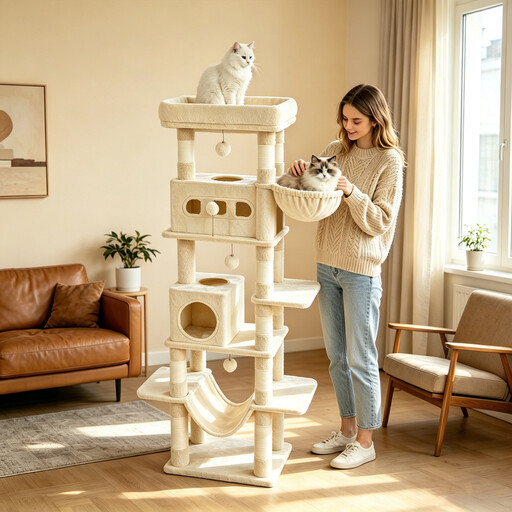
Why this choice suits this profile: Its height works well in many rooms, while offering six levels, two cubbies, a hammock, and a large 50 × 30 cm platform.
The detailed dimensions stop you from relying on the number of levels alone. The eight sisal posts are spread across the whole structure.
Six levels, two enclosed spaces, a hammock, and removable cushions that are described as washable.
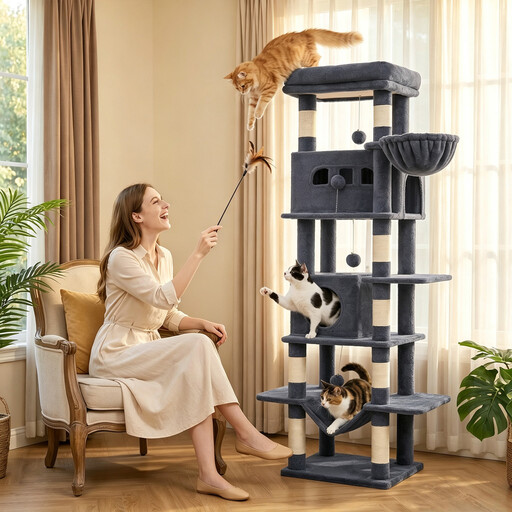
Why this choice suits this profile: This version focuses on great height, a 60 × 40 cm platform, and a layout suited to adult or large cats. Households with several cats also benefit from a clearer separation of resting areas.
The reinforced base, thicker boards, and anti-tip device reduce the risk of wobbling, provided it’s installed correctly. The cubbies, hammock, and basket create several distinct zones instead of concentrating all the cats on one platform.
Wider platform, two cubbies, a hammock, a basket, eight sisal posts, and fabric described as 400 g/m².
We’ve put together a comprehensive, real-time updated list of products that fully meet these strict selection criteria and European safety regulations.
Before letting your cats use their new tree, check every fixing and tighten the screws without forcing them. For a tall structure, wall anchoring is worth considering when the instructions allow for it. Leave enough space around the platforms so that jumps don’t end up against a window or piece of furniture.
Regularly vacuum or use a lint roller on the cushions. Removable items should be cleaned according to the manufacturer’s instructions. Replace a sisal post when it’s heavily frayed or when a part starts to feel loose.
A height of 160 to 180 cm can work in a flat, while a model over 2 m offers more levels and vertical separation. In any case, check the width of the base, the ceiling height, and whether anchoring is possible.
Not necessarily. A vertical model can limit the floor footprint, but its base and the areas around it need to stay clear. Measure the available space before you buy and allow a safety zone around the structure.
How long it lasts depends on the weight of your cats, how often they scratch, the quality of the fixings, and how well it’s maintained. Regularly checking the screws, sisal, and covers lets you quickly spot parts that need tightening or replacing.