
Livraison le jour même ou le lendemain

Qualité garantie

Débloquez vos offres de bienvenue: Livraison GRATUITE | Jusqu'à -80 % | 30 jours d'essai gratuits à JoyPlus
Téléchargez l'application
A cat tree can bring together a place to rest, a lookout post, a scratching post and several play areas in one piece of furniture. The key is choosing the right model. One that’s too large may take up valuable space without your cat ever using it. One that’s too lightweight could wobble when your cat jumps on it and wear out sooner.
Before you compare shapes, sizes and colours, there are three common pitfalls to watch out for.
Start by measuring the floor area, ceiling height and distance between the planned spot and nearby furniture or windows. A compact cat tree measuring 40 to 80 cm can be ideal for a studio flat, while an XXL model over 170 cm needs plenty of clear space around it.
Check the dimensions of the platforms, cubbies and hammocks too. A large cat should be able to turn around and stretch out without hanging over the edge. If you have more than one cat, look for separate spaces to help prevent jostling and conflict.
Stability depends on the width of the base, the weight of the frame, the quality of the joints and how the platforms are positioned. Models over 150 cm should generally be placed on a perfectly level floor. Depending on the manufacturer’s instructions, an anti-tip wall fixing may also be needed.
Before you buy, check:
Natural sisal is commonly used to cover the posts and ramps on cat scratching posts. Choose posts that are long enough for your cat to stretch fully upright, as well as horizontal or angled surfaces to offer a choice of scratching positions.
Plush covering adds comfort, but it should also be easy to maintain. Removable, washable cushions are particularly handy for indoor cats. Particleboard frames should be protected from damp and checked regularly, especially around the joints.
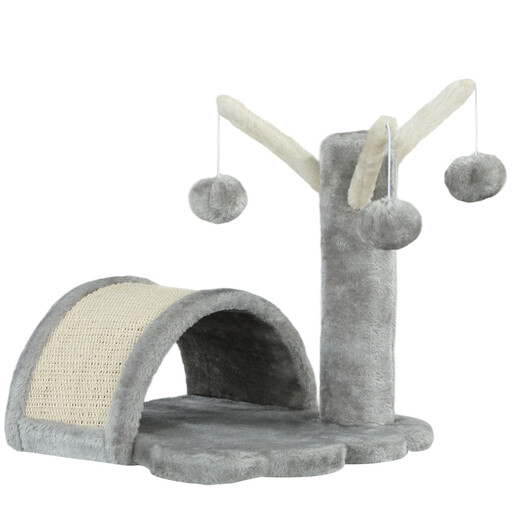
Why it suits this type of home: With a 38 × 38 cm base and a height of 40 cm, this model fits easily into a flat or small room.
Its dimensions are clearly stated, and the natural sisal mat covers the arch instead of limiting the scratching area to a small section.
A cubby, an open bed, a scratching surface and two dangling balls, all in a compact design.
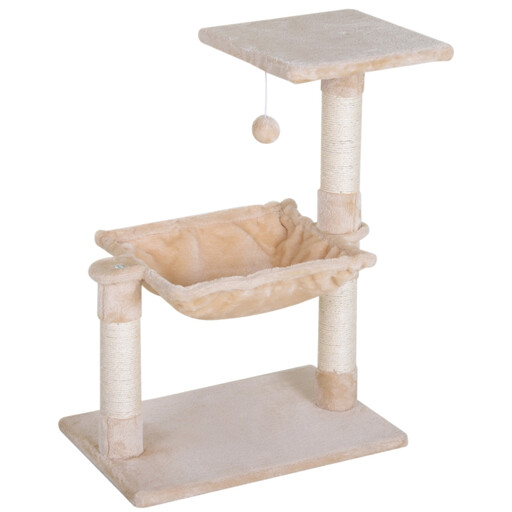
Why it suits this type of home: Measuring 50 × 36 × 70 cm, it provides an elevated place to rest without taking up as much room as a large tower.
The product details state a total load capacity of 10 kg and specify three sisal posts, so you can compare the model using clear, practical information.
A 37 × 32 × 10 cm hammock, a 30 × 30 cm top platform and a dangling ball.
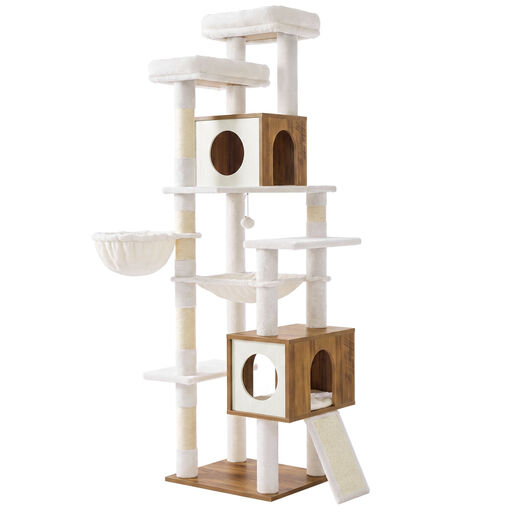
Why it suits this type of home: Its wooden design, eight levels and two cubbies make it a good choice for homes looking for a functional, sturdy cat tree with a well-defined look.
At 193 cm tall, it has a sturdy lower base and comes with an anti-tip wall fixing kit, which should be fitted according to the instructions.
Two wooden cubbies, platforms with washable covers, a ramp and sisal-covered posts.

Why it suits this type of home: With its many levels and separate spaces, this model is designed for homes with several cats or very active pets.
Its 13 sisal posts and angled ramp spread scratching across several surfaces. At this height, wall fixing is strongly recommended.
Two cubbies, two platforms, a basket, a hammock and a stated total static load capacity of up to 75 kg.
We’ve brought together a comprehensive selection of models, updated in real time, that meet these selection criteria and take European safety requirements into account.
Place the cat tree on a flat, non-slip surface away from heat sources. If you have a tall tower, follow the fixing instructions carefully. Help your cat get used to the different levels gradually, using a toy or treat. Never force them into a cubby.
Check the screws, platforms, sisal ropes and seams regularly. Remove any hanging parts as soon as they become damaged. Vacuum away loose fur and clean the surfaces according to the manufacturer’s instructions. Above all, avoid soaking the particleboard panels.
In a small home, a model measuring 40 to 80 cm keeps the footprint compact. A 100 to 150 cm tower offers more opportunities for climbing and watching the world go by, provided it has a stable base. For taller models, check your ceiling height and whether you can install an anti-tip fixing.
Its lifespan depends on how often your cats jump on it, their weight, the quality of the joints and how quickly the sisal wears. Tighten the screws regularly, and replace or repair damaged parts as soon as they become unstable.
A hammock can provide a place to sleep, but it won’t replace having several resting spots. If you’re choosing a cat tree for more than one pet, look for several platforms, cubbies or baskets, a suitably wide base and a stated load capacity that can support your cats’ combined weight.