
Livraison le jour même ou le lendemain

Qualité garantie

Débloquez vos offres de bienvenue: Livraison GRATUITE | Jusqu'à -80 % | 30 jours d'essai gratuits à JoyPlus
Téléchargez l'application
An XXL cat tree can transform a flat into a real vertical playground. But not all large models are created equal. Extra height alone does not make a structure comfortable and safe for everyday use. A base that is too narrow, tiny platforms or poorly positioned scratching posts can quickly make your purchase disappointing.
To choose a large cat tree, you therefore need to look beyond the number of levels and flattering photographs. Here are the criteria to check before installing a tower suited to your home and your cat’s temperament.
A 200 cm structure can provide a superb lookout point, but it is also more susceptible to sideways movement. A wide base, sufficiently thick panels and an anti-tip device are essential. For a tall cat tree, wall fixing is often unavoidable, particularly when several cats jump from one platform to another at the same time.
Two hideaways do not necessarily provide two genuinely comfortable spaces. Large cats need platforms wide enough to lie down without hanging over the edge, while households with several animals should avoid areas that are too close together, as these can cause tension.
Check the dimensions of the platforms, the width of the passageways and the gap between the different levels. A well-designed multi-level cat tree should allow cats to climb, descend or retreat without blocking the others.
A single sisal post is likely to wear out quickly or be ignored in a household with several cats. A cat tree with a scratching post should offer several surfaces spread across different levels. This allows animals to scratch in a variety of positions, reducing the appeal of your furniture — although it will not magically eliminate all scratching behaviour.
A 200 cm cat tower makes use of the available height and can be a good option in a flat where every square metre of floor space matters. However, measure the installation area carefully, taking skirting boards, doors and the clearance needed to fit the safety device into account.
For everyday use, prioritise:
The maximum load specified by the manufacturer should be compared with the actual weight of your cats. In a cat tree designed for several animals, movement is dynamic: the combined weight at rest does not necessarily reflect the forces exerted during jumps and landings.
A structure rated for six cats weighing 7 kg each has a specific limit that must be respected. Do not assume it can support more simply because the base appears sturdy.
Wood-based panels, sisal rope and fabric covering are the most common materials used for this type of product. Natural sisal is well suited to scratching posts, while a dense fabric improves the comfort of hideaways and platforms.
Before buying, also check:
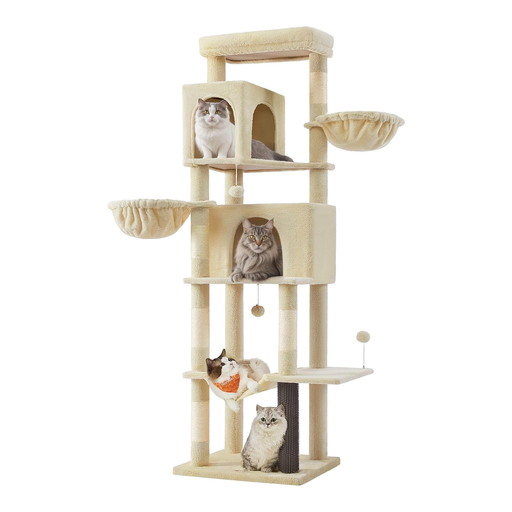
Why this choice suits this profile: Standing 190.7 cm tall, this structure combines several functions without requiring you to buy multiple pieces of equipment: two hideaways, two inclined platforms, a hammock and a large lookout platform.
The five posts covered with jute rope are distributed across the different levels. The anti-tip fixing must be installed before first use.
A stated weight of 19.5 kg, five scratching posts and an integrated brush at the base.
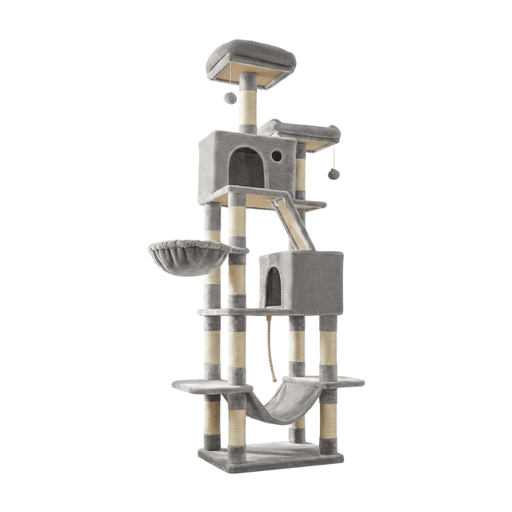
Why this choice suits this profile: This model is designed for households looking for a tall cat tree with a range of spaces for climbing, resting and keeping an eye on their surroundings.
The reinforced base and anti-tip kit address the demands associated with a 206 cm tower. Wall fixing remains essential before use.
Thirteen scratching posts, two hideaways, a hammock, a basket and a stated capacity of up to six cats weighing 7 kg each.
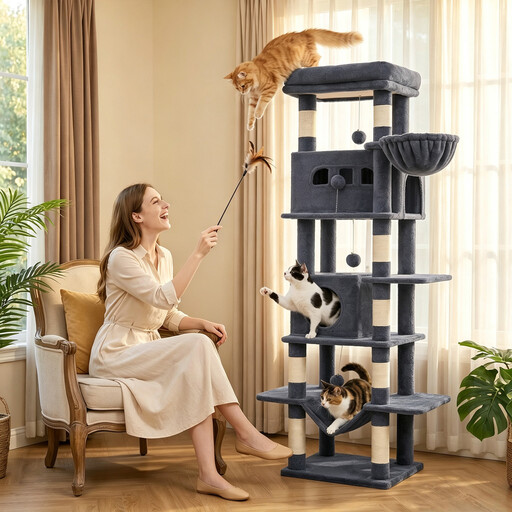
Why this choice suits this profile: Its height and separate spaces suit active cats, multi-cat households and animals that enjoy switching between hideaways and lookout points.
Its eight sisal posts and widened base are suited to intensive use. The anti-tip devices must be secured before allowing cats to use it.
A 60 × 40 cm top platform, two hideaways, a hammock and a basket with removable cushions.
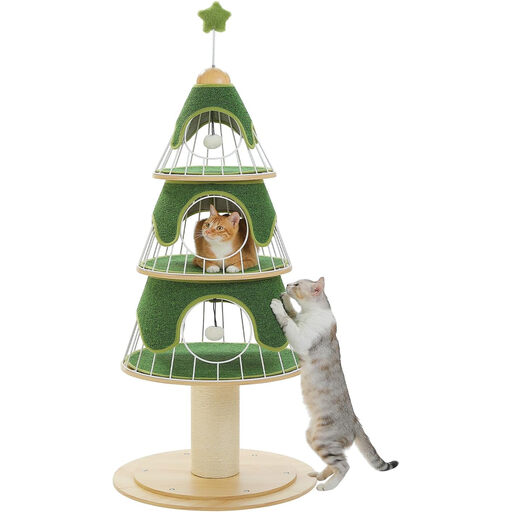
Why this choice suits this profile: Its more moderate height and 60 × 60 cm base may suit a living room where there is not enough room for a 200 cm cat tower.
Its three hideaways and 12.5 cm-diameter posts provide clearly defined spaces. The structure should be assembled carefully and checked regularly.
Three levels, three shelters and a square 60 × 60 cm base, with a green finish inspired by a fir tree.
We have brought together a complete, real-time updated selection of products that meet these demanding selection criteria and European safety standards.
Install the structure on a level floor, close to a wall suitable for fixing. Tighten each component according to the instructions, then check that there is no movement before first use. For taller models, never remove the anti-tip kit, even if the base appears heavy enough.
Regular care helps extend its lifespan:
A height of between 170 and 210 cm provides several levels as well as an elevated lookout point. In a flat, above all, check the ceiling height and whether the structure can be securely fixed to the wall.
Yes, provided it has several platforms, hideaways and scratching areas. Check the stated maximum load as well as the dimensions of the sleeping areas. For large cats, a narrow platform may still be uncomfortable, even when the load capacity is sufficient.
Its lifespan depends on how often it is used, the cats’ weight and how well it is maintained. Sisal posts generally wear out before the panels. Regular inspections help identify loose rope, torn fabric or fixings that need tightening.