
Livraison le jour même ou le lendemain

Qualité garantie

Débloquez vos offres de bienvenue: Livraison GRATUITE | Jusqu'à -80 % | 30 jours d'essai gratuits à JoyPlus
Téléchargez l'application
An XXL cat tree can turn your living room into a real playground, lookout point and place to rest. However, greater height alone does not guarantee a successful purchase. Some models offer multiple platforms without stating their actual load capacity, while others take up little floor space but become unstable as soon as a cat jumps to the upper level.
To avoid unpleasant surprises, examine the structure, resting areas, scratching posts and installation requirements carefully. Here are the criteria to check before choosing a giant cat tree for one or more cats.
A 170, 190 or 200 cm cat tree provides valuable vertical space, but its stability also depends on the width of the base, the overall weight and the wall fixing. A tall, narrow structure is more likely to move when a cat climbs quickly or several animals move around at the same time.
An anti-tip device is not simply a minor detail. For tall models, it must be secured according to the instructions, to a sufficiently strong part of the wall. Place the tree on a flat, dry floor, away from the busiest walkways.
A cat tree with six or seven levels does not necessarily offer platforms suitable for a large cat. Check the depth of the resting areas, the diameter of the baskets and the space available inside the cubbies. A large cat must be able to change position without becoming stuck or extending well beyond the platform.
In a household with several cats, several separate spaces are particularly useful: cubbies, hammocks, baskets and platforms positioned at different heights. This arrangement helps prevent disputes over a single resting spot.
A cat tree fitted with scratching posts should offer scratching surfaces across several levels. If the posts are too short or too thin, your cat will not be able to stretch properly. Conversely, several posts covered in sisal prevent wear from becoming concentrated in one area.
Also check whether the covers are removable, whether the cushions are machine washable and whether worn parts can be replaced. On a large cat tree, fur, dust and small fibres build up quickly.
Measure the available height up to the ceiling and the floor space before ordering. A 170 cm cat tree is often suitable for a living room where you want to keep circulation clear. Models close to 190 cm, or a 200 cm cat tree, such as a 206 cm structure, require greater care during assembly and securing.
Also check:
The stated load capacity should be interpreted carefully. An indication of six cats weighing 7 kg each, for example, corresponds to a theoretical total load distributed across the entire structure. It does not remove the need to follow the assembly instructions or check the screws and connectors regularly.
For a large cat tree for several cats, choose a wide base, several access points and at least two enclosed or semi-enclosed resting areas. Active cats place greater strain on the joints when jumping from one level to another.
Wood-based panels are common in this category. Their rigidity depends on their thickness, the quality of the assembly and the design of the base. Plush surfaces provide comfort, while sisal rope withstands everyday scratching.
An XXL cat tree with a hammock offers a soft place to sleep, but check its dimensions and the strength of its attachment system. Removable, washable hammocks make maintenance easier. For a heavy cat or one that is uncomfortable in confined spaces, a more spacious cubby or basket will often be preferable.
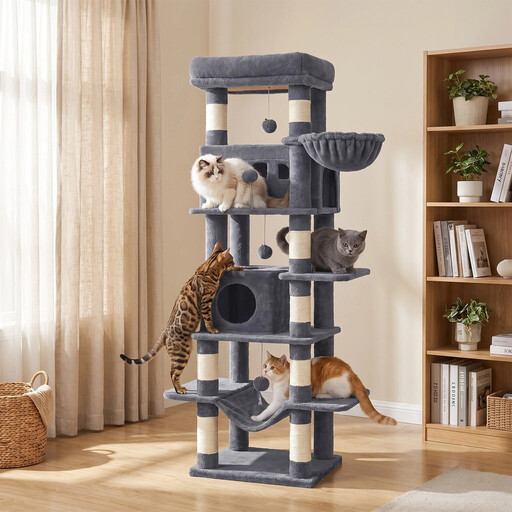
Why this choice suits this profile : This 170 cm structure combines several functions in a format suited to most homes, with two cubbies, a hammock and two removable cushions.
The dimensions, 17 support posts and eight sisal-covered surfaces are clearly stated, making it easier to compare this model with others.
50 × 30 cm platform, 50 × 40 cm cubby, washable cushions and reinforced base with an anti-tip device.
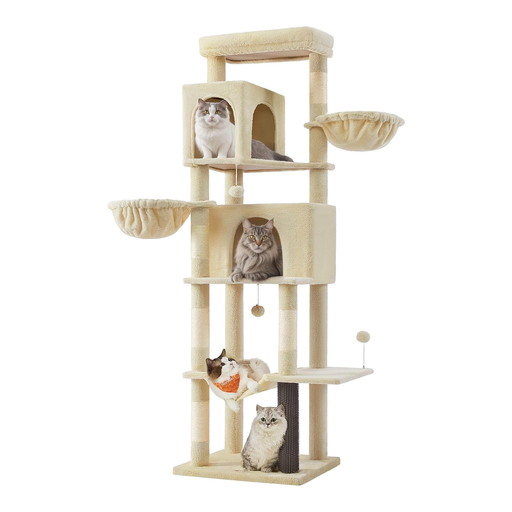
Why this choice suits this profile : Its design focuses on versatility, with two cubbies, two resting platforms, a hammock and a large lookout platform.
The mandatory wall fixing is clearly stated, highlighting the essential precaution required for a structure this tall.
190.7 cm high, five jute-rope posts, 500 g/m² plush fabric and an integrated brush at the base.
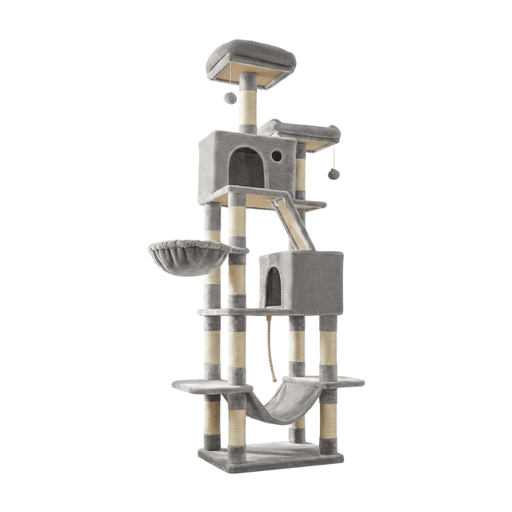
Why this choice suits this profile : This tower is suitable for households with several cats, provided you respect the stated load capacity and secure the structure to the wall.
The recommended load is specified: up to six cats weighing 7 kg each, giving an indicative total limit of 42 kg, with anti-tip fixing.
206 cm high, 13 sisal posts, two cubbies, a hammock, a basket, a scratching board and replacement toys.
We have put together a complete, real-time updated selection of products that meet these strict criteria, as well as European safety requirements.
Assemble the structure in the order shown in the instructions, then check every connection before allowing your cat to use it. For a very tall model, install the wall fixing before first use. Place the tree on a flat surface, away from damp areas and heat sources.
Every month, check:
Regularly vacuum or use a lint roller on the plush surfaces. Clean stains with a damp cloth and a mild product suitable for the materials. Washable accessories must be completely dry before being put back in place.
A 170 cm cat tree generally requires less vertical space and may suit a home with a standard ceiling height. A 190 to 206 cm model offers more opportunities for looking out, but requires a stable base, a suitable location and correctly installed anti-tip fixing.
Yes, provided the structure has enough separate areas and the stated load capacity corresponds to the combined weight of the animals. In a household with several cats, look for multiple platforms, cubbies or hammocks, as well as scratching posts distributed across the different levels. Supervising your cats during the first few uses allows you to observe how they move around and spot any tension between them.
Routine maintenance mainly involves cleaning the fabrics and gradually replacing worn sisal components or toys. The cost depends on the availability of spare parts and how intensively the tree is used. A model with removable covers and replaceable posts will be easier to maintain over time.