
Livraison le jour même ou le lendemain

Qualité garantie

Débloquez vos offres de bienvenue: Livraison GRATUITE | Jusqu'à -80 % | 30 jours d'essai gratuits à JoyPlus
Téléchargez l'application
Living with several cats, adult cats or a large breed requires much more than a simple scratching post. An XXL cat tree for multiple cats must provide enough space for climbing, observing, resting and scratching, without turning every ascent into a bout of jostling. Yet some imposing models can prove disappointing after just a few weeks.
The Joybuy Product Recommendation Officer’s selection is based on verifiable criteria: dimensions, number of posts, resting areas, stated capacity and stability features.
A 200 cm cat tree may look impressive without providing enough room for adult cats. Narrow or closely spaced platforms make it harder to move around and can quickly become uncomfortable for a large breed.
In a multi-cat household, therefore, examine the platform surface area, the number of levels and the variety of spaces available: cubby holes, beds, hammocks or perches.
Stability depends on several factors: the width of the base, the weight of the structure, the diameter of the posts, the quality of the fixings and the type of flooring. A cat tree that is perfectly stable on carpet may be much more wobbly on smooth wooden flooring.
For models over 150 cm, an anti-tip kit or wall fixing is strongly recommended where provided by the manufacturer. Also remember to tighten the screws regularly, especially during the first few weeks.
A cat tree fitted with sisal posts should offer enough scratching surfaces to prevent a single post from taking all the abuse. Diameter matters too: thick posts provide adult cats with a more natural and comfortable grip.
Removable hammocks and cushions make cleaning easier, but check how they should be washed before placing your order. Hanging toys, elastic cords and pom-poms should be removed as soon as they are chewed or damaged.
The models in this selection measure approximately 143 cm to 206 cm. A 170 cm or 168 cm cat tree is generally suitable for homes where you want to make use of vertical space without sacrificing too much floor area. Towers measuring 206 cm offer greater height, but require a suitable location and anti-tip fixing.
Measure the available space, taking into account:
The total static load should not be confused with the structure’s resistance when subjected to repeated jumping. Some products in this selection state a total capacity of up to 65 or 75 kg, while PAWZ Road models are listed as suitable for cats weighing up to 10 kg per animal.
These figures are indications taken from the product listing. Also observe the maximum load per platform where specified. In a multi-cat household, distributing resting areas across different levels limits simultaneous movement in the same place.
A model fitted with 13 sisal posts measuring 11 cm in diameter provides multiple scratching surfaces. An inclined ramp can also make it easier to reach the upper levels, particularly for less agile cats or those that prefer to climb gradually.
Choose removable and washable components wherever possible: hammock, bed, cushion or cubby-hole cover. Regularly vacuuming or using a lint roller prevents fur from building up on an indoor cat tree.
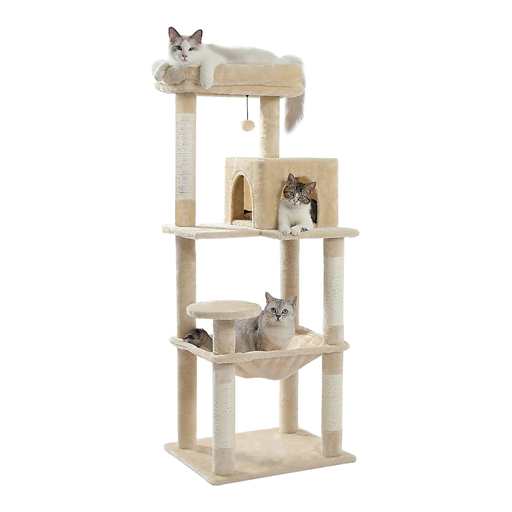
Why this choice suits this profile : its sensible height and 55 × 45 cm base make it easy to set up in a flat or medium-sized room.
The listing mentions a reinforced base, six levels and a hammock with a metal frame, rather than just a narrow platform.
Two enclosed resting spaces, several levels, sisal posts and a washable top cover.

Why this choice suits this profile : its 206 cm tower is designed for interiors with sufficient ceiling height and cats that enjoy surveying their territory from above.
It combines a reinforced base with an anti-tip system; wall fixing is recommended for a structure of this height.
Two perches, two cubby holes, a bed, a hammock, a scratching ramp and a stated total static load of up to 75 kg.
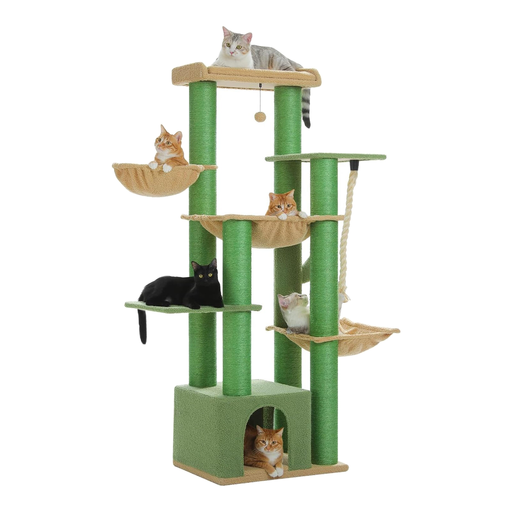
Why this choice suits this profile : its seven-level layout and three hammocks are well suited to a household with several adult cats.
The 13 posts measuring 11 cm distribute the scratching surfaces, while the three hammocks reduce competition for resting spots.
Seven levels, three upper platforms, a large cave and removable hammock covers, according to the product listing.

Why this choice suits this profile : its five levels offer a versatile set-up for indoor cats without the footprint of a tower over two metres tall.
Its anti-tip system and reinforced base address the often-underestimated risk presented by tall towers.
Thirteen posts and a scratching ramp, two cubby holes, two perches, a bed and a hammock.
We have put together a complete selection, updated in real time, of products that meet these strict criteria and the requirements of European safety regulations.
Before first use, assemble the structure on a level floor, following the instructions. For an anti-tip cat tree over 150 cm, secure the device to a suitable load-bearing wall. Avoid damp areas, sources of heat and places where blind cords could be reached.
During the first few uses, observe how your cats react: some will begin by exploring the cubby hole or bed, while others will head straight for the upper platforms. A toy or a few treats can help them get used to the set-up, but never force them to climb.
Check regularly:
A model measuring 168 to 175 cm already offers several levels, cubby holes and platforms. A 206 cm tower is better suited to cats that enjoy climbing and rooms with sufficient ceiling height. In both cases, the width of the base and the wall fixing are just as important as the height.
It depends on the cats’ weight and activity levels, how often they jump and how well the tree is maintained. Sisal posts are wear parts: inspect them regularly and replace damaged components when they are no longer secure. A properly assembled and regularly checked structure will naturally last longer than a model that is left without maintenance.
It provides attractive scratching surfaces, but does not guarantee that cats will immediately stop scratching furniture. Place the posts near areas that have already been scratched, maintain the sisal and reward your cats for using the tree. In a multi-cat household, providing several scratching areas can make a real difference.