
Livraison le jour même ou le lendemain

Qualité garantie

Débloquez vos offres de bienvenue: Livraison GRATUITE | Jusqu'à -80 % | 30 jours d'essai gratuits à JoyPlus
Téléchargez l'application
When several cats live under the same roof, a small cat tree quickly shows its limits. Platforms become difficult to share, quiet spots are in short supply, and the structure can wobble at the slightest jump. To avoid a disappointing purchase, it’s best to look beyond the advertised height.
Certain pitfalls crop up time and again:
To choose a stable cat tree, check the width of the base, the total weight of the structure, and whether it has an anti-tip device. A wall fixing is particularly useful in a flat, near a window, or in a room where your cats are used to leaping about.
The maximum load stated should also be interpreted with caution. A total static capacity does not mean that several cats can hurl themselves onto the same platform at the same time. By spreading out the access and resting areas, you limit sudden movements and premature wear on the joints.
A cat tree for large cats must offer surfaces that are spacious enough for an animal to turn around and lie down comfortably. A platform of 50 × 30 cm is a good benchmark, while a surface of 60 × 40 cm gives heavier cats a bit more room.
Cubbies need to be sufficiently open to make getting in and out easy. In a household with several cats, two cubbies, a basket and a hammock can help reduce tension over a single resting spot. However, it’s still best to observe each animal’s habits before choosing the configuration.
A cat tree with sisal scratching posts spread across several levels offers far more possibilities than a model with just one post. Check the number of wrapped posts, their thickness and their placement, especially near high-traffic areas.
To make maintenance simpler, go for:
A washable cat tree doesn’t necessarily mean the whole structure can be hosed down. It usually refers to removable cushions or platforms that can be cleaned separately. Always check the manufacturer’s instructions.
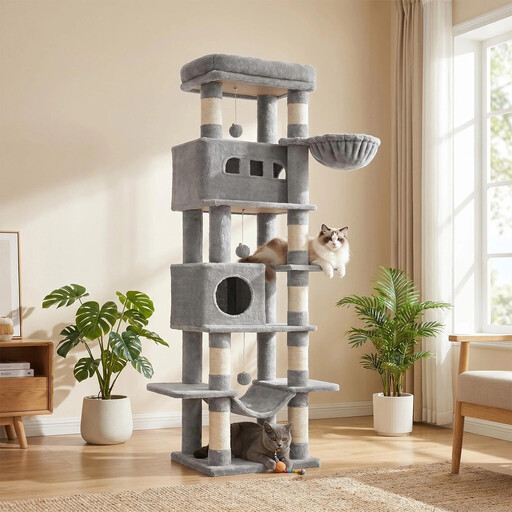
Why this choice suits this profile: At 170 cm tall, this configuration is ideal for households that want to move up to a multi-level tower without taking up too much floor space.
Scratching areas are spread across several levels, with a reinforced base and an anti-tip device mentioned in the description.
Six levels, 17 posts including 8 wrapped in sisal, two cubbies, a hammock, a 30 cm basket and two removable cushions.
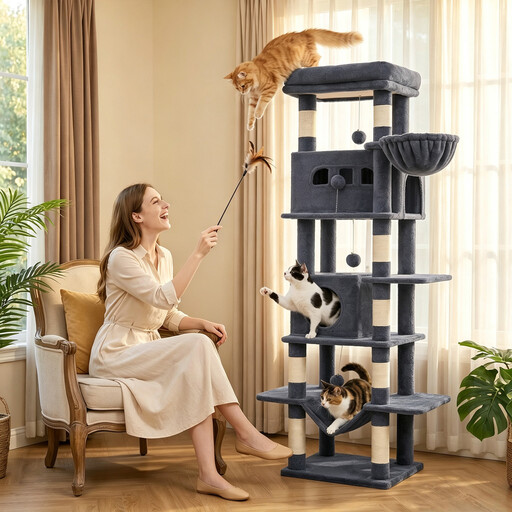
Why this choice suits this profile: Its height and 60 × 40 cm platform make it ideal for households with a room that has good ceiling height and large cats.
The structure sits on a widened base, with thickened boards and anti-tip devices. Wall fixing must, however, be carried out in accordance with the instructions.
Six levels, 8 sisal posts, two cubbies, a hammock, a basket and a platform with a removable, washable cushion.
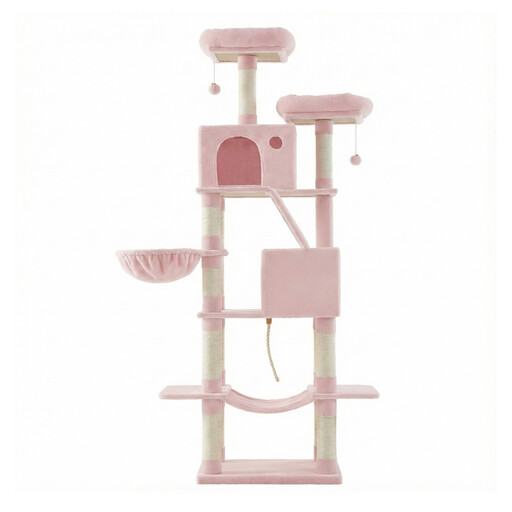
Why this choice suits this profile: With its many activity zones, this model is aimed at households where several cats use the structure intensively for climbing, playing and resting.
The description mentions a reinforced base, an anti-tip bar, a sloping ramp and several dedicated scratching surfaces.
13 scratching posts, a ramp, two perches, two cubbies, a basket, a hammock and a stated total static load of 75 kg.
Before you start assembling, check that all the parts are present and identify any that have a label. Assemble the structure from the base upwards, tightening the screws gradually. Then place the tree in a corner or against a wall, without blocking an exit or getting in the way of a frequently used walkway.
Fit the anti-tip kit according to the instructions. Check the tightness of the screws regularly, especially during the first few weeks. Replace or repair any damaged cubby, and remove any pom-poms or elastic bands immediately if a cat tries to chew them.
To keep maintenance costs down, vacuum the fabrics each week and wash the cushions following the manufacturer’s guidelines. Sisal posts wear naturally: their lifespan depends on the number of cats, their weight and how often they use them.
We’ve put together a comprehensive, real-time updated selection of products that meet these strict selection criteria as well as European safety requirements.
A 170 cm cat tree is generally suitable for a flat with a standard ceiling height. A model of 206 cm or more offers a higher vantage point, but requires you to measure the room carefully and plan for an anti-tip fixing.
It all depends on the animals’ weight, the stated load capacity and the number of available zones. Several cubbies and platforms, along with a hammock and a basket, help to spread out usage. A seller’s claim of five or six cats is no substitute for a stable installation or supervision during the first uses.
Place the scratching posts near the spots where your cats already tend to scratch, then attract them with a toy or a suitable treat. A model with sisal on several levels multiplies the scratching possibilities, but no piece of equipment on its own can guarantee that your furniture will be completely spared.