
Livraison le jour même ou le lendemain

Qualité garantie

Débloquez vos offres de bienvenue: Livraison GRATUITE | Jusqu'à -80 % | 30 jours d'essai gratuits à JoyPlus
Téléchargez l'application
Living with several cats, especially when they are large or sturdy, requires a suitable setup. An extra-tall XXL cat tree can give them places to climb, watch, play, sleep and scratch, while keeping them away from sofas and curtains.
But a crowded product photo and promises of stability are not enough to make the right choice. Some models offer a multitude of levels but stand on a base that is too narrow. Others pile on the accessories without providing enough genuinely usable space for adult cats. Here are the criteria to consider before placing your order.
A 206 cm cat tree provides an excellent vantage point, but its height also places greater demands on the structure. A base that is too light or imprecise assembly can cause wobbling when several cats jump onto it at the same time.
For a tall tower, prioritise a wide base, reinforced panels and an anti-tip device. This must be secured to a load-bearing wall support, in accordance with the manufacturer’s instructions. A tall cat tree must never be used freestanding when its anchoring system is designed to be installed.
A multi-level cat tree may include dens, a hammock, a basket and toys without providing each cat with a comfortable space. Check the dimensions of the platforms and sleeping areas, particularly if your pets weigh more than 5 or 6 kg.
A platform that is too small may end up being ignored, even if the product appears particularly comprehensive on its product page.
Decorative posts do not always replace proper scratching areas. To protect your furniture, choose a cat tower fitted with sisal-covered posts spread across several levels, as well as an easily accessible scratching board.
The sisal should be wrapped securely, and worn areas should remain easy to inspect. As for hanging toys, these are enrichment features that should be checked regularly and replaced as soon as they become damaged.
Measure the ceiling height and allow enough space around the cat tree for your cats to jump and move around. A 206 cm model can suit many rooms with high ceilings, provided it is installed on a level floor, against a wall and with no obstruction above it.
In a home with lower ceilings or in a narrow room, a 170 cm model can offer an appealing compromise between vertical space, footprint and ease of installation.
The stated weight capacity should be compared with the total weight of all the cats, not just one animal. The 206 cm model featured here states a recommended capacity of 6 cats weighing up to 7 kg each, or around 42 kg in total. This information does not remove the need to secure the cat tree with the supplied kit or to check every connection carefully.
Some 170 cm models, meanwhile, state a capacity of up to 6 cats weighing 6.8 kg each. These figures correspond to the information shown on the product pages and must not be exceeded.
When choosing a cat tree suitable for larger cats, pay particular attention to:
A configuration combining a hammock, dens and open platforms generally provides a variety of positions. However, every cat has its own preferences: some seek high vantage points, while others prefer an enclosed den or a soft bed.
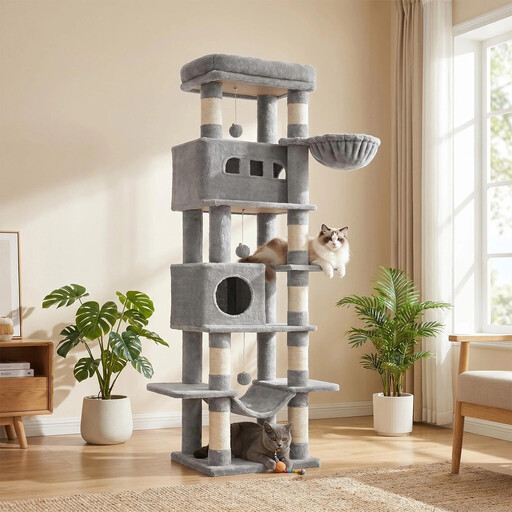
Why this choice suits this profile : At 170 cm high and with six levels, this model suits households looking to create a vertical space without going straight for a 206 cm tower.
The product page mentions a reinforced double base, an anti-tip device and scratching areas spread across five levels.
17 posts, including 8 covered in sisal, two washable cushions and a 30 cm basket.
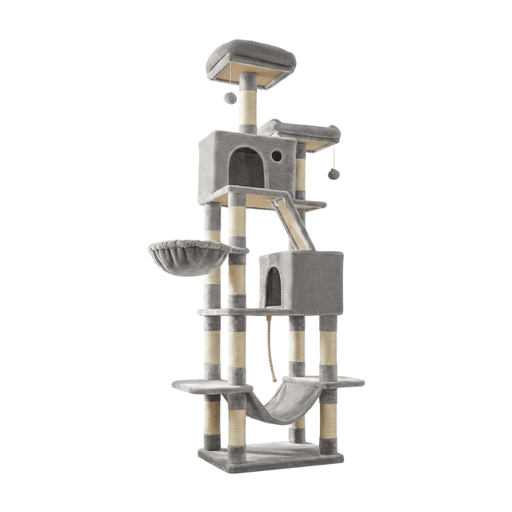
Why this choice suits this profile : This tall tower focuses on vertical space and provides multiple separate areas for households seeking a very comprehensive setup.
The base measures 60 × 50 cm and the anti-tip kit must be secured to the wall before use.
Five levels, two platforms, two dens, a hammock, a basket, a walkway and 13 scratching posts.
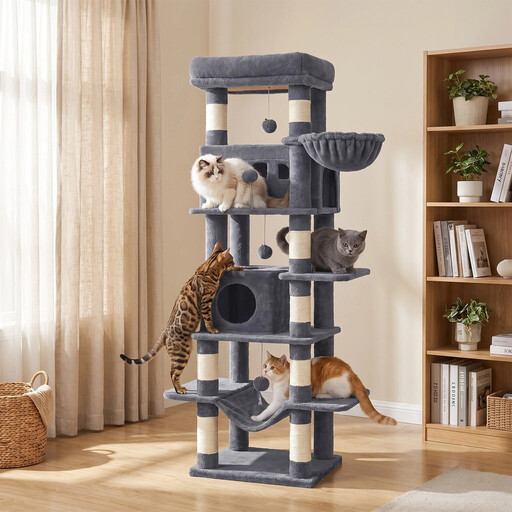
Why this choice suits this profile : It is designed for households looking for several resting areas, different routes to higher levels and well-distributed scratching surfaces.
The removable cushions and detachable top platform make regular removal of fur easier.
Two dens, a hammock, a basket, four balls and eight sisal-covered posts.
We have put together a complete, real-time selection of products that meet these strict selection criteria, as well as European safety requirements.
After assembly, check every numbered part and tighten all the connectors. For a cat tree fitted with an anti-tip device, wall anchoring is not just an optional accessory: it must be installed before allowing your cats to climb onto the structure.
Place the cat tree on a level surface and avoid very slippery floors. Regular inspection helps you quickly identify:
A vacuum cleaner or lint roller is generally enough to remove fur and dust from fabric surfaces. Washable cushions are a real everyday advantage, but always check the care instructions provided on the product page.
Install it against a wall, on a level floor, in a spot where your cats like to watch the room. Measure the available height and leave a clear passage around the base. The anti-tip kit must be secured to a load-bearing wall support before first use.
This depends on the total weight supported, how often the cats jump on it, the quality of the assembly and maintenance. Sisal posts and the various connections should be inspected regularly. Replace or repair worn components as soon as they could compromise the stability of the whole structure.
Not necessarily. The stated capacity must correspond to the combined weight of the animals, not simply their number. Also examine the dimensions of the sleeping areas and how the levels are arranged. For very active cats, two separate scratching or resting areas can help reduce conflict.