
Livraison le jour même ou le lendemain

Qualité garantie

Débloquez vos offres de bienvenue: Livraison GRATUITE | Jusqu'à -80 % | 30 jours d'essai gratuits à JoyPlus
Téléchargez l'application
Living with several cats often means rethinking how you arrange your home. A sofa that’s constantly occupied, armrests turned into scratching posts, and squabbles over a bed that’s too small quickly reveal the limits of a standard model. An XXL cat tree for multiple cats needs to offer enough height, plenty of scratching surfaces, and separate sleeping spots.
But behind the marketing promises, some points deserve a closer look.
A cat tree that’s 170 or 200 cm tall might seem particularly spacious. However, its height increases the strain on the base when cats leap from one level to another. A structure that’s too narrow or lightweight can then wobble, or even tip over.
Check for a reinforced base, an anti-tip device, and clear instructions for wall anchoring. A tall tower must be placed on a flat floor, ideally against a wall when the manufacturer recommends it, and then checked regularly.
A large number of posts doesn’t guarantee balanced use. If the sisal surfaces are all grouped in one spot, your cats may still scratch the furniture. In a home with several animals, choose a cat tree with sisal scratching posts spread across multiple levels.
A multi-level tower can pack in lots of accessories while still offering beds that are too narrow for adult or large cats. The actual usable dimensions of the platforms, hammocks, and hideaways are far more telling than the total number of features advertised.
A 170 cm cat tree works well in many flats. A 200 cm cat tree offers more vertical space, provided your ceiling height allows it. Also think about measuring the floor space it will take up, the presence of skirting boards, and the distance to nearby furniture.
A vertical model can be particularly well suited to a cat tree for a flat, as it uses height rather than width. However, its base must leave enough clear space around the structure.
Stability depends on several factors: the width of the base, the thickness of the panels, the quality of the joints, and the presence of an anti-tip fixing. The weight capacities stated by manufacturers are a useful guide, but they never replace proper installation.
With several cats, watch their first movements and check that the structure doesn’t develop any play. Tighten the screws after a few days of use, then carry out regular checks.
Sisal is well suited for scratching surfaces, while textile coverings make the resting areas more comfortable. Removable, washable cushions make daily upkeep much easier, especially when several cats use the same structure.
A setup that combines hideaways, a hammock, a basket, and platforms lets each animal find its favourite spot. It won’t eliminate all conflicts, but it reduces competition for a single bed.

Why this choice suits this profile: At 168 cm tall, with five levels, two hideaways, two platforms, a basket, and a hammock, this structure offers a complete setup without reaching the imposing size of 200 cm towers.
The scratching areas are spread across 13 posts and a ramp, rather than being concentrated at the base. An anti-tip kit is supplied and must be installed before first use.
Its dimensions of 55 × 45 × 168 cm, a stated total static load of 65 kg, and clearly identified accessories make assembly straightforward.
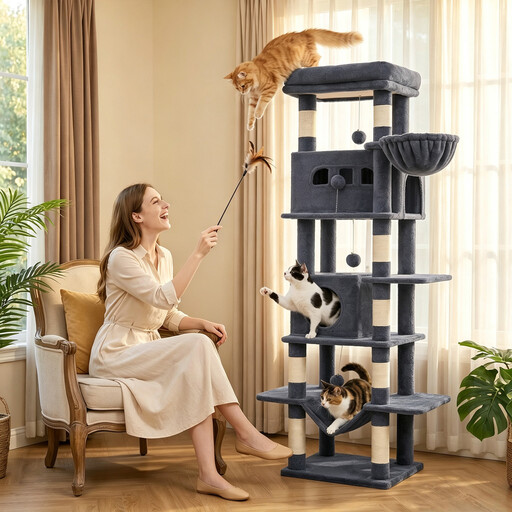
Why this choice suits this profile: Its height and 60 × 40 cm platform are designed for households that want to make the most of vertical space while offering a generous resting area for their adult cats.
The eight sisal posts are spread across the different levels. The reinforced base and anti-tip device limit potential movement from such a tall tower.
Six levels, two hideaways, a hammock, a basket, and removable cushions stated as washable make daily maintenance easier.
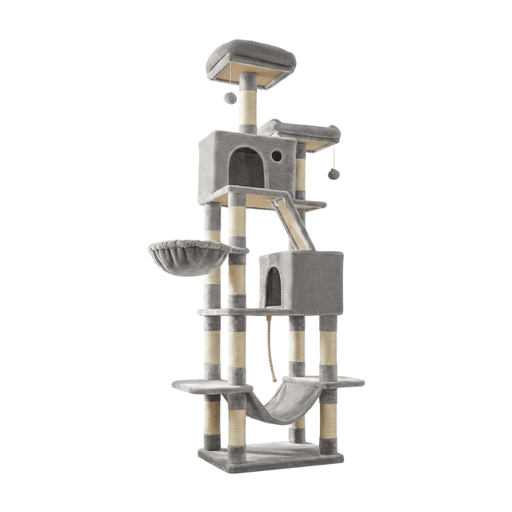
Why this choice suits this profile: This tower is aimed at households with several active cats, especially where the needs for scratching, playing, and resting are high.
The 13 sisal posts and the angled scratching board multiply the available surfaces. Wall anchoring is essential and must be done before any use.
Two hideaways, two platforms, a basket, a hammock, and a structure measuring 60 × 50 × 206 cm. The stated load corresponds to a maximum of six cats weighing 7 kg each.
We’ve put together a complete, real-time updated selection of products that meet these demanding criteria, while also taking European safety regulations into account.
A 170 cm model already offers several levels without taking up too much space. A tower of 190 to 212 cm can work if your ceiling height, the width of the base, and the wall anchoring are compatible with your home.
There’s no universal number. With several cats, posts spread across different heights reduce competition and offer several scratching angles. Pay particular attention to their diameter, their usable length, and how securely the sisal is attached.
It all depends on how often it’s used, the weight of the cats, the quality of the joints, and the maintenance. Regularly checking the screws, the base, the covering, and the anti-tip device lets you spot wear before it compromises stability.