
Livraison le jour même ou le lendemain

Qualité garantie

Débloquez vos offres de bienvenue: Livraison GRATUITE | Jusqu'à -80 % | 30 jours d'essai gratuits à JoyPlus
Téléchargez l'application
Living with several cats often means tackling three problems at once: giving each cat enough space, protecting your furniture from scratching and avoiding turning the lounge into an obstacle course. An XXL cat tree for multiple cats can meet these needs, provided you do not choose one based solely on its height or its long list of accessories.
A large, poorly balanced model may wobble as soon as a cat races up it. Having numerous dens does not necessarily make a cat tree practical either, particularly if the platforms are too narrow or all the resting areas are at the same level. Here are the key points to check before buying, along with a selection of models suited to different needs.
A tall cat tree measuring 170, 206 or more than 210 cm makes effective use of the available height, which can be a real advantage in a flat. However, the taller the structure, the more important the width of the base, the overall weight and the anti-tip system become.
In particular, check:
The cat tree should be installed on a perfectly level floor. On smooth wooden flooring or tiles, wall fixing is particularly important for the tallest models.
A den, hammock or hanging ball is not enough to meet the needs of several cats. A genuinely well-designed cat tree should offer several routes, platforms that are wide enough and spaces where each cat can retreat.
For a cat tree with dens and several resting areas, examine the layout of the levels carefully. Platforms spaced approximately 20 to 40 cm apart make it easier for cats to move around, but the width of the platforms is just as important for adult or larger cats.
Plush surfaces quickly collect fur. It is better to choose removable, washable cushions, platforms that are easy to reach with a vacuum cleaner and replaceable components where the manufacturer provides for them.
When it comes to scratching, the number of posts is not everything. A cat tree with sisal scratching posts should provide scratching areas spread across several levels, allowing cats to scratch as they climb up, come down or wake up after a nap.
In a multi-cat household, look for a structure described as reinforced and check the maximum load stated by the manufacturer. This figure is a total limit: it does not guarantee stability in every situation involving play, jumping or running.
A stable cat tree should remain securely fixed once assembled. Tighten the connections again after a few days of use, then regularly inspect the posts, screws and anti-tip system.
A large cat should be able to turn around and lie down without half of its body hanging over the edge. Dimensions are therefore more informative than vague descriptions such as ‘XXL size’.
As a guide, a 50 × 30 cm platform already provides considerably more space than a small perch. A 60 × 40 cm platform is more suitable for larger cats that like to stretch out. Remember to measure the available space in the room before placing your order.
A cat climbing tower helps minimise the floor space required while providing room to climb, observe and rest. In a flat, measure the ceiling height and leave enough clearance around the base.
The models featured below offer several levels, enclosed spaces and areas dedicated to scratching. The right choice mainly depends on the number of cats, their weight and the amount of space available.
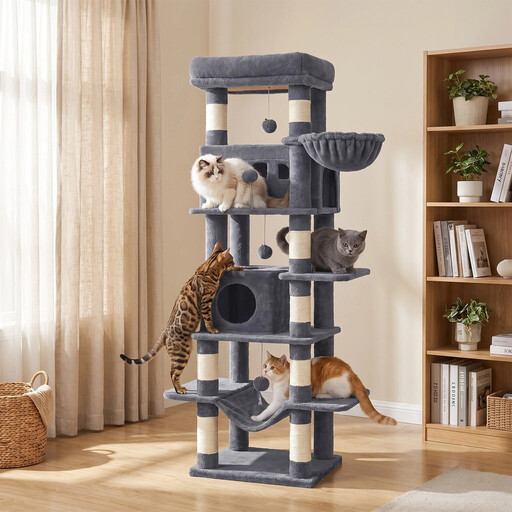
Why this choice suits this type of buyer : With six levels and dimensions of 170 × 50 × 40 cm, this model is a complete first tower for a household that wants to try out different features without investing in a particularly imposing structure.
The specifications detail the dimensions, scratching areas and anti-tip system, rather than relying solely on a promise of extra height.
17 posts, including 8 covered in sisal, two removable cushions, a hammock, a spacious den and a 30 cm basket.
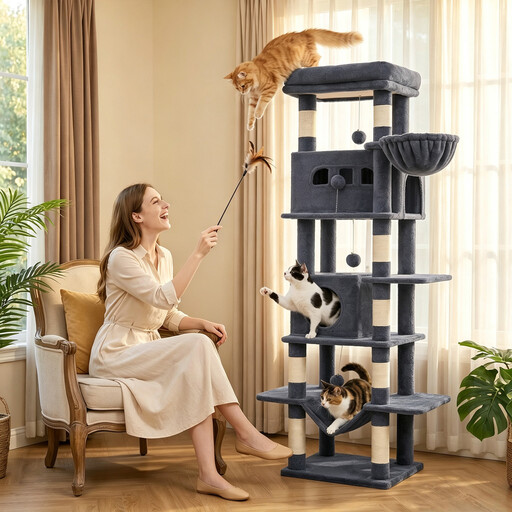
Why this choice suits this type of buyer : Its tall design is ideal for homes where floor space is limited, while offering a 60 × 40 cm platform for cats that like to survey their territory from above.
The wider, reinforced base, together with an anti-tip system, reduces the risk of the swaying associated with very tall towers, provided it is securely fixed.
Two dens, a hammock, a basket, eight sisal posts and removable cushions described as washable.
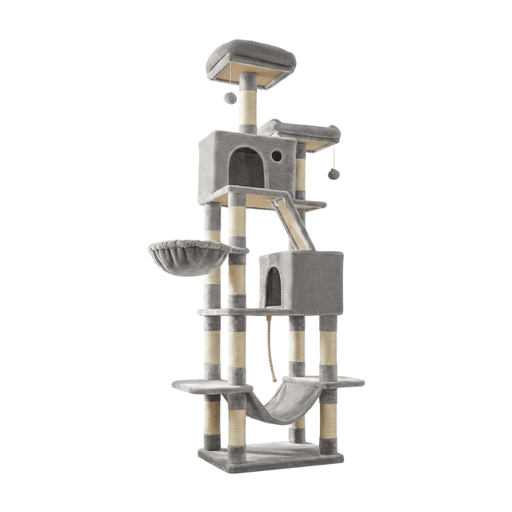
Why this choice suits this type of buyer : This tower is designed for households with several active or larger cats. Its stated total load capacity of 42 kg corresponds, according to the product information, to a maximum of six cats weighing 7 kg each.
The model combines a reinforced base, a compulsory wall-fixing kit and scratching surfaces distributed across the different levels.
13 sisal posts, two dens, two platforms, a basket, a hammock and an angled scratching board.
We have put together a complete, real-time selection of products that meet these demanding selection criteria and European safety requirements.
Once assembly is complete, place the cat tree against a wall on a level surface, then install the anti-tip system if one is supplied. Children must not climb on the structure. Replace any damaged post, rope or fixing without delay.
To extend its service life:
The cost of use is generally limited to maintenance and the occasional replacement of toys or worn parts. However, the service life depends on the cats’ combined weight, how often they jump, the quality of the assembly and the condition of the materials.
A 170 cm model can be perfectly suitable for a flat with a standard ceiling height. Towers measuring 206 cm or 212.5 cm offer more vertical space, but require you to check the available height, the stability of the base and whether wall fixing is possible.
Assemble each component according to the instructions, install the anti-tip system on a load-bearing wall where provided and place the structure on a level floor. Check the screws and connections regularly, particularly when several cats use the tree at the same time.
There is no universal number. Two dens, a hammock, a basket and several platforms help distribute the available spaces, although the cats may still decide that they all want the same spot. A multi-level structure with different routes reduces encounters and makes it easier for the cats to live together.