
Livraison le jour même ou le lendemain

Qualité garantie

Débloquez vos offres de bienvenue: Livraison GRATUITE | Jusqu'à -80 % | 30 jours d'essai gratuits à JoyPlus
Téléchargez l'application
An XXL cat tree can transform your home into a true playground, with spaces for climbing, relaxing and scratching. But height is not everything. A poorly secured structure may wobble, platforms that are too narrow may go unused, and an unsuitable covering can wear out within just a few weeks.
To avoid unpleasant surprises, here are the criteria to review before choosing a large 168 or 206 cm cat tree, especially if several cats share your home.
A very tall tower appeals to cats who like to keep watch over their territory, but it also places greater strain on the base when a cat leaps from one level to another. A 206 cm structure must therefore rest on a sufficiently wide base, feature robust connectors and, above all, include an anti-tip system.
The wall-mounting kit is not an accessory to leave in the box: install it according to the instructions, using a suitable wall support. A tower placed on an uneven or particularly slippery floor may lose stability, even with a reinforced base.
A cat tree equipped with a hammock, cubbies, platforms, beds and hanging toys may appear fully featured. These elements still need to be accessible and properly spaced. In a multi-cat household, make sure every cat can move around without becoming trapped and that several resting areas are available.
Also keep an eye on pom-pom toys and elastic-mounted toys. If they have been chewed or damaged, remove them to reduce the risk of ingestion or entanglement.
A cat tree can be tall and comfortable while still lacking genuinely suitable scratching surfaces. Sisal should cover several posts and, ideally, an inclined ramp. This allows cats to scratch at different heights instead of relying on a single cat scratching post.
Measure the room before placing your order. A large 206 cm cat tree requires sufficient ceiling clearance, as well as open space around the structure. A width of 60 cm may seem reasonable, but you should also allow room for movement and ensure convenient access for cleaning.
A 168 cm cat tree may be better suited to a more compact room while still providing multiple levels. It generally offers a well-balanced combination of vertical space, floor footprint and ease of installation.
Read the stated capacity carefully. It may refer to the maximum static load rather than a recommendation for several cats in motion. Add up the weight of your cats and leave a safety margin, particularly if they are highly active or use the tower at the same time.
For a cat tree for multiple cats, prioritise:
Particleboard and chipboard panels are commonly used for these structures. Their strength nevertheless depends on the quality of the assembly, connectors and screw tightening. Plush covering adds comfort but traps fur, so plan to vacuum or brush it regularly.
Inspect the screws, platforms, sisal posts and stitching on a regular basis. Any cracked, loose or heavily worn component should be repaired or replaced before allowing your cats to use the tower again.
The models below address different needs. The dimensions, materials and load capacities listed correspond to the information provided for each product.

Why this model suits this profile: at 168 cm tall, it is ideal for households that want to provide several climbing levels without installing a tower more than two metres high.
It distributes scratching areas across 13 posts and a ramp rather than concentrating everything in one place.
Dimensions of 55 × 45 × 168 cm, stated total static load capacity of 65 kg, two cubbies, two platforms, a hammock and a bed.

Why this model suits this profile: its five levels and distinct spaces make it possible to separate lookout, resting and scratching areas.
A reinforced base and anti-tip kit are included, but securing the tower to the wall remains essential before first use.
Dimensions of 60 × 50 × 206 cm, 13 sisal posts, a ramp, two cubbies, two platforms, a bed and a hammock.
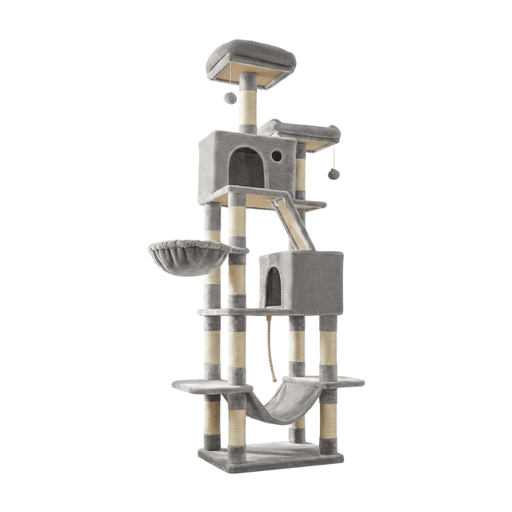
Why this model suits this profile: its design is intended for households with multiple cats, provided you respect the stated load capacity and secure the structure to the wall.
The 13 sisal posts, inclined scratching board and multiple levels distribute the different activities.
Five levels, two cubbies, two platforms, a bed, a hammock and a recommended capacity for six cats weighing up to 7 kg each.
Always assemble the tower on a level floor, following the sequence provided in the instructions. Tighten the connectors without overtightening, then check every level before allowing your cats to access it. To create a stable cat tree with an anti-tip system, secure the upper section to a load-bearing wall using the supplied hardware or compatible equipment.
Position the structure away from radiators, open flames, windows with accessible cords and busy walkways. During the first few days, use a toy or a few treats to encourage gradual exploration. Vacuum the plush surfaces regularly and check the condition of the sisal.
Discover a regularly updated selection of products that meet these criteria, helping you create a space tailored to your cats.
The 168 cm model is suitable when ceiling height or available space is limited. The 206 cm version provides greater verticality, but requires a clear area and especially careful wall mounting. In both cases, measure the room and check the width of the base.
Its lifespan depends on the cats’ weight, their activity level, the quality of the assembly and ongoing maintenance. Retighten the screws after the first few weeks, then regularly inspect the sisal, platforms and cubbies. Replace any damaged component rather than continuing to use a weakened structure.
It does not use electricity, but it does require time to clean and may eventually need replacement sisal components or toys. Choosing an easily accessible location simplifies maintenance and makes it easier to spot signs of wear early.