
Livraison le jour même ou le lendemain

Qualité garantie

Débloquez vos offres de bienvenue: Livraison GRATUITE | Jusqu'à -80 % | 30 jours d'essai gratuits à JoyPlus
Téléchargez l'application
An XXL cat tree can transform your living room into a genuine playground, rest area and observation post. But height isn't everything. Some models boast an impressive succession of levels, yet their base lacks width, their platforms are too small for larger cats, or their accessories are fiddly to clean.
In a multi-cat household, it's best to rely on concrete criteria: floor footprint, height, pole diameter, number of sleeping spots, maximum stated weight capacity and anti-tip system. Here are the points to consider before buying, followed by a selection suited to different needs.
A cat tower of 170 or 200 cm takes up little floor space, but its centre of gravity is higher. If the base is lightweight or too narrow, the structure can wobble when your cat leaps from one level to another.
Be sure to check:
The fixing kit must be installed according to the manufacturer's instructions. Even a stable cat tree deserves regular checks, especially after moving house or retightening screws.
A multi-level cat tree isn't necessarily easy to climb. Gaps that are too large, cramped platforms or a poorly thought-out route can discourage an older, heavy or less agile cat.
Examine the distance between perches, the width of passages and whether there is a ramp or sloping access. For a tall cat tree, a gradual route is often more practical than a series of widely spaced platforms.
Cushions, hammocks and cubbies quickly become covered in fur. A removable cover or washable platform makes daily maintenance much easier. Also check pom-poms and elastic cords: if they are chewed or damaged, remove them straight away.
The plush covering can be vacuumed with a suitable attachment. As for the sisal parts, keep an eye on them as soon as they start to fray. The ability to replace an accessory or a pole extends the life of your cat condo.
Measure the available height up to the ceiling, but also the width and depth you can realistically dedicate to the tree. In a flat, a vertical model can free up floor space, provided it doesn't block a door, radiator or walkway.
The models in this selection measure approximately 168 to 212.5 cm. A height of 170 cm suits many homes; above 190 cm, wall fixing becomes particularly important.
For a cat tree for large cats, a platform of at least 50 × 30 cm generally allows your cat to stretch out more comfortably. Households with several animals should favour a model offering several distinct spaces: cubbies, hammocks, baskets and observation platforms.
An XXL cat tree with hammock and cubbies reduces competition between cats, provided each space is genuinely accessible. Two cubbies don't necessarily mean two large cats can fit inside comfortably – always check the dimensions stated on the product page.
Poles covered in sisal should be distributed across several levels. A cat tree with sisal scratching posts allows cats to sharpen their claws at different heights, according to their habits. The diameter of the poles also matters: with 11 cm diameter, there is more surface area for stretching.
Don't confuse the total number of poles with the number of poles covered in sisal. The technical specifications sometimes make this distinction. Also check the material of the structure, the overall weight and the static load stated by the manufacturer.

Why this profile suits it: its five levels and dimensions of 55 × 45 × 168 cm offer a complete setup without reaching the heights that are hardest to accommodate.
The product page mentions a reinforced base, an anti-tip kit and a total static load capacity of 65 kg.
Two cubbies, two platforms, one basket, one hammock, 13 poles and a scratching ramp.
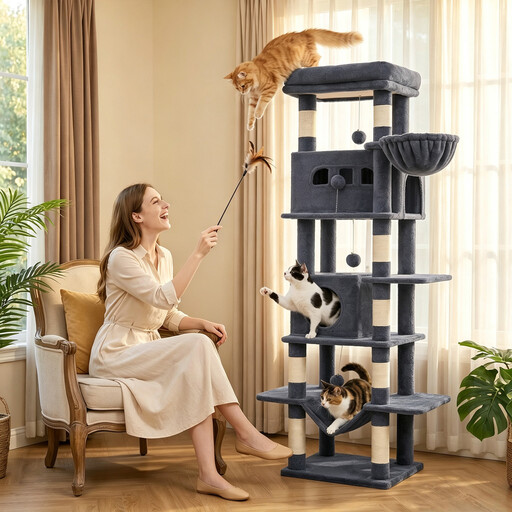
Why this profile suits it: its tall design suits rooms where you want to minimise the floor footprint while multiplying observation posts.
The stated structure includes a widened, reinforced base and an anti-tip device to be fitted.
One platform measuring 60 × 40 cm, two cubbies, one hammock, one basket and removable, washable cushions.
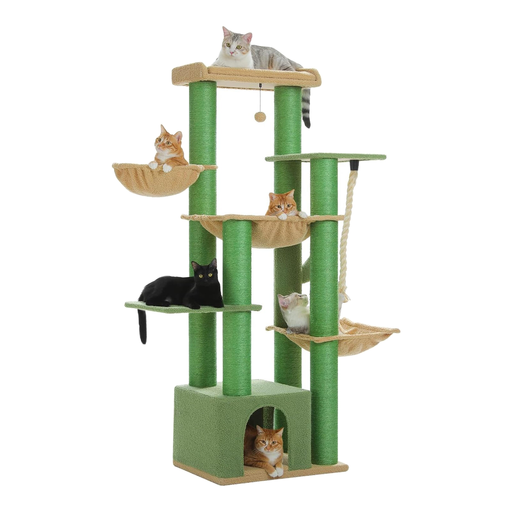
Why this profile suits it: this model is designed for multi-cat households and for animals weighing up to 10 kg, with plenty of separate spaces.
Its 13 sisal poles with 11 cm diameter distribute the scratching areas and prevent wear being concentrated on a single pole.
Seven levels, three hammocks, three upper platforms and one large cubby. The hammocks and cubby are removable.
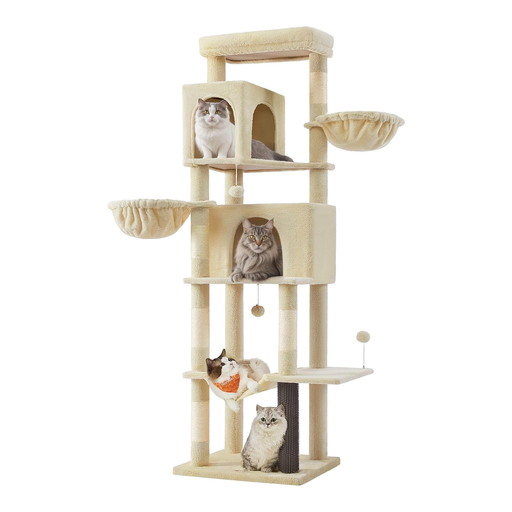
Why this profile suits it: it combines several resting spaces and a built-in grooming brush – an appealing setup for a home where your cat spends a lot of time.
The product page requires wall fixing and recommends regularly checking the parts, as well as cleaning the structure with a damp cloth.
Two cubbies, two resting areas, one hammock, one large platform, five sisal poles and a built-in grooming brush.
Place your indoor cat tree on a level floor, away from high-traffic areas. A spot near a window may encourage your cat to use the observation platform, but avoid draughts and heat sources.
Before first use:
Vacuum the textile surfaces regularly and wash only those items described as removable or washable. A monthly inspection of the poles, platforms and fixings helps you spot the first signs of wear quickly.
Browse an updated selection of XXL cat trees with multiple levels, scratching posts, cubbies and stability solutions.
Between 168 and 175 cm, installation is generally straightforward in a standard home. Models close to 190 or 212.5 cm offer more height, but require you to measure the ceiling precisely and plan for an anti-tip fixing.
Yes, if the model offers several independent spaces. Two cubbies, multiple platforms and several hammocks reduce access conflicts. However, compare the sleeping area dimensions with the size of your cats and respect the weight capacity stated on the product page.
Routine maintenance mainly involves vacuuming, dusting the structure and washing the removable cushions. An additional expense may arise if a hammock, toy or sisal rope needs replacing. Check the availability of spare parts before ordering a particularly well-equipped model.