
Livraison le jour même ou le lendemain

Qualité garantie

Débloquez vos offres de bienvenue: Livraison GRATUITE | Jusqu'à -80 % | 30 jours d'essai gratuits à JoyPlus
Téléchargez l'application
An XXL cat tree can transform your living room into a proper playground, with spaces for climbing, resting and scratching. But height isn't everything. Some models take up a lot of floor space without offering wide enough platforms, while others lack stability the moment an energetic cat leaps from one level to another.
Before choosing a large cat tree, focus on three things: stability, the genuinely usable dimensions, and the durability of the scratching areas. Here are the criteria to examine so you can compare models without making a mistake.
A tower over 180 cm may look spacious, but its platforms, cubbyholes or baskets can still be very narrow. If you have a large cat or several pets, check the width of the sleeping areas, the depth of the platforms and the gap between different levels.
A multi-tier cat tree also needs to be easy to navigate. Platforms that are too far apart or difficult to reach risk putting off older cats, kittens and less agile animals.
A base that is too thin or too light increases the risk of tipping during chases and jumps. To stay stable, the cat tree must sit on a flat surface, with a base that is wide enough relative to its height.
Above 190 cm, models often come with an anti-tip device that needs fixing to the wall. This isn't just a decorative extra: read the instructions and install it before first use.
A large number of scratching posts doesn't necessarily guarantee a longer lifespan. Check the diameter of the posts, the quality of the sisal wrapping and how they are distributed across the different levels. Posts positioned near resting areas are particularly handy: the cat can scratch without having to climb back down.
Measure the available space, taking into account skirting boards, windows and nearby furniture. A tall cat tree also needs enough vertical clearance, especially if the ceiling is low or if a wall fixing needs to be fitted.
If you have several cats, check the maximum load stated by the manufacturer. According to the product sheet, this value may refer to the total load or to the load supported by each animal. It doesn't replace correct installation or regular checks of the structure.
A cat tree with cubbyholes will suit animals that like to hide away, while open platforms serve more as lookout posts. The hammock adds a soft surface that many cats love, but check its dimensions and how securely it is attached.
In a multi-cat household, several separate sleeping spots can help avoid squabbles over a single cubbyhole. Also choose platforms that are big enough for the animal to turn around and stretch out comfortably.
The plush covering is pleasant, but it needs to be easy to clean with a vacuum cleaner or a slightly damp cloth. The sisal must be firmly fixed and cover a sufficient length of the post to match the cat's natural movements when it stretches.
Also inspect the hanging toys, ropes and removable parts. Any loose, frayed or chewed piece should be removed promptly. If in doubt, the safety instructions supplied with the product take priority.
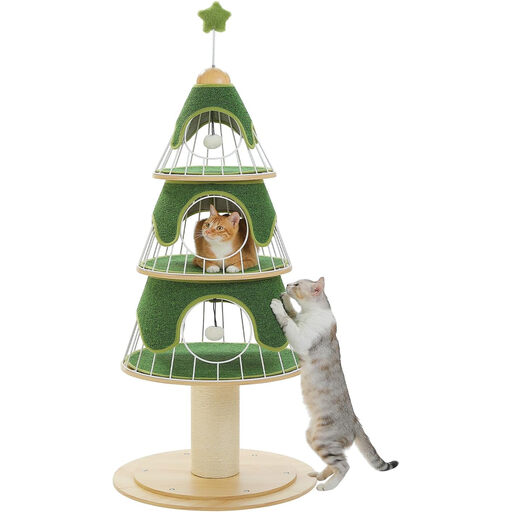
Why this choice suits this profile: At 130 cm tall with a 60 × 60 cm base, this model is ideal for households that want to introduce vertical space gradually without taking over the whole room height. Its three levels and three cubbyholes offer plenty of resting options.
Its widened base and 12.5 cm central posts reduce the risk associated with a structure that is too narrow. Installation should still be checked before first use.
130 cm tall, three cubbyholes, sisal-covered posts and a 14.6 kg structure.
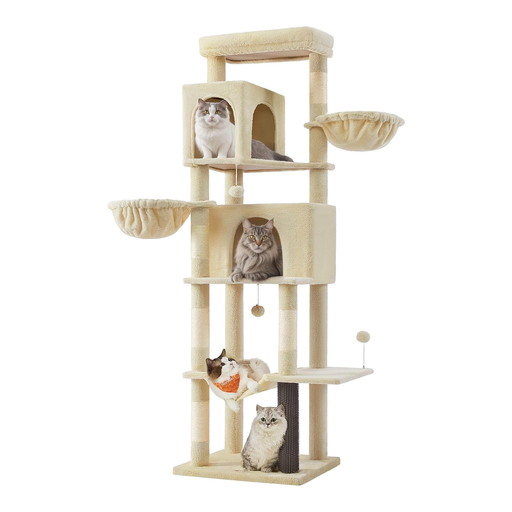
Why this choice suits this profile: At 190.7 cm tall, this model is designed for cats that love to survey their surroundings from on high. Its two cubbyholes, two relaxation areas, hammock and large platform offer a variety of uses in a dedicated room.
The mandatory anti-tip fixing reduces the risks associated with this great height. The five sisal posts distribute scratching areas across the different levels.
Dense plush covering stated at 500 g/m², integrated brush, 19.5 kg weight and mounting accessories included.
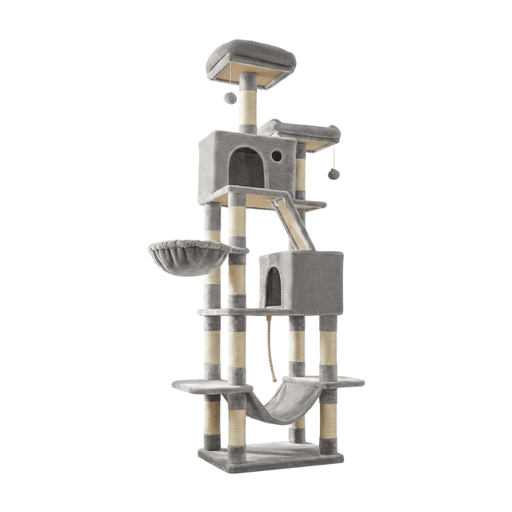
Why this choice suits this profile: At 206 cm tall, this structure is aimed at households with several cats or particularly active animals. Its five levels, two cubbyholes, basket, hammock and two platforms help spread activities out better.
Its 13 scratching posts and angled board prevent all activity from being concentrated in one spot. The anti-tip kit must be fixed to a load-bearing wall before use.
Stated capacity for up to six cats of 7 kg each, 13 sisal posts, five levels and a weight of 23.5 kg.
We have put together a complete, real-time updated selection of products that meet these demanding criteria as well as European safety standards.
A wall-mounted cat tree can complement a classic tower in a home where floor space is limited. However, you need to choose a fixing that is compatible with the wall type and arrange the different elements to avoid dangerous jumps.
It all depends on the available space, the cat's age and agility. A 130 cm model can be a good first piece of equipment. Towers from 190 to 206 cm offer more verticality, but generally require an anti-tip fixing and a ceiling that is high enough.
Place it on a flat floor, check that its base is wide enough and tighten all the screws following the instructions. For a tall structure, always use the anchoring kit supplied when one is provided. Then check the fixings, posts and platforms at regular intervals.
Its lifespan depends on the number of cats, their weight, how often they scratch and the quality of the sisal. Regular inspection lets you spot worn fibres, loosening seams or parts that are starting to move. Where possible, replace damaged pieces to extend the life of the whole unit.