Who needs to make this decision?
The right approach depends both on the condition of your fridge and on how much storage space your household now needs.
Households with an older but working appliance
Before replacing a fridge that cools properly, check its settings, any ice build-up, the door seals, the rear grille and where it’s positioned. Energy-info and UFC-Que Choisir recommend these checks to help avoid unnecessary energy use.
Households with changing storage needs
You may need to reconsider the format if you need a different capacity or a different balance of fridge and freezer space. However, ADEME warns that a larger or more feature-packed appliance can increase your bills. Compare annual energy consumption for models with a similar capacity and layout.
People considering a repair or second-hand appliance
If you’re considering a repair, start by identifying the fault and asking for a diagnosis. For a second-hand or refurbished appliance, ask for its model reference, stated energy consumption and a clear description of its condition. Also check who is selling it and which guarantees apply.
How should you choose between maintenance, repair and replacement?
Follow these steps: check what can be put right on your current appliance, establish how much energy it uses, then consider other options based on the capacity and format you need.
Keep it and optimise its performance
Consider this when: the fridge cools properly and its maintenance or positioning could be improved.
Bear in mind: these steps may not be enough if the appliance still uses a lot of energy after you’ve checked it.
Get it repaired
Consider this when: a diagnosis identifies a repairable fault, such as a door seal that no longer closes properly.
Bear in mind: ask for a quote and check the repair terms before deciding whether to keep the appliance.
Buy a new model
Consider this when: your current appliance still uses a lot of energy after being checked, or its capacity and format no longer suit your needs.
Bear in mind: a better energy label rating alone doesn’t tell you how much you’ll save if the new appliance is larger or has different features.
Choose second-hand
Consider this when: you can check the appliance’s model reference, condition, capacity and annual energy consumption.
Bear in mind: without this information, you can’t tell whether it will use less energy than your current fridge.
| Priority | What to check | Consider your needs |
|---|
| Use and maintenance |
UFC-Que Choisir recommends setting the fridge to 4 to 5 °C and the freezer to −18 °C. Energy-info recommends checking for ice build-up once it reaches 3 mm, as well as checking the seals, rear grilles and distance from heat sources. |
My appliance still cools: I want to rule out fixable causes of excess energy use before deciding whether to replace it. |
| Annual energy consumption |
Measure your old appliance’s energy use over a representative period or look for a documented estimate. Compare it with the kWh/year shown on the label of a similar type and capacity of model. Actual energy use may vary. |
I want to know whether replacing my fridge will meet my energy-saving goal, rather than relying on its age alone. |
| Capacity and layout |
Check the fridge and freezer capacities separately, as well as the format and installation dimensions. ADEME notes that a larger size and too many features can increase your bills. |
My storage needs have changed: I’m looking for useful capacity, not simply choosing a larger format to get more space. |
| Label and features |
According to the European Commission, the label shows the A to G energy class, kWh/year, capacity and noise level. Also consider which features you’ll actually use. |
If I choose a new appliance, I want to compare all its details with those of similar-capacity models, rather than looking at its energy class alone. |
| Repairs and second-hand appliances |
For a repair, ask for a diagnosis and a quote. For a second-hand appliance, check its model reference, condition and stated energy consumption. Find out who the seller is and which guarantees apply. |
I’m open to keeping my appliance or buying second-hand, but I need accurate information to compare my options. |
Which brands should you look at when comparing or arranging a repair?
Manufacturer product details and services can help you identify a model or part. Always compare the specifications for the exact model, rather than judging a brand as a whole.
Bosch
Bosch Home Appliances France offers fridges in a range of formats, including freestanding and built-in fridge-freezers.
- Its product range pages provide information for each individual model.
- Bosch says energy consumption varies by model, energy class and age. Check the kWh/year and capacity of the model you’re considering.
Beko
Beko France publishes details for fridges and fridge-freezers, including annual energy consumption and capacity.
- Model-specific information lets you compare stated capacities and kWh/year.
- These figures vary from model to model. A particular cooling system or capacity alone doesn’t prove that an appliance uses less energy.
Liebherr
Liebherr offers freestanding and built-in appliances, as well as a spare parts search tool.
- Liebherr says you can use its tool to search for parts using your appliance’s serial number.
- Before arranging a repair, confirm that the part you need is available and compatible with your exact model.
New fridges to consider on Joybuy
These models are options if you’re thinking of replacing your current appliance with a new fridge-freezer. Their inclusion here doesn’t mean that you need to replace yours: first check the capacity you need, your current appliance’s energy consumption and the label details of each model you’re considering.
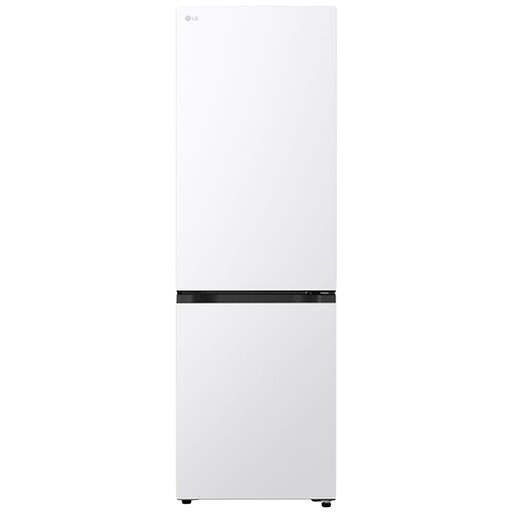 Image unavailable
LG GBBSJ1CCSW, 333 L white fridge-freezer, class C
Worth considering if a 333 L fridge-freezer suits your storage needs. Class C is stated in the product title; check the kWh/year on the label for the exact model and make sure it will fit before comparing it with your current appliance.
View on Joybuy
 Image unavailable
Samsung RB33B612EBN, 344 L black fridge-freezer, class E
The stated capacity is 344 L. If that suits your household, compare its kWh/year with similar configurations and check the space required for installation.
View on Joybuy
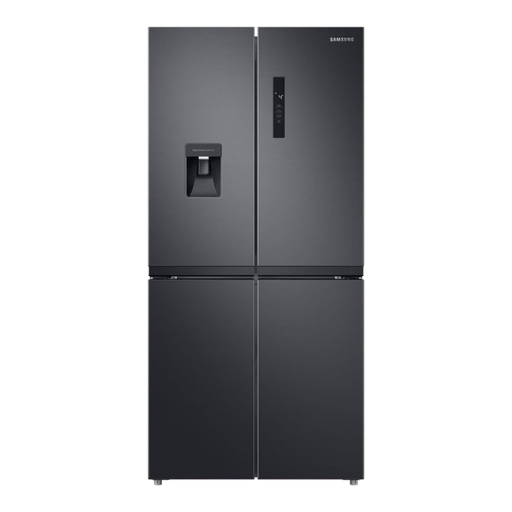 Image unavailable
Samsung RF48A401EB4, 488 L black American-style fridge
This 488 L format is worth considering if you genuinely need that much space. Check the kWh/year for the exact model and make sure you have enough room. Don’t assume you can tell how much energy it uses from its format alone.
View on Joybuy
 Image unavailable
Candy CFQQ5T817EPS, 467 L four-door fridge-freezer, class E
The product title states a 467 L capacity and Total No Frost. If this capacity suits your needs, check the kWh/year, compartment layout and dimensions before comparing it with your current fridge.
View on Joybuy
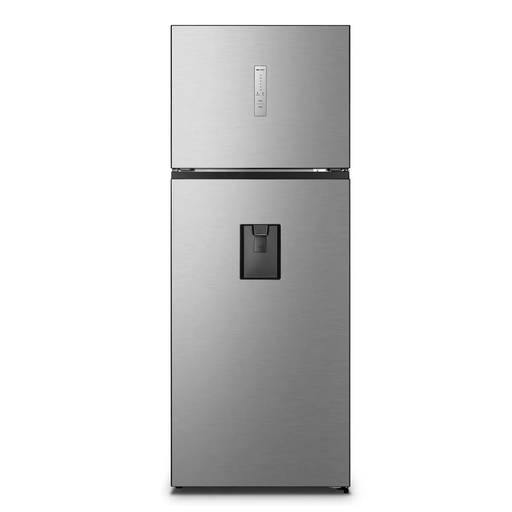 Image unavailable
Hisense FTN461WCE1, 467 L fridge-freezer, class E
The product title states a capacity of 467 L and Total No Frost. Check that the capacity and compartment layout suit your needs, then compare the kWh/year with similar-capacity models.
View on Joybuy
Frequently asked questions
How do I compare my old fridge with a new model?
Measure its energy use with a suitable meter over a representative period, or use a documented estimate. Then compare the result with the kWh/year on the label of a new model with a similar type and capacity. Bear in mind that this is only an estimate: room temperature, settings, ice build-up and how often you open the door all affect actual energy use.
What temperature should I set the appliance to, and when should I defrost it?
UFC-Que Choisir recommends setting the fridge to 4 to 5 °C and the freezer to −18 °C. Energy-info advises defrosting once ice reaches 3 mm, checking the seals and dusting the rear grilles.
Is the energy class enough to choose a more energy-efficient appliance?
No. According to the European Commission, the label also shows annual energy consumption, capacity and noise level. To decide whether another fridge would better suit your needs, compare the kWh/year of models with a similar type and capacity rather than looking at two energy class letters in isolation.
Can repairs qualify for the Bonus Réparation in France?
A repair may qualify if the appliance and work meet the scheme’s conditions. The French ministry responsible for the environment says the discount is applied to your bill by a certified repairer. ecosystem also specifies that eligible appliances must be owned by a household and bought in France. Check that your fridge and the fault qualify before arranging a repair.
What should I check when buying a second-hand or refurbished fridge?
Ask for its exact model reference, condition, capacity and annual energy consumption so you can compare it with your current appliance. In France, the Ministry of the Economy explains that the legal guarantee of conformity applies to second-hand and refurbished goods sold by a business to a consumer, so check the seller’s identity too. This same guarantee does not apply to private sales.


