An essential kitchen tool, the cutting board is often an accessory that's chosen without much thought. The result? You quickly end up with a model that warps, cracks, or dulls your finest knives in just a few months. This guide is here to arm you against marketing promises and hidden flaws. Our mission: to help you find the perfect board, one that will last for years, whether for daily prep or for arranging an elegant charcuterie board.
To avoid disappointment, let's start by navigating the two most common pitfalls.
- The Fast-Warping Trap: A board that warps after just a few washes is a classic problem. The cause? Poor-quality wood, rushed industrial drying, or an "edge grain" design that's too thin to withstand moisture.
- The Wood vs. Bamboo Confusion: Be careful—even if the label suggests it, a bamboo cutting board is not made of wood, but of compressed grass. The difference is significant: bamboo, being harder, tends to prematurely dull the edge of your knives. Its manufacturing also requires glues, and it's crucial to check their composition and food-safe certification.
Criteria to Check Before You Buy
To make the right choice, set aesthetics aside for a moment and focus on these few decisive technical points.
1. The Material: Solid Wood or Bamboo?
The choice of material directly impacts the board's durability, maintenance, and effect on your knives.
- Solid Wood (Oak, Beech, Acacia, Walnut): There's a reason it's the gold standard. Hardwoods with a tight grain, like oak or acacia, offer a resilient surface that is gentler on your knife blades. They have natural antimicrobial properties and, with proper care (regular oiling), can last for decades. A large cutting board made of solid oak is a true long-term investment.
- Bamboo: Praised for its rapid growth and "eco-friendly" image, bamboo is dense and less porous than wood, giving it good water resistance. The downside: its extreme hardness is tough on the edge of high-quality knives. Reliable models are hot-pressed (carbonised) to improve their resistance and use certified food-safe glues.
2. The Design: Consider the Use Case
Beyond the material, the shape and practical details make all the difference in daily use.
- Thickness: Aim for a minimum of 2 cm (0.8 inches). This is a guarantee of stability and durability. A thick board won't move during cutting and will be much less prone to warping.
- Juice Groove: For cutting juicy meats, tomatoes, or citrus fruits, a cutting board with a juice groove isn't an option, it's a necessity. This simple channel prevents juices from escaping and dirtying your work surface.
- Versatility: Love to entertain? Consider a dual-purpose model that can be transformed into a wooden serving board. Versions with handles or a refined design (round, long rectangular) are ideal for presenting cheeses, cured meats, and appetisers. A cutting board set of different sizes is also an excellent solution for juggling preparations and maintaining hygiene.
Recommended Cutting Board Picks
Let's get practical with our selection of boards that check all the right boxes for durability and functionality.
IDEAL FOR: ELEGANT ENTERTAINING
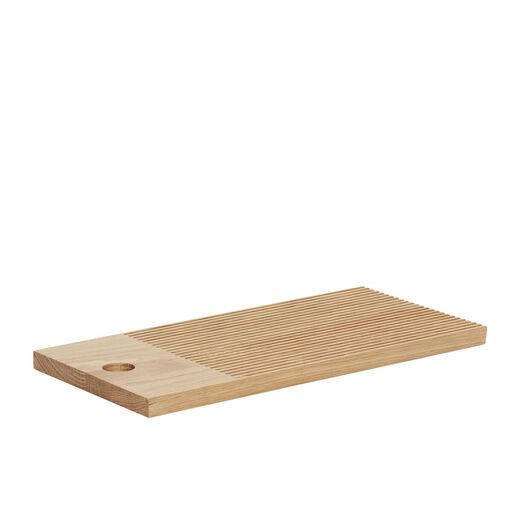
The Profile: Perfect for those seeking an object that is as beautiful as it is practical. Its clean design and solid oak make it a superb presentation board for charcuterie or cheese, transitioning elegantly from the kitchen to the dining table.
The Anti-Warp Guarantee
With its FSC certified solid oak and substantial 2 cm thickness, it's built to last and resist warping, unlike low-end models that bend within weeks.
Key Features
Its dual use for cutting and serving. The elegance and durability of oak. An artisanal design that promotes responsible forest management.
IDEAL FOR: THE PRACTICAL EVERYDAY COOK
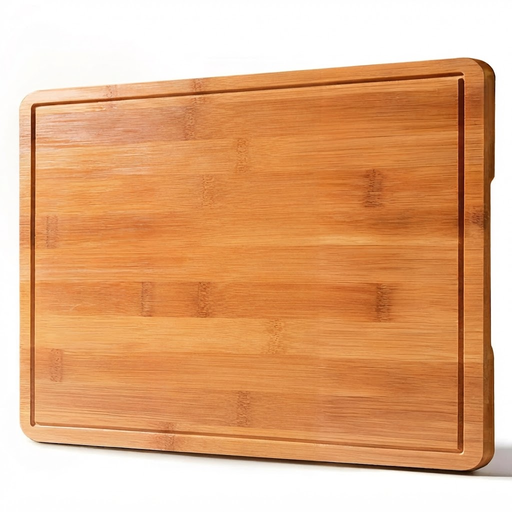
The Profile: For those who prioritise efficiency and a large work surface. Its generous dimensions (40x29 cm), juice groove, and handles make it the perfect tool for hassle-free daily prep.
The Anti-Warp Guarantee
Its high-temperature carbonisation treatment and cross-laminated structure reinforce its stability, limit moisture absorption, and effectively prevent warping.
Key Features
Its large work surface. Its deep juice groove that catches liquids. Its very practical integrated handles. Its enhanced durability from carbonisation.
IDEAL FOR: VERSATILE KITCHENS
The Profile: The all-in-one solution. This set of three boards allows you to easily juggle tasks: one for meat, one for vegetables, one for bread. It's ideal for impeccable hygiene and for always having the right size on hand.
The Anti-Warp Guarantee
This carbonised bamboo set offers much better durability than entry-level bamboo boards, while remaining a very economical and versatile option.
Key Features
Excellent value for money. Three sizes to handle any situation. The juice groove and handles on each board. The sturdy construction.
Looking for Other Models?
Discover our full selection of products that meet our quality criteria and food safety standards.
Your Questions, Answered
How do I clean and maintain my wooden cutting board?
Proper cleaning is the key to your board's longevity.
- Washing: Wash it by hand with hot water, a bit of dish soap, and a sponge. Most importantly, do not let it soak and forget the dishwasher, which will cause it to swell and warp without a doubt.
- Drying: Wipe it immediately with a clean cloth, then let it dry completely upright so that air can circulate on both sides.
- Maintenance: About once a month (or whenever the wood looks dry), condition it by generously applying a food-grade mineral oil over its entire surface. Let it penetrate for a few hours, then wipe off the excess with a cloth. This simple step protects the wood from moisture and prevents cracks from forming.
Can you really cut anything on a wooden board?
Yes, as long as you follow some basic hygiene rules. Hardwoods with a fine grain have natural antimicrobial properties. However, to avoid cross-contamination, it's best to use different boards for raw meat and for other foods (vegetables, bread, etc.). If you only have one board, wash and disinfect it meticulously (with white vinegar or lemon juice) after cutting raw meat.
End Grain vs. Edge Grain: What's the Difference?
This technical distinction has a direct impact on the lifespan of your knives and your board.
- Edge Grain: The boards are made of wood strips glued together lengthwise. This is the most common and affordable construction. The wood fibres run horizontally.
- End Grain: Here, the board is an assembly of wooden blocks with vertically oriented fibres. The knife blade slips between the fibres, which then "close up" naturally. This type of board is better at preserving the knife's edge and is self-healing on the surface. On the other hand, it is often more expensive and requires more regular oiling because it is more absorbent.