
Same-day & Next-day Delivery

Quality Guaranteed

Unlock Your Welcome Offers: FREE Delivery | Up to 80% OFF | Free 30-day JoyPlus trial
Download the APP
The wooden cube wall shelf has become a classic for anyone looking to combine practical storage with a decorative touch. Ideal for dressing up a living room wall, optimising a small space, or showcasing objects, plants, or books, its simplicity is its main appeal. But be careful not to fall for common pitfalls: materials that sag under the weight of a paperback, finishes that chip away, and mounting systems that inspire anything but confidence. This guide breaks down the key points to watch out for to make a smart, long-lasting choice.
Before you start, keep these three common issues in mind, which can quickly turn a great find into a disappointment.
oak cube shelf finish can quickly lose its lustre. Low-end adhesive coatings tend to peel at the edges or discolour over time, revealing the composite material underneath and ruining the aesthetic of your decorative wall storage.To be sure of the quality of your future shelf, focus on these key technical specifications.
The choice of material is crucial for the strength and lifespan of your shelf.
The elegance of a wooden floating shelf lies in its invisible mounting. It is therefore crucial that this system is robust. It usually consists of a metal plate to be fixed to the wall, onto which the shelf is slotted. One essential step: always check the maximum supported weight indicated by the manufacturer and plan to buy high-quality wall plugs suitable for your wall type (plaster, brick, concrete).
One of the great advantages of the square wall shelf is its modularity. A set of 3 wall shelves of different sizes allows you to create a graphic and personalised composition. Before buying, measure your space and imagine the arrangement: aligned for a clean, minimalist style, or staggered for a more dynamic effect. Also consider the depth of the shelves, which must be sufficient to accommodate the objects you wish to display.
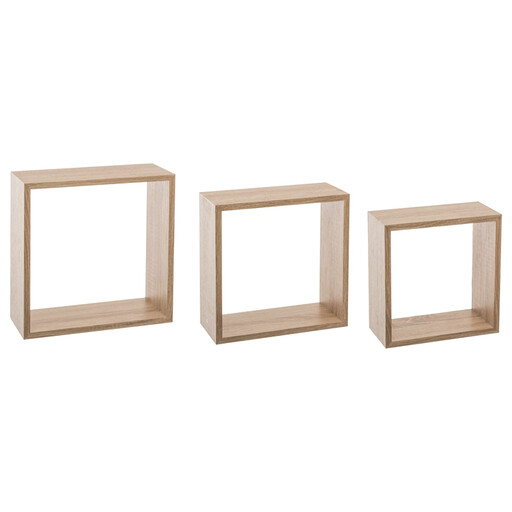
Why it's a great choice: Perfect for those who love to compose their own wall decor. The three different sizes (15, 20, and 25 cm) invite you to play with volumes to create a unique and personal arrangement.
Made from engineered wood (MDF), this set ensures much better stability than entry-level particleboard, limiting the risk of sagging. The natural oak finish is applied to a smooth surface, guaranteeing better durability.
The creative freedom offered by the three distinct sizes. The clean design and oak finish blend effortlessly with most interior styles.
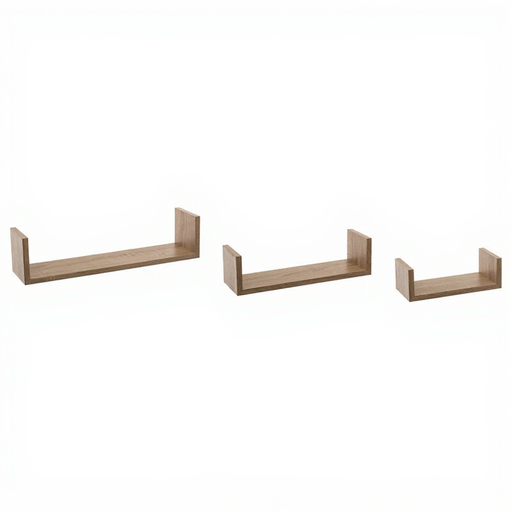
Why it's a great choice: The perfect solution for those seeking functional, linear storage. With their varying widths (22, 32, 42 cm) but a single depth, they are designed for lining up paperbacks or a collection of objects.
This model relies on its invisible mounting system, designed for a flawless "floating" look and secure installation. The maximum load of 3 kg per shelf is clearly specified, preventing any unpleasant surprises.
Its invisible mounting system, which creates a true floating effect without any visible brackets. The MDF construction ensures good support for decorative items and small-format books.
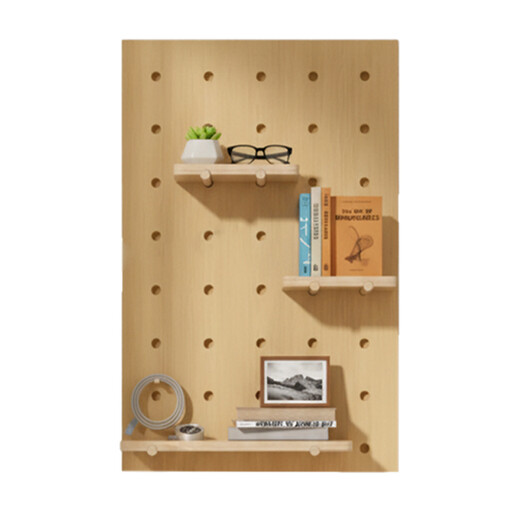
Why it's a great choice: For those who dream of wall storage that evolves with their needs. Much more than a shelf, this pegboard allows you to endlessly reconfigure shelves and supports for a home office, entryway, or workshop.
Thanks to its solid wood construction, this product bypasses the pitfall of fragile composite materials. The priority here is durability and versatility, not just aesthetics.
Its flexibility is its number one selling point. The ability to move the pegs and shelves allows you to adapt the storage to objects of all shapes, offering a much more dynamic solution than a fixed shelf.
Browse our full selection of wall storage solutions that meet our standards for quality and durability.
The supported weight depends on three key factors: the shelf's material, the strength of its mounting, and the type of your wall. A well-mounted MDF shelf in drywall with appropriate anchors can typically support between 3 and 5 kg. For heavier loads, it is essential to anchor into a stud (the wall's frame) or a load-bearing wall. The rule of thumb: always consult the maximum load specified by the manufacturer.
To minimise damage, it's best to use a stud finder to locate solid structures behind the drywall. Use a spirit level to ensure a perfectly horizontal installation. The choice of anchor is crucial: Molly bolts for drywall, expansion anchors for hollow brick, etc. Drill clean holes of the correct diameter for a perfect fit.
It all depends on your budget and the desired aesthetic. Solid wood offers an authentic look and great robustness, but it is often more expensive and can react to temperature changes. MDF is more affordable, stable, and its smooth surface is perfect for lacquered finishes or uniform veneers, like an oak cube shelf effect. For purely decorative use with light objects, MDF is an excellent compromise.