
当日/次日达

品质保障

开启新人专享福利: 全场免邮 | 低至 2 折 | 免费试用 30 天 JoyPlus 会员
下载 Joybuy
A wood stove fan without electricity can help distribute heat more evenly around a room, without needing an appliance that plugs into a socket. But be careful: not all listings are talking about the same type of product. Some models sit on a hot stove, while others are genuine air circulation fans or portable pumps intended for the workshop, garage or outdoor activities.
Before you place an order, there are three pitfalls to avoid:
A thermodynamic model, also called a heat-powered stove fan, converts part of the heat from the stove’s surface into mechanical movement. It therefore needs neither a cable nor a battery. However, its operation depends on the temperature reached by the stove and the compatibility between the appliance and the surface on which it sits.
In contrast, an electric fireplace fan or a motorised warm air circulator can provide a more consistent airflow, but it increases your electricity consumption. Battery-powered devices, such as a cordless air pump, offer greater freedom of movement, with a battery life that depends directly on the battery’s capacity.
Airflow refers to the volume of air moved over a given period. The Vacmaster AM1202 claims 245 litres per second, with a 124 W motor and three speeds. This setup is suitable for ventilation, cooling or drying. However, with a stated noise level of 75 dB, it is clearly not designed to be placed near a living or sleeping area.
For a pump, pressure and flow rate are not the same thing. The Porbi Mini Outdoor Air Pump claims 300 l/min and a pressure of 4,800 Pa. The Greenworks G24IN reaches up to 11 bar, with a low-pressure mode for larger items. These values are for inflating or deflating, not for distributing heat from a stove.
A thermodynamic fan must be placed on a stable surface that is compatible with the manufacturer’s recommendations. Avoid unstable areas, edges and any position where the appliance might fall. Safety distances around the stove, flue and combustible materials must also be observed.
For an electrical appliance, check the voltage, cable length and conditions of use. The Vacmaster runs on a 220 V supply and must be placed on a flat surface, away from water and damp areas. For a cordless pump, also check whether the battery and charger are included: this is not the case with the Greenworks G24IN.
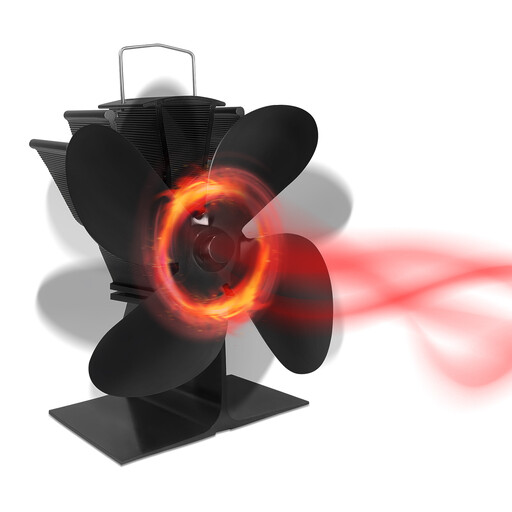
Why this choice suits this profile: This cordless fireplace fan is aimed at those who want to try a simple solution for better heat distribution from a wood stove.
Its electricity-free operation prevents you from mistaking it for a standard mains-powered ventilation fan.
A design made for stoves, wood burners and fireplaces; no cables to install.
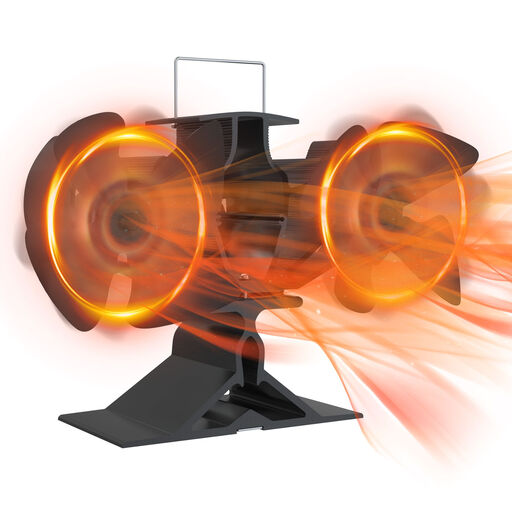
Why this choice suits this profile: This variant is for those comparing several LZQ formats and looking for a discreet integration around the stove.
The listing clearly states it is intended for the heat of a stove or fireplace, not for use as a multi-purpose air blower.
No plug required; design focused on circulating warm air around the hearth.
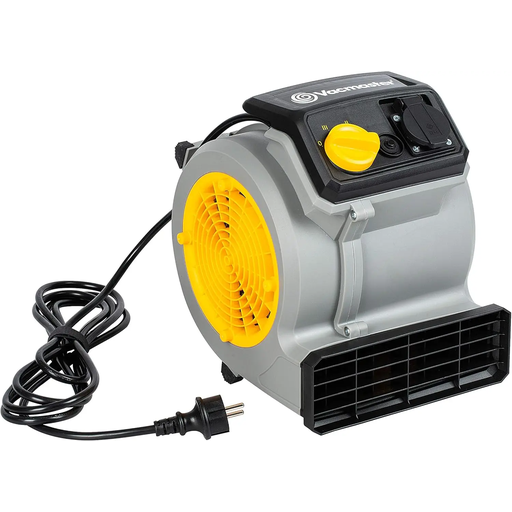
Why this choice suits this profile: This air circulation fan is aimed at garages, workshops, gyms, cellars and drying sites where a measurable airflow is needed.
Its 245 l/s airflow, three speeds and adjustable tilt clearly indicate a ventilation use, very different from that of an electricity-free model.
124 W; three speeds; tilt up to 45°; built-in socket to daisy-chain up to 12 units.
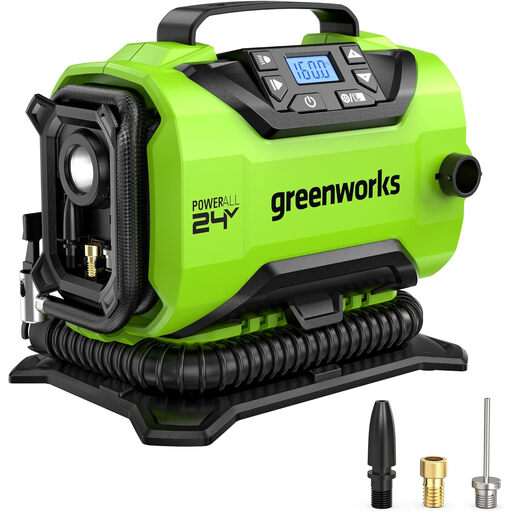
Why this choice suits this profile: This cordless air pump is made for inflating car tyres, bike or camping gear, and for workshop tasks – not for circulating heat.
It does not claim to replace a stove fan: its 11 bar pressure, adaptors and intended use are all about inflation.
Auto shut-off, digital display, three adaptors and a 0.5 m hose; Greenworks 24 V battery not included.
Yes. A thermodynamic model uses the heat from the stove’s surface to drive its mechanism. It does not generate additional heat and does not replace the heating system. Its operation depends on the stove’s temperature, the chosen location and the model’s characteristics.
Place it only on a stable surface of the stove, following the instructions and the areas recommended by the manufacturer. Do not install it directly on the flue, in front of the loading door or on any part that might exceed the intended usage limits. The grilles and blades must remain completely unobstructed.
A wood stove fan without electricity consumes no energy from the grid. However, a 124 W electric fan uses electricity depending on how long it runs, while a cordless pump draws from its battery. To compare costs, look at the wattage, the usage time and, for battery-powered devices, the capacity and the price of a potential replacement.