
Livraison le jour même ou le lendemain

Qualité garantie

Débloquez vos offres de bienvenue: Livraison GRATUITE | Jusqu'à -80 % | 30 jours d'essai gratuits à JoyPlus
Téléchargez l'application
A wireless lavalier microphone can transform a video recorded on your smartphone, an interview or a presentation. But a well-written product description does not necessarily guarantee a trouble-free experience. Unclear compatibility, optimistic battery life or noise reduction promoted without further detail: there are plenty of potential surprises.
Before choosing a wireless lapel mic, focus on three criteria:
A compact design does not automatically mean versatility. The right choice depends on your device, your surroundings and how you plan to record.
For a wireless microphone for smartphones, the receiver’s connector is a key consideration. A model with an iOS interface is designed for compatible Apple devices, while a universal interface may work with several configurations. Check your phone’s port: USB-C, Lightning or a dedicated audio input.
With a camera, computer, speaker or mixing desk, 3.5 mm jack and 6.35 mm jack connections are still very common. A Bluetooth wireless microphone is not necessarily compatible with a wireless system equipped with its own receiver, either. The Bluetooth 5.0 label indicates the technology version, but you should still check compatibility with your equipment.
Wireless systems do not all use the same technology. A 2.4 GHz transmission can, for example, offer a stated range of up to 30 metres in an open area, as with the Muse Wireless Microphone. Indoors, this distance can quickly decrease because of walls, furniture and other sources of interference.
When filming outdoors, a wireless lavalier microphone supplied with a wind muff or wind-noise protection will often be more practical. Conversely, for live streaming in a quiet room, straightforward set-up may matter more than maximum range.
A rechargeable microphone should be able to get back into action quickly between sessions. Check the stated operating time, charging method and whether a charging case is included. The Verbex models featured below claim between 3 and 6 hours of battery life, while the Muse promises up to 8 hours.
A battery-life figure described as ‘up to’ always relates to specific usage conditions. For a class, event or lengthy interview, allow yourself a safety margin and check whether the microphone can be charged independently. Also store the device in a dry place at a moderate temperature, following the manufacturer’s recommendations.
The number of transmitters deserves particular attention. A creator filming alone may prefer a lightweight set. For a microphone for interviews, a dual wireless microphone lets you record two people, provided that the receiver and app being used properly support this configuration.
Noise reduction and a wind muff can be useful in certain situations, but they will not eliminate every unwanted sound. A room with an echo, strong gusts or a nearby sound source can still degrade the recording. Position the microphone close to your mouth, avoid it rubbing against clothing and carry out a quick test before going live.
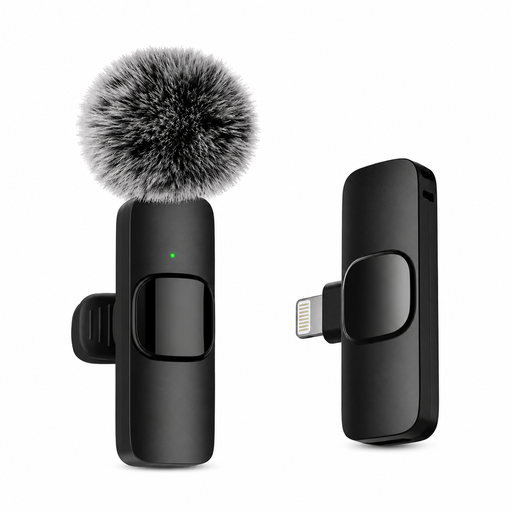
Why this choice suits this profile : Compact and easy to use, this wireless microphone is ideal for anyone starting out with live streaming, vlogging or interviews on an Apple device with a compatible iOS interface.
The description clearly specifies an iOS interface, reducing the risk of mistakenly choosing a model designed for an Android smartphone. Its single-microphone format also means you do not pay for a second transmitter that would simply sit unused in a drawer.
Stated noise reduction and wind protection, Bluetooth 5.0, a listed weight of 78 g and claimed battery life of 3 to 6 hours.
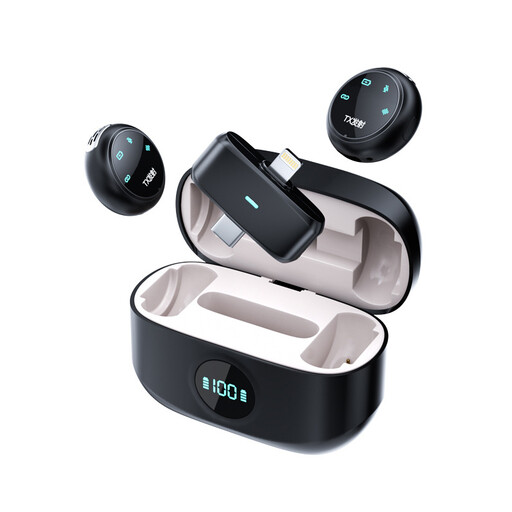
Why this choice suits this profile : With its two microphones, this model is aimed at creators who switch between filming solo, two-person conversations and live content.
The second transmitter means you do not need to invest in another device for interviews. The magnetic charging case makes storage simpler and lets you top up the battery between uses.
Two microphones, magnetic charging case, stated noise reduction and wind protection, with an interface listed as compatible with Android and Apple devices.
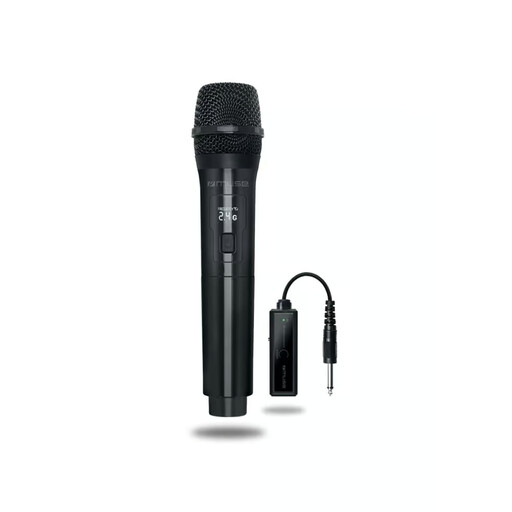
Why this choice suits this profile : This model is designed for presentations, performances and conferences, as well as audio set-ups requiring a jack connection to a console, amplifier or speaker.
The inclusion of 6.35 mm and 3.5 mm jack connectors reduces uncertainty when connecting to audio equipment. As the stated range is measured in an open area, you can set more realistic expectations for indoor use.
2.4 GHz transmission, stated range of up to 30 metres in an open area, built-in rechargeable battery offering up to 8 hours of battery life and a white LED display.
We have selected a comprehensive, real-time updated range of products that meet these demanding criteria, as well as European safety regulations.
Start by identifying the type of interface on the receiver. Connect it to the appropriate port, switch on the transmitter and receiver, then start pairing if the model requires it. Before live streaming, make a recording of a few seconds to check the sound level and ensure that no rubbing or handling noise is affecting the recording.
The models in this selection claim between 3 and 6 hours for the Verbex references, and up to 8 hours for the Muse Wireless Microphone. Battery life varies depending on usage. For a full day of filming or a conference, charge the equipment in advance and keep the case or suitable cable close at hand.
No. Noise reduction can lessen certain sounds, but it cannot replace careful positioning, a wind muff or a reasonably quiet environment. For an outdoor vlog or interview, test the sound on location before you start recording.