
Livraison le jour même ou le lendemain

Qualité garantie

Débloquez vos offres de bienvenue: Livraison GRATUITE | Jusqu'à -80 % | 30 jours d'essai gratuits à JoyPlus
Téléchargez l'application
Whether you're planning an outing, tending to your garden, or simply optimising your indoor comfort, accurately predicting the local weather has become a daily habit. A modern wireless weather station does more than just display the temperature; it acts as a personal assistant and can even be a decorative piece. But with an overwhelming number of options on the market, it can be hard to know where to start. This guide is here to break down the essential criteria and present our selection of the best models to help you make an informed decision.
Before you buy, a few technical points deserve your attention. These are the features that will make all the difference in your day-to-day use.
The sensor is the heart of any indoor/outdoor weather station. Wireless technology, most often operating on the 433?MHz frequency, offers great installation flexibility. Be sure to check the advertised range (typically between 30 and 100 metres in an open field), keeping in mind that thick walls or metal frames can significantly reduce it. To ensure reliable measurements, the outdoor sensor should be placed away from direct sunlight and heavy rain.
The era of stark, monochrome screens is over. A colour weather station with a good-sized LCD screen offers immediate reading comfort. Information, often organised into blocks (indoor, outdoor, forecast), can be viewed at a glance. Design is also a key factor: a designer weather station with a wood-effect finish or clean lines will blend seamlessly into your home's decor.
Your needs will determine which type of station is right for you.
Our editors have reviewed several models to bring you a selection that combines features, design, and practicality for everyday use.
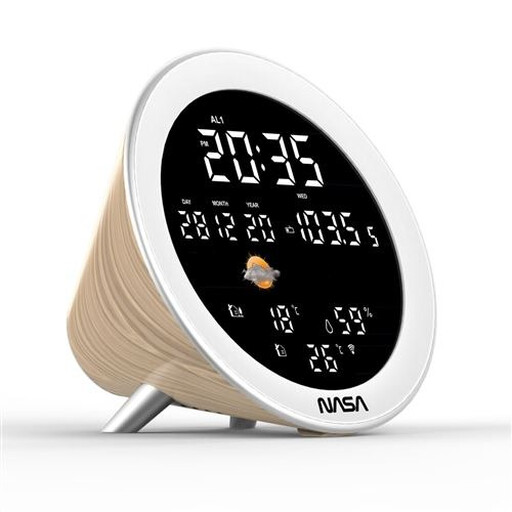
Why it stands out: This model is distinguished by its large 5.7-inch colour touchscreen and elegant dark wood-effect finish. It's as informative as it is decorative, proudly featuring the official NASA logo.
Pros:
Who is it for? Ideal for technology and space exploration enthusiasts looking for a device that is as functional as it is stylish for their living room or office. Its sophisticated design also makes it an excellent gift idea.
See details for the Nasa WSP1700 station
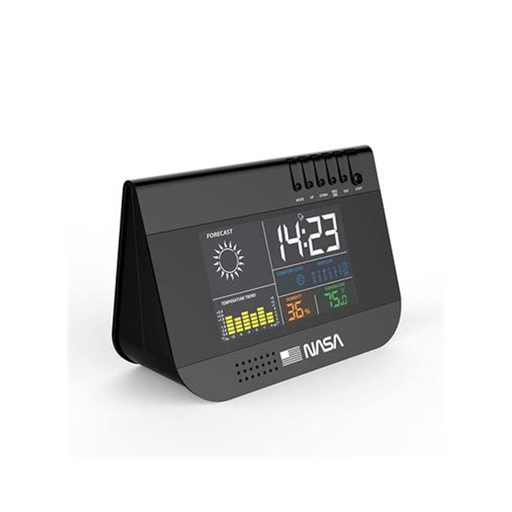
Why it stands out: The WS100 focuses on compactness and simplicity. It provides essential indoor climate information in an ultra-discreet format that fits anywhere.
Pros:
Who is it for? Designed for those who want to monitor the comfort of a single room (bedroom, office, wine cellar) without the hassle of an outdoor sensor. Its simplicity and low price make it an excellent entry-level model.
Discover the NASA WS100 station
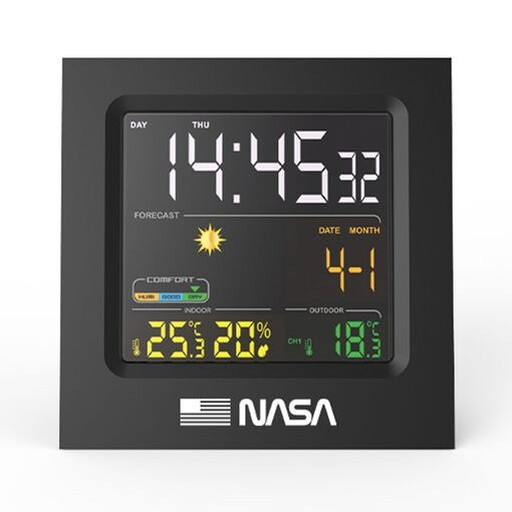
Why it stands out: This model is for users seeking comprehensive data. Its multi-function outdoor sensor provides a detailed overview of local weather conditions.
Pros:
Who is it for? Recommended for gardeners, weather enthusiasts, and anyone who wants precise, detailed information about their microclimate, going far beyond just the temperature.
Explore the Nasa WS300 station
Our selection focuses on models that represent the most common needs. If you are looking for other types of devices, such as connected stations or different designs, feel free to browse our full catalogue.
Explore our selection of electronic devices
1. Where should I place the outdoor sensor for a wireless weather station? For accurate measurements, install the sensor in a shaded, well-ventilated area, about 1.5 to 2 metres off the ground. Avoid proximity to heat sources (sun-drenched walls, air conditioning vents) and direct exposure to rain to ensure its longevity and the reliability of the data.
2. What is the difference between a basic weather station and a more comprehensive model? A basic model focuses on indoor and outdoor temperature and humidity. A more comprehensive station, like the Nasa WS300, adds sensors for wind (anemometer), rain (rain gauge), and sometimes atmospheric pressure or the UV index. This provides more refined home weather forecasts and valuable data for activities like gardening or sports.
3. Are NASA-branded weather stations professional devices? The products featuring the NASA logo presented here are officially licensed items intended for the general public. They are designed to offer reliable measurements and a quality user experience in a domestic setting. They are not scientific or professional-grade meteorological instruments, whose requirements and costs are on a completely different scale.