
Livraison le jour même ou le lendemain

Qualité garantie

Débloquez vos offres de bienvenue: Livraison GRATUITE | Jusqu'à -80 % | 30 jours d'essai gratuits à JoyPlus
Téléchargez l'application
Whether you're anticipating a sudden shower to bring in the laundry, adjusting the heating for optimal comfort, or simply satisfying your curiosity about your garden's microclimate, the wireless weather station has become an invaluable ally in many homes. It provides local data with remarkable accuracy, far more reliable than generalized forecasts.
Faced with an overwhelming number of options, it can be difficult to know where to start. This guide is here to break down the criteria that truly matter and introduce you to a selection of proven models. The goal: to help you make the right choice, without the unnecessary marketing jargon.
Before you take the plunge, let's look at the few technical points that will make all the difference in your daily use.
The reliability of your station depends entirely on its outdoor sensor. This is the unit that measures temperature and humidity and transmits them wirelessly to the indoor base. Make sure it is weatherproof. For reliable measurements, it is crucial to place it away from direct sunlight and heavy rain. The signal range is also a key point, especially in a large house or if thick walls separate the sensor from the station.
The screen of a digital weather station must be easy to read at a glance. Beyond temperatures and humidity levels, certain features genuinely enhance the experience:
Certain details can make life much easier. A radio-controlled clock (via the DCF signal in Europe) is a real convenience: it sets itself and manages daylight saving time changes without you having to do anything. Also, consider the power source: battery-powered models offer complete flexibility, while a mains adapter (sometimes optional) ensures a continuously backlit display.
To guide you, we have selected three models that cater to various needs and budgets.
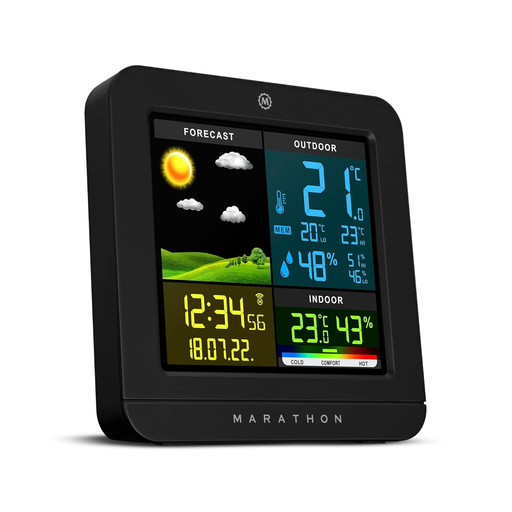
What sets it apart
The Berlin model stands out with its large colour LCD screen that organises information in a highly visual way. The weather forecast is illustrated by 5 clear icons, making it particularly intuitive to read upcoming trends. It's a true climate dashboard for your home.
Key Features
Who is it for?
Ideal for those looking for a complete and stylish station to place in a living area like the living room or kitchen, where its colour screen will be perfectly showcased.
See the Marathon Berlin on Joybuy.fr
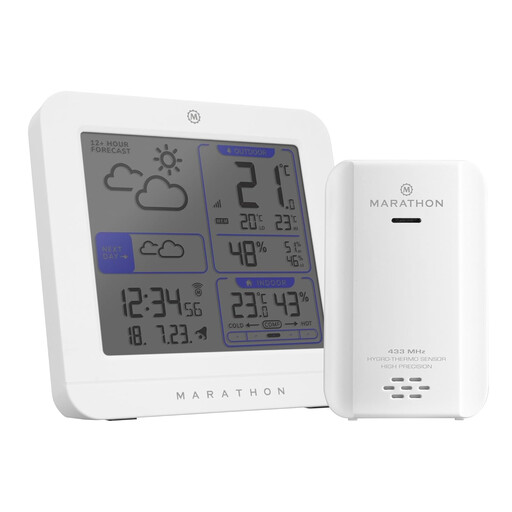
What sets it apart
The Paris model focuses on a clean, compact design. Its white colour and small footprint allow it to blend in discreetly with any interior, whether on a bedside table, a desk, or a shelf.
Key Features
Who is it for?
Perfect for users who prioritise functionality and discretion. Its compact size makes it an excellent choice for bedrooms, offices, or apartments where space is at a premium.
See the Marathon Paris on Joybuy.fr
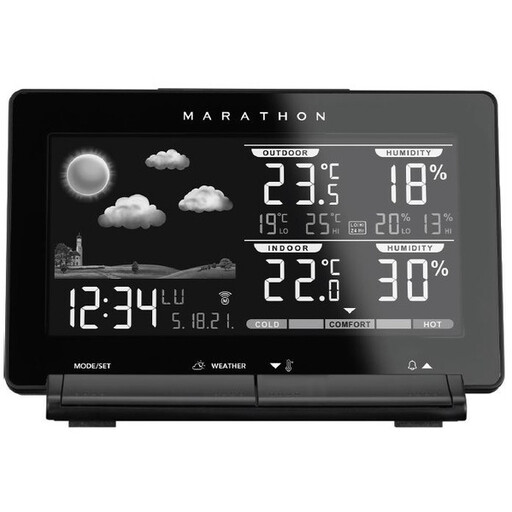
What sets it apart
Very similar to the Paris model, the Lisbon station focuses on the fundamental functions of a wireless thermometer-hygrometer. It gets straight to the point by providing essential data reliably and clearly on its crisp digital screen.
Key Features
Who is it for?
A recommended option for beginners or those looking for a simple, reliable device to monitor basic conditions at home, in a garage, or a workshop.
See the Marathon Lisbon on Joybuy.fr
If these models don't check all your boxes or if you're looking for more advanced features (Wi-Fi connectivity, anemometer, rain gauge, etc.), feel free to explore further.
Discover our full range of weather stations and sensors to find the model that's right for you.
For reliable measurements, the sensor should be installed away from direct sunlight and rain. The ideal location is under an eave or on a north-facing wall, about 1.5 to 2 metres (5-6.5 feet) off the ground. Avoid proximity to heat sources (vents, air conditioners, etc.) at all costs.
Most home weather stations use a built-in barometer. They don't analyse regional maps but instead detect changes in local atmospheric pressure. Rising pressure suggests an improvement (sun), while falling pressure indicates a possible downturn (clouds, rain). It is therefore a very short-term trend forecast, hyper-localised to your microclimate.
Yes, almost all models sold in Europe receive the DCF77 signal broadcast from Frankfurt, Germany. This signal covers a vast area of Europe. Synchronisation happens automatically (often at night) to ensure the time is always accurate to the second.