
Livraison le jour même ou le lendemain

Qualité garantie

Débloquez vos offres de bienvenue: Livraison GRATUITE | Jusqu'à -80 % | 30 jours d'essai gratuits à JoyPlus
Téléchargez l'application
Having your own wireless weather station at home means you no longer have to rely on national forecasts that are often too vague for your specific neighbourhood. The exact temperature in your garden, the humidity level in your basement, the risk of frost for your plants... local data will no longer hold any secrets for you. But be warned: the market is flooded with models that make tempting promises but quickly lead to disappointment once unboxed. Our guide is here to help you avoid the common pitfalls and invest in a device that will truly be useful.
Before diving into the technical specifications, let's review the most common disappointments faced by uninformed buyers.
To find the model that's right for you, focus on a few key parameters rather than on gimmicks.
The main purpose, of course, is to measure temperature and humidity. A basic indoor/outdoor weather station comes with a single wireless thermo-hygrometer to be placed outside.
However, if you want to monitor several areas (a baby's room, greenhouse, garage, wine cellar, etc.), choose a model that can handle multiple sensors simultaneously. Check how many probes are included and how many can be added later. Accuracy is also a key factor; for home use, an error margin of +/- 1°C for temperature and +/- 5% for humidity is an excellent benchmark for quality.
The type of screen has a direct impact on your user experience.
Certain options provide a real everyday advantage:
Rather than an endless list, we have selected three models that meet specific needs and cleverly avoid the pitfalls we've just described.
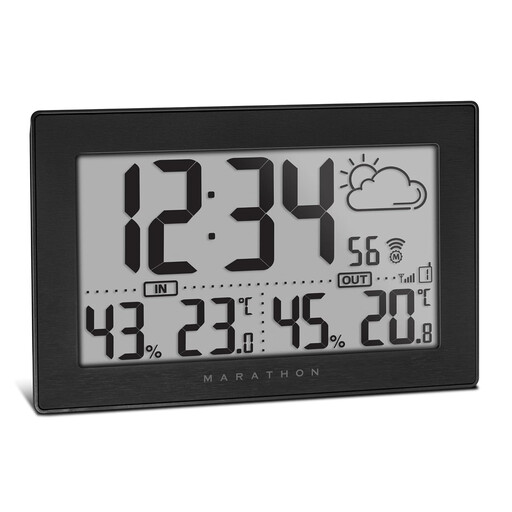
Editor's Verdict: Perfect for families or homeowners who want to keep an eye on multiple areas. Kids' room, wine cellar, conservatory... place the sensors wherever you want and view all the data on a single screen.
This model was designed from the ground up to manage multiple sensors. The connection is stable and the interface is clear for navigating between zones, unlike many competitors who offer a tacked-on, unreliable feature.
Expandable: Supports up to 3 sensors in total. Large LCD Screen: All data is readable at a glance, without having to juggle menus.
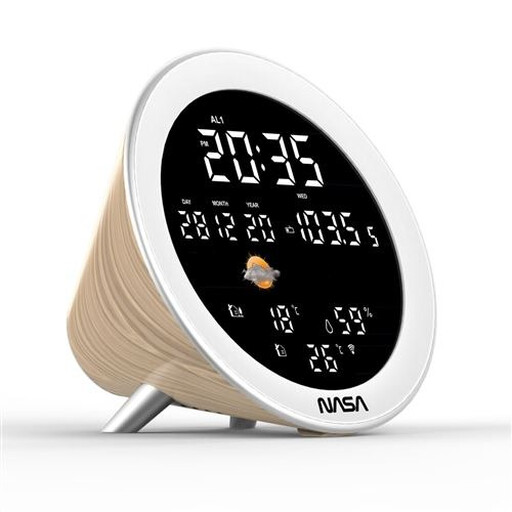
Editor's Verdict: For those who want a device that is as beautiful as it is powerful. With its wood-effect finish and large colour touchscreen, it will easily find its place on a desk or in a contemporary living room.
It avoids the power-hungry colour screen trap thanks to its dual power supply. Plug it into the mains with the included adapter for a permanent display, without ever worrying about batteries.
5.7" Colour Touchscreen: Smooth navigation and a very clear display. Sleek Design: Its dark wood finish blends elegantly into most interiors.
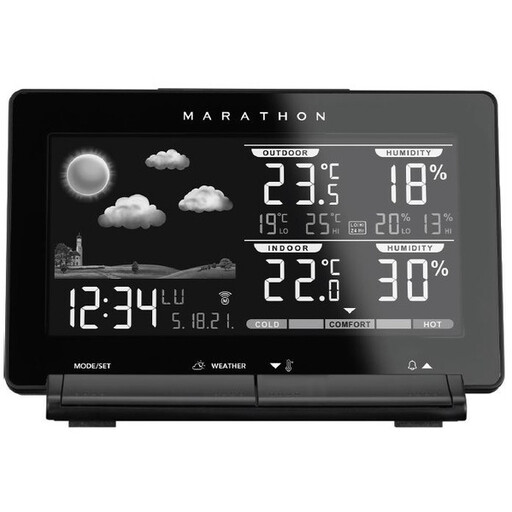
Editor's Verdict: The sensible choice for those who want reliable information without unnecessary frills. It does everything you ask of it, and it does it well: temperature and humidity (in/out), weather trend, and always-accurate time.
Unlike many entry-level models, its radio-controlled clock function is truly reliable in Europe. Its monochrome LCD screen is incredibly efficient: battery life is measured in months, not weeks.
Radio-Controlled Clock (Europe): The time is always right, including daylight saving changes. Comfort Level Indicator: A simple icon tells you if the ambient air is healthy, too dry, or too humid.
We've put together a complete selection of products that meet our criteria for reliability and performance.
For reliable measurements, the outdoor sensor should be placed in a shaded area and sheltered from direct rain. Avoid positioning it in direct sunlight, against a wall that retains heat, or near a heat source (like an air conditioning unit). Ideally, place it at a height of 1.5 to 2 metres off the ground.
Battery life varies enormously from one model to another. Expect between 12 and 24 months for an outdoor sensor. For the main unit with a monochrome LCD screen, the battery life is generally similar. Conversely, a colour screen station on batteries will only last a few weeks (or even days!) if its screen is often on.
Yes, but only for a very short-term local trend (the next few hours). The icons (sun, clouds, rain) are deduced from the rise or fall in atmospheric pressure. If the pressure drops rapidly, the station will display a rain symbol. It's a good indicator of an imminent change in weather, but it will never replace the detailed forecasts from a professional weather service.