
Livraison le jour même ou le lendemain

Qualité garantie

Débloquez vos offres de bienvenue: Livraison GRATUITE | Jusqu'à -80 % | 30 jours d'essai gratuits à JoyPlus
Téléchargez l'application
Achieving a pristine lawn is a chore that demands time and energy. The wireless robotic lawnmower has become the dream solution for garden owners who want a perfect lawn and free weekends. The problem: the market is saturated with technological promises that, once in your garden, can be a major disappointment. Navigating the jungle of models and spec sheets often feels like an uphill battle.
As a product selection expert at Joybuy, my role is to help you cut through the technical jargon to make the right choice. Here are the most common pitfalls to avoid and the essential criteria to scrutinise before you pull out your credit card.
The myth of "zero-effort" installation: The absence of a boundary wire is a major advantage, but it doesn't always mean instant setup. Poor GPS reception due to walls or dense trees can quickly turn the initial mapping into a real headache. The "plug-and-play" promise often shatters when faced with the specifics of your terrain and the onboard navigation technology.
The overuse of the term "AI": Marketing departments throw the term "Artificial Intelligence" around for everything. Yet, there's a world of difference between an AI robotic lawnmower with true computer vision (capable of identifying and avoiding a toy or a pet) and a basic model that just uses contact sensors to change direction after a collision. Paying extra for superficial "AI" is a classic mistake.
Underestimating your garden's complexity: Many robots promise to cover large areas, but their performance plummets on terrain that is out of the ordinary. The ability to climb slopes (slope-climbing robotic lawnmower), navigate narrow passages, or manage multiple, unconnected lawn areas are decisive criteria. An unsuitable model will spend its time getting stuck or will miss entire sections of your garden.
To ensure you don't make a mistake, focus on the technical features that truly match the specifics of your garden.
This is THE deciding factor for a boundary wire-free robotic mower. Two technologies dominate the market:
The recommended area is a good starting point, but you need to dig deeper:
A connected robotic lawnmower should offer much more than a simple remote on/off button. A mobile app worth its salt must at least allow you to:
Here are a few models that stand out from the crowd with their technical specs, suited for different needs and garden types.
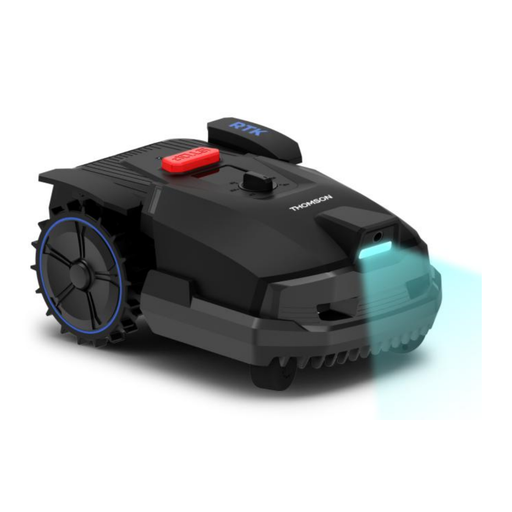
Who is it for? Ideal for owners of standard-sized gardens (up to 800 m?) looking for a modern, easy-to-install solution. Its dual navigation technologies make it highly versatile for most layouts.
It doesn't fall for the "AI" marketing gimmick. It features a true AI camera paired with RTK navigation, a dual guarantee for precise mapping and reliable obstacle detection.
Simplified installation with no boundary wire. Full control via the MowMate app (Wi-Fi and Bluetooth), with automatic return to the charging station.
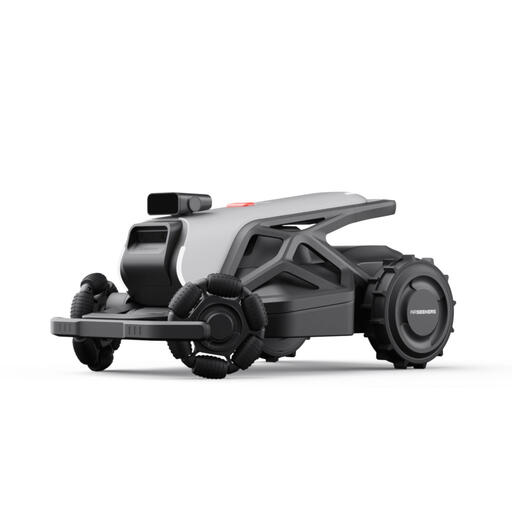
Who is it for? Designed for owners of large properties (up to 1,800 m?) and uneven gardens. Its ability to tackle the steepest slopes makes it a top choice for the most demanding layouts.
It tackles the complex terrain pitfall head-on. Its spec sheet makes a bold statement: it can climb slopes up to 65% (33°), a figure that speaks for itself and positions it as the champion of difficult terrains.
Powerful navigation that combines a 140° AI vision, VSLAM, and nRTK for formidable precision. Its FlowCut 3-in-1 mowing system ensures perfect mulching to naturally fertilise the lawn.
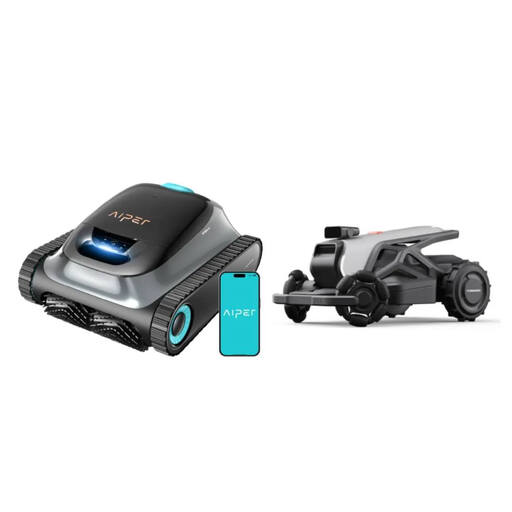
Who is it for? For smart home enthusiasts who dream of 100% automated outdoor maintenance. This bundle handles both the lawn and the pool, an all-in-one solution for complete peace of mind.
This bundle doesn't just make one promise; it addresses a holistic need: complete garden automation. No more disappointment from having to handle other manual chores.
Two specialised, high-performance devices for comprehensive outdoor maintenance. The pool robot and lawnmower are controlled via their respective apps for simplified management.
If, after consideration, maintaining a natural lawn—even an automated one—still seems too demanding, there are durable alternatives for a pristine garden all year round.
Discover our selection of artificial turf for a pristine garden all year round, with zero effort.
It all depends on its navigation technology. A model that relies solely on the GPS/RTK signal will struggle if the tree canopy is dense, as it can block the satellite connection. For this type of garden, it is highly recommended to opt for a hybrid model that combines RTK with camera-based navigation (VSLAM). The latter takes over as soon as the GPS signal weakens, ensuring an uninterrupted mow.
A well-maintained robotic lawnmower can last for many years. The quintessential wear-and-tear component is the battery, whose lifespan is measured in charge cycles (often around 800 cycles before its capacity begins to noticeably decrease). A crucial point to check before buying: ensure the battery is easily replaceable. This guarantees you can extend the life of your device at a lower cost when the time comes.
Yes, installing a wireless model is much simpler than one with a boundary wire, but it does require some initial setup. You just need to place the charging station in a strategic location, let the robot fully charge, and then launch the first mapping session from the app. The robot will then travel around the perimeter of your lawn to create its virtual map. Just allow for a little time to get used to this step and to later fine-tune the mowing zones or exclusion areas.