
Livraison le jour même ou le lendemain

Qualité garantie

Débloquez vos offres de bienvenue: Livraison GRATUITE | Jusqu'à -80 % | 30 jours d'essai gratuits à JoyPlus
Téléchargez l'application
A flawless lawn, mown to perfection without lifting a finger: the promise is certainly appealing. This is the whole point of a wireless robotic lawnmower: no more perimeter wire to bury, installation is done in a flash, and autonomy is guaranteed. The problem? The market is flooded with models making enticing marketing promises that often fall short in real-world conditions. Before you take the plunge, it's essential to know how to distinguish true innovations from purely promotional claims.
To make the right choice, let's start by identifying the most common pitfalls. Here are the most frequent disappointments among users:
To avoid these traps, you need to focus on the few technical specifications that truly make a difference. These are what separate an overpriced gadget from a genuine ally for your garden.
The heart of the matter is the navigation technology. Where 100% GPS-based systems fail due to their lack of reliability, LiDAR technology is a game-changer.
A LiDAR robotic lawnmower scans its environment with a laser to create an ultra-precise 3D map. This technology offers very tangible advantages:
If your garden has any inclines, slope management is not an optional feature. Check the maximum supported slope, expressed as a percentage (%). For uneven terrain, aim for at least 45% (or 24°)—this is an excellent benchmark. All-terrain tyres and good traction control are then essential to ensure a solid grip and prevent slipping.
Also, be wary of the advertised maximum mowing area (e.g., 1500 m? robotic lawnmower). Make sure this value corresponds to the complexity of your garden, not just its raw surface area.
A connected GPS (or LiDAR) lawnmower must offer an intuitive and comprehensive mobile app. Essential features to look for include:
Rather than a long list, we prefer to highlight one model that ticks all the boxes in terms of performance, reliability, and simplicity for owners of complex gardens.
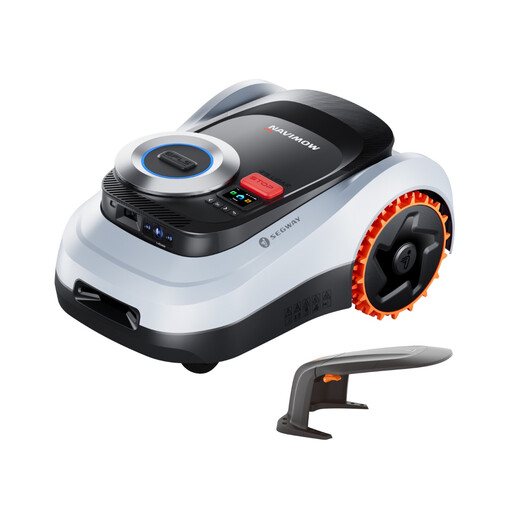
Why it stands out: Built for large gardens (up to 1500 m?) and difficult terrain, this model meets the expectations of the most demanding users. Its ability to climb slopes up to 45% and its state-of-the-art navigation make it an ideal solution for complex layouts, while its app and compatibility with voice assistants will appeal to tech enthusiasts. The numerous reviews for the Navimow i215 also confirm its incredibly simple installation.
This model overcomes the classic pitfalls thanks to its dual LiDAR + Vision navigation technology. The result is reliable mapping without depending on a random GPS signal or an external antenna. Designed for sloped terrain, it will save you the disappointment of a robot that gives up at the first hill.
100% wireless and antenna-free installation. Handles slopes up to 45% with all-terrain tyres. Precise obstacle detection thanks to AI-powered vision (VisionFence).
We have selected other products that meet our high standards for performance and current safety regulations.
Generally, a robotic lawnmower has a lifespan of 5 to 10 years, depending on the quality of the model and its maintenance. The main consumable part is the battery, which often needs to be replaced after 3 to 5 years. Regular cleaning, changing the blades, and storing it in a sheltered place during the winter are key to making it last.
Yes, and that's one of the major advantages of LiDAR technology. Unlike camera-based systems, LiDAR uses a laser to analyse its environment and therefore works with the same efficiency in complete darkness. This gives you total flexibility to schedule mowing times, including at night so as not to disturb anyone.
Yes, the installation is much simpler than with older, wired models. There's no need to dig trenches or unroll a cable over hundreds of metres. You simply steer the robot once along the borders of your lawn using the smartphone app. The robot then saves the virtual map of the area to be mown. The entire process rarely takes more than an hour.