
Livraison le jour même ou le lendemain

Qualité garantie

Débloquez vos offres de bienvenue: Livraison GRATUITE | Jusqu'à -80 % | 30 jours d'essai gratuits à JoyPlus
Téléchargez l'application
A wireless microphone can make interviews, smartphone videos and live broadcasts much easier. The problem is that product specifications often focus on range, noise reduction or battery life without explaining the conditions in which these figures are achieved. To avoid a disappointing purchase, it is best to start by checking compatibility, the type of transmission and the controls available.
A range of ‘up to 30 metres’ generally refers to an unobstructed space. In a home, classroom or busy street, walls, people and other radio devices can affect signal stability. A 2.4 GHz wireless microphone is suitable for many uses, but it is still best to keep the transmitter and receiver reasonably close together.
A smartphone microphone does not necessarily use the same connector as a model designed for a camera or computer. A USB-C wireless microphone is convenient with a recent phone, tablet or certain computers, provided you check that the USB-C port supports audio input.
For a camera, speaker or mixing desk, 3.5 mm or 6.35 mm jack connectors may be essential. An adaptor does not always guarantee sound transmission or correct power for the receiver.
A microphone with noise reduction can minimise certain background sounds, but it can never replace a quiet room and careful positioning. In an already quiet environment, this feature may even alter the tone of your voice. Being able to switch it off is therefore a real advantage, depending on the recording environment.
When filming a video with a smartphone, a kit containing the transmitter, USB-C receiver and charging case avoids the need for multiple connections. For a streaming microphone, a wired USB model may be easier to set up on a computer, with no battery or radio connection to manage.
In particular, check:
A rechargeable microphone should cover the usual duration of your sessions. An advertised battery life of up to 8 or 9 hours may be enough for several lessons, meetings or filming sessions, but it varies according to the conditions of use and transmission power. For long recording sessions, a charging case or replaceable battery provides greater flexibility.
Remember to check the charging time, battery-level indicator and whether the system can be recharged between takes. An integrated battery should be protected from moisture, heat and knocks.
A wireless lavalier microphone clips close to your mouth and leaves your hands free. It is particularly suitable for interviews, presentations and videos filmed while moving. However, the clip and cable must not rub against your clothing: even the slightest unwanted noise can be picked up by the capsule.
For a USB microphone, a directional capsule, mute button and headphone output can make calls, podcasts or gaming easier. The sampling rate and resolution, such as the 24-bit / 96 kHz offered by some models, provide useful indications, but they are not enough to predict how the microphone will sound in a reverberant room.
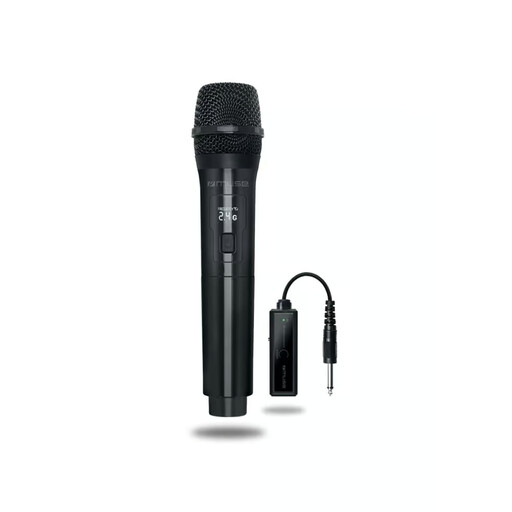
Why this choice suits this profile : Its 2.4 GHz transmission and 3.5 mm and 6.35 mm jack connections allow it to connect to a range of audio equipment for speeches, events or straightforward recordings.
The dual connectivity prevents you from choosing a device based solely on its range without checking how it connects. However, the advertised range of up to 30 metres should be understood as a figure achieved in an unobstructed space.
2.4 GHz transmission, integrated battery advertised to last up to 8 hours and white LED display.
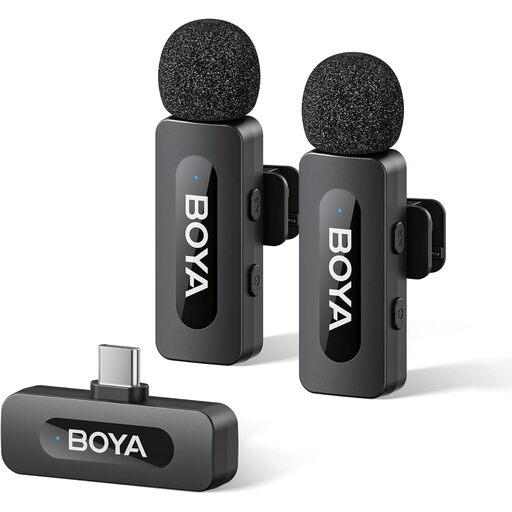
Why this choice suits this profile : Its two transmitters and USB-C receiver are suitable for two-person interviews, vertical videos and recordings made with a compatible smartphone.
USB-C compatibility is clearly defined, and noise reduction can be activated with a single press. Even so, check your phone’s port and settings before buying.
2 TX + 1 RX configuration, one-touch noise reduction and battery life advertised to last up to 9 hours.
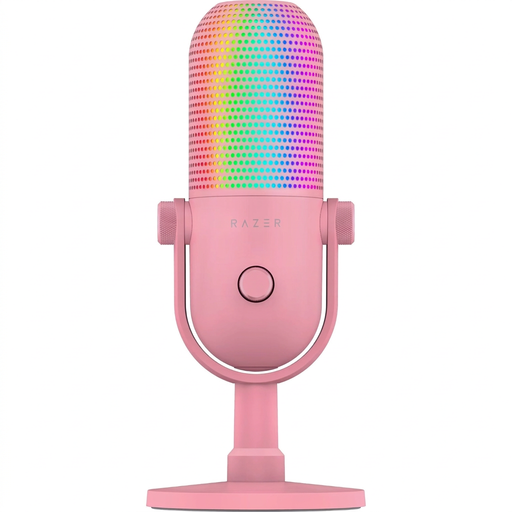
Why this choice suits this profile : This desktop USB microphone is aimed at streamers, gamers and video-conferencing professionals who want to stay in control of their sound while enjoying customisable lighting.
The mute button, headphone monitoring and shock mount reduce the need for adjustments, as well as noise transmitted through the desk. Please note that this is a wired model, not a wireless microphone.
USB, hypercardioid directionality, 24-bit / 96 kHz audio and Razer Chroma RGB lighting.
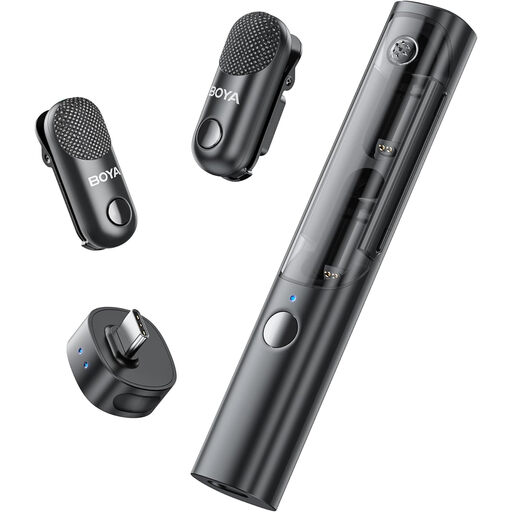
Why this choice suits this profile : Its two transmitters, USB-C receiver and charging case are suitable for regular filming, interviews and audio recording with a compatible camera or mobile device.
The case keeps all the components together and recharges them. Noise reduction can be disabled in a treated room, in line with the product’s safety instructions.
2 TX + 1 RX configuration, transformable design and USB-C charging case.
We have put together a complete, real-time updated list of products that fully meet these strict selection criteria and European safety regulations.
Position a wireless lavalier microphone a few centimetres from your mouth, without covering it with clothing. For a desktop microphone, point the front towards you and keep it away from your keyboard, fans and highly reflective surfaces.
Before a live broadcast or podcast, check:
Clean the equipment with a soft, dry cloth. Avoid water, abrasive products and extreme temperatures. Electrical and electronic equipment must be disposed of through a suitable collection scheme, in accordance with local regulations.
Insert the receiver into the compatible port, switch on the transmitters, then select the microphone as the audio source in the app you are using. With a USB-C model, check that your phone allows external audio input and that the connector is not obstructed.
For a short interview, a few hours may be enough. For a full day of filming, choose a kit with a charging case, battery indicator and two transmitters. Leave some spare capacity, as advertised battery life always depends on the conditions of use.
Yes, if you mainly work from a computer. A USB microphone eliminates the need to manage a radio connection and may include volume controls, a mute function and headphone monitoring. For filming on the move, a USB-C wireless microphone or wireless lavalier microphone will generally be more convenient.