
Livraison le jour même ou le lendemain

Qualité garantie

Débloquez vos offres de bienvenue: Livraison GRATUITE | Jusqu'à -80 % | 30 jours d'essai gratuits à JoyPlus
Téléchargez l'application
A wireless microphone can make a street interview, a smartphone livestream or a video call from home far easier. However, product pages often list specifications that are difficult to compare: “noise reduction,” “universal connectivity,” advertised battery life or compatibility with multiple devices.
To avoid unpleasant surprises, pay particular attention to the connectors, the number of microphones and real-world usage conditions. Here are the key criteria to consider before choosing a wireless lavalier microphone, a streaming microphone or a kit designed for interviews.
A microphone may be advertised as compatible with iPhone and Android while still requiring a different receiver depending on the phone’s port. Recent devices generally use USB-C, while some iPhones and older equipment require a Lightning interface or a dedicated audio input.
Before placing your order, check the following:
A product page mentioning a “universal interface” therefore deserves a careful review of its technical specifications.
The term microphone with noise reduction may refer to electronic processing or a design that attenuates certain ambient sounds. It does not guarantee that nearby conversations, wind or traffic will disappear entirely.
For outdoor filming, also look for:
On a busy street, microphone placement often matters just as much as the feature highlighted on the product page.
An advertised battery life of 3 to 6 hours may be sufficient for a short interview but prove limiting during a full day of filming. With a dual wireless microphone, check whether this figure applies to each transmitter, the receiver or the complete kit.
A magnetic charging case makes storage easier and lets you recharge between takes. You should also check the included cable, charging time and whether the battery level can be monitored.
Compact microphones use several connection methods. Some kits designed for phones work with a receiver that plugs directly into the device’s port. Others use 2.4 GHz transmission and a receiver that connects to a speaker, mixing console or camera.
The Muse Wireless Microphone, for example, is listed with 2.4 GHz transmission, an advertised range of up to 30 metres in open space, and 6.35 mm and 3.5 mm jack connectors. This configuration is better suited to presentations, events and audio equipment with a jack input than to a wireless microphone for smartphones.
A single microphone is suitable for one person filming face-to-camera content or making calls. For an interview, discussion or video featuring two speakers, a dual wireless microphone eliminates the need to share a single transmitter.
However, check whether the two audio tracks are recorded separately or mixed directly. This will affect audio editing and your ability to adjust each voice after filming.
A lavalier microphone with a clip attaches discreetly to clothing. It is particularly well suited to presentations, vertical videos and interviews on the move. A desktop USB microphone is a better fit for podcasts, gaming or streaming from a fixed computer setup.
The Elgato Wave:3 MK.2 is a wired USB microphone, not a wireless model. Its product page notably lists Clipguard 2.0 and Auto Gain. It can therefore be a strong option for a stationary setup, but it will not meet the needs of a creator who moves around.
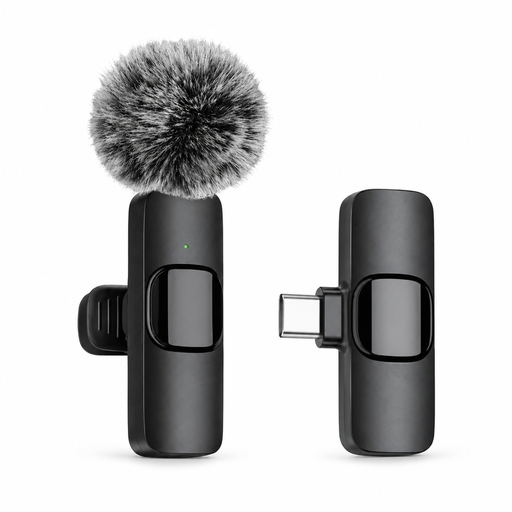
Why this choice suits this profile: Its compact design and Type-C interface are well suited to first attempts at recording videos, livestreams or interviews with a USB-C device.
The product page specifies the Type-C interface and an advertised battery life of 3 to 6 hours, allowing you to verify both details before buying rather than relying solely on the word “universal.”
Compact lavalier microphone, black finish, advertised noise reduction and 5 V/1 A power supply.
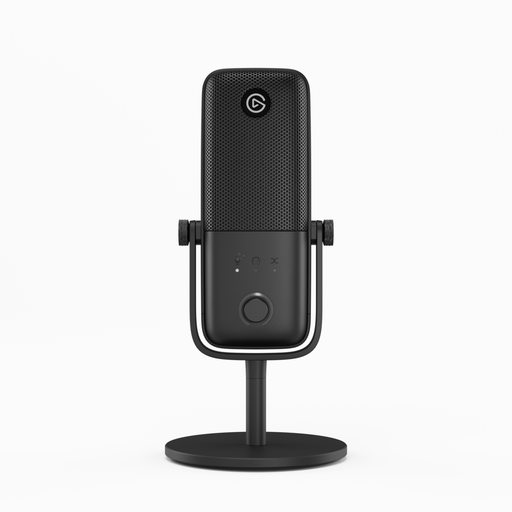
Why this choice suits this profile: In a dedicated streaming, podcasting or gaming setup, this USB microphone prioritises easily accessible controls over mobility.
Its product page clearly identifies it as a wired USB model, so it cannot be mistaken for a wireless microphone.
USB connectivity, Clipguard 2.0, automatic gain adjustment, and volume and mute controls.
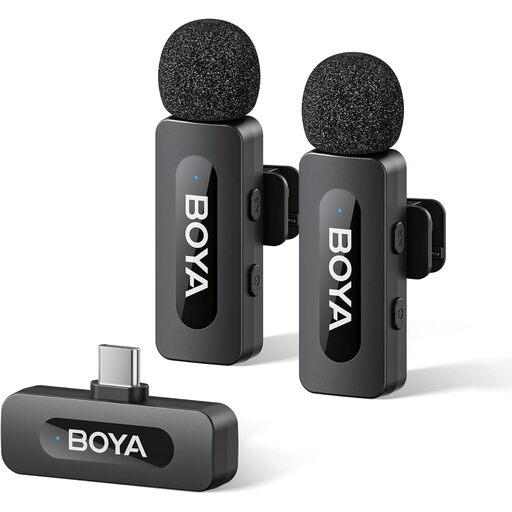
Why this choice suits this profile: With two transmitters and a USB-C receiver, this kit is designed for interviews, two-person videos and extended content-creation sessions.
The product page mentions USB-C compatibility, one-touch noise reduction and an advertised battery life of 9 hours: three details to compare with your intended use.
2 TX + 1 RX configuration, USB-C microphone and manufacturer-specified noise-reduction adjustment.
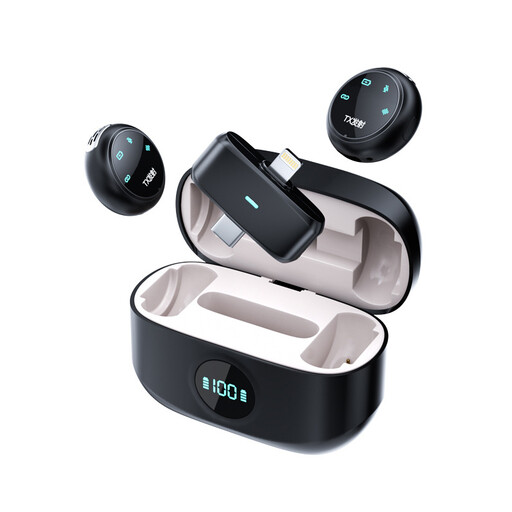
Why this choice suits this profile: Its dual-microphone design and magnetic charging case make it a strong fit for creators who alternate between interviews, livestreams and on-the-go presentations.
The product page explicitly states that it includes two microphones, magnetic charging and an advertised battery life of 3 to 6 hours, making it easier to compare with a single-microphone model.
Two transmitters, magnetic charging case, interface advertised as compatible with Android and Apple, and a magnetic-attachment design.
We have compiled a comprehensive, real-time-updated list of products that fully meet these strict selection criteria and European safety regulations.
Connect the receiver to the phone’s compatible port, switch on the transmitter, then follow the pairing procedure described in the manual. Open your recording app and carry out a brief test. Some apps automatically switch to the external microphone, while others require you to select it in their settings.
For a short interview, an advertised battery life of 3 to 6 hours may be sufficient. For an extended shoot, allow a safety margin, fully charge the transmitters before leaving and choose a charging case or kit whose advertised battery life provides several additional hours.
Not always. Compatibility depends on the connector and the receiver supplied. A USB-C model may work with many Android smartphones as well as Apple devices equipped with this port, but always check the specifications for the model you choose. With an older iPhone, an adapter or a specific iOS version may be required.