
Livraison le jour même ou le lendemain

Qualité garantie

Débloquez vos offres de bienvenue: Livraison GRATUITE | Jusqu'à -80 % | 30 jours d'essai gratuits à JoyPlus
Téléchargez l'application
The appeal of a minimalist desk, free from the eternal clutter of cables, is driving many users toward the wireless mechanical keyboard. Whether for gaming, productivity, or simply the joy of customization, the idea of cutting the cord is tempting. But be warned: the market is a jungle where spec sheets are often designed to mislead you. To ensure you invest in a keyboard that will go the distance, it's crucial to know how to decode the marketing jargon and identify the features that truly matter.
Navigating the world of mechanical keyboards can be complex. To avoid falling into common traps, here are three essential points to watch out for.
Beyond the pitfalls to avoid, here are the three technical points on which you must be uncompromising to guarantee a flawless typing and gaming experience.
A truly versatile keyboard must offer multiple connection options to adapt to all your needs. The most complete and sought-after configuration is the triple-mode keyboard:
The keyboard's form factor determines its footprint and ergonomics. While 60% or 75% layouts are appealing for their compactness, the 98% gamer keyboard represents an excellent compromise. It retains the number pad in a condensed layout, freeing up precious mouse space without sacrificing essential keys.
The hot-swappable capability is also a major asset for customization enthusiasts. Ensure the keyboard is compatible with both 3-pin and 5-pin switches to access a wider range of typing feels (linear, tactile, clicky) without ever needing to break out the soldering iron.
Beyond the typing experience itself, certain features enhance daily usability. An RGB keyboard with a volume knob allows for quick and intuitive media control. This knob, often made of metal and clickable, can also be reassigned to other functions like scrolling or zooming.
Meanwhile, a mechanical keyboard with an integrated TFT screen takes customization one step further. It can display system information (CPU load, temperature), the time, notifications, or even GIF animations, adding a unique touch to your setup.
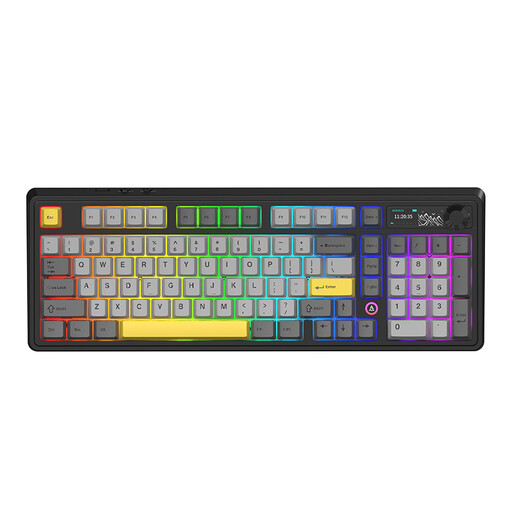
Why it's the perfect match: This user wants total control. The AK980 V2's 98% layout retains the number pad while optimizing space. Its advanced features (TFT screen, knob) are built on a solid technical foundation for serious gaming and deep customization.
It includes triple-mode connectivity (including low-latency 2.4G), a hot-swappable PCB compatible with 3/5-pin switches, and an internal structure (Gasket Mount, sound-dampening foams) that proves its features are more than just smoke and mirrors.
Triple-mode connectivity: 2.4G, Bluetooth, and wired. Comprehensive features: Volume knob, TFT screen, hot-swap, and 98% layout.
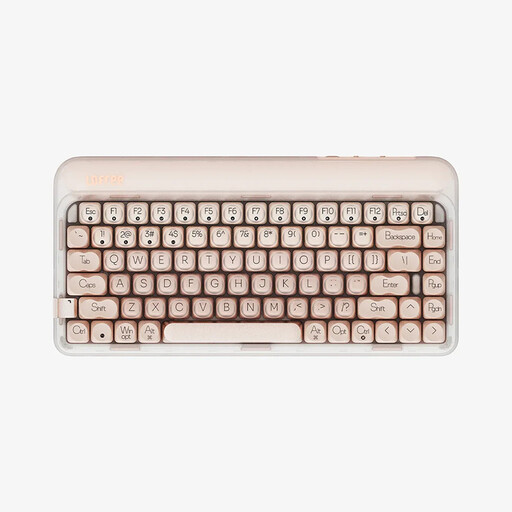
Why it's the perfect match: This profile prioritizes a sleek design and the flexibility to switch between work and casual gaming. The Lofree OE914's compact 75% form factor and polished aesthetic fit perfectly into a modern desk setup, while its triple-mode connectivity ensures full compatibility with a PC, laptop, and tablet.
It doesn't just settle for Bluetooth, offering a 2.4G connection for low latency. Its full hot-swappable capability allows for future customization, ensuring the keyboard's longevity beyond its initial look.
Compact and sleek design: 75% form factor and a distinctive aesthetic. Versatile connectivity: USB-C, Bluetooth 5.3, and 2.4G for multi-device use.
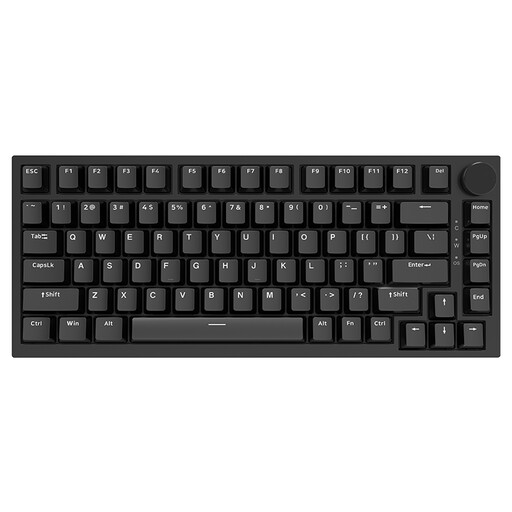
Why it's the perfect match: This user wants a premium mechanical experience without breaking the bank. The AK820 offers high-end features (Gasket structure, hot-swap, volume knob) in a wired format, prioritizing typing performance and customization over mobility.
By focusing on a wired connection, it immediately eliminates any concerns about latency or battery life. It bets everything on typing quality and customization (hot-swap), offering an ultra-solid foundation for a first step into the world of custom keyboards.
Wired performance: Zero latency and no battery management. Advanced features: Gasket structure, hot-swap, and a CNC volume knob for a formidable price-to-performance ratio.
We have selected the best products for you that meet our demanding criteria.
Battery life varies enormously depending on the battery capacity (in mAh), the intensity of the RGB backlighting, and the connection mode used. As a general rule, with backlighting on, a 4000 mAh battery will last from a few days to a week. Without backlighting, the battery life can extend to several weeks or even months. Most models charge via a USB-C cable and can still be used in wired mode while charging.
Yes, absolutely. It's entirely possible to use a keyboard with a QWERTY (US) layout in a country that primarily uses another standard, like AZERTY. You just need to set the input language in your operating system (Windows, macOS) to "English (United States)". You can also leave it on your local language setting if you are a proficient touch typist. For developers and certain creative professionals, the QWERTY layout is often preferred for its more direct access to special characters used in programming.
For fast-paced and competitive games (FPS, fighting games, etc.), a 2.4G connection is almost mandatory. It offers very low latency, often under 5 milliseconds, which is imperceptible and guarantees maximum responsiveness. Bluetooth, even in its latest versions, can introduce higher latency (over 10-15 ms) and micro-disconnects that can be particularly infuriating mid-game. For single-player games or less demanding genres, Bluetooth can be more than adequate.