
Livraison le jour même ou le lendemain

Qualité garantie

Débloquez vos offres de bienvenue: Livraison GRATUITE | Jusqu'à -80 % | 30 jours d'essai gratuits à JoyPlus
Téléchargez l'application
A clean desk, top-tier performance: in the quest for the perfect setup, the wireless mechanical keyboard has become an essential component. No more tangled messes of cables ruining your aesthetic! But with a flood of options on the market, making a choice can quickly become a headache. Should you prioritize latency, battery life, or customization options?
Our mission: to clear the path for you. This guide gives you all the keys to understand the critical factors and choose the keyboard that perfectly suits your needs, whether you're a gamer, a creative, or a productivity pro.
Before diving into our top picks, let's review the essential criteria to ensure you make the right choice.
The size of your keyboard is no small detail. It dictates your typing comfort and desk organization.
The true superpower of a mechanical keyboard is its modularity. The magic word here is hot-swappable keyboard. In practical terms, this means you can change the switches without needing a soldering iron.
This flexibility opens the door to experimentation: test linear, tactile, or clicky switches to find the perfect feel and sound. It's how you can transform a simple keyboard into a custom mechanical keyboard that is uniquely yours.
A good wireless keyboard must be stable and versatile. Most top-tier models offer a trio of connection options:
Certain refinements, like a programmable knob, can be a daily game-changer: adjust volume, brightness, or scrub through your editing timeline with a simple twist. Finally, an RGB mechanical keyboard is more than just a gimmick: it allows you to match your keyboard to the rest of your setup with endless possibilities.
Here are three options that stand out for their features and cater to different needs.
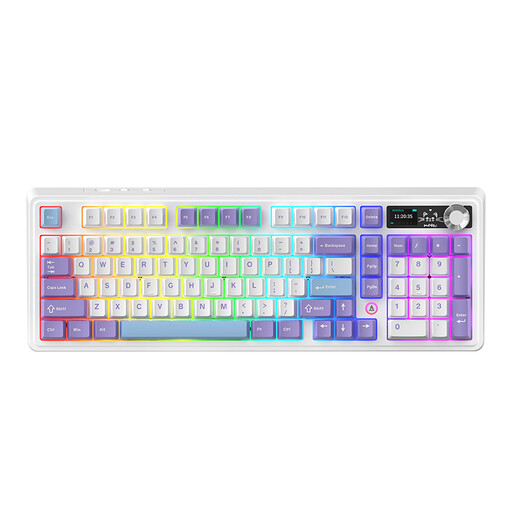
Why it stands out: The AJAZZ AK980 V2 is a true tech powerhouse. Its 98% layout retains almost all the keys of a full-size keyboard in a smaller footprint. It sets itself apart with its customizable TFT screen and metal control knob, which offer direct access to a host of functions.
Pros:
Who is it for? For demanding users who want it all, right out of the box: gaming performance, work comfort, and maximum features, without sacrificing the number pad.
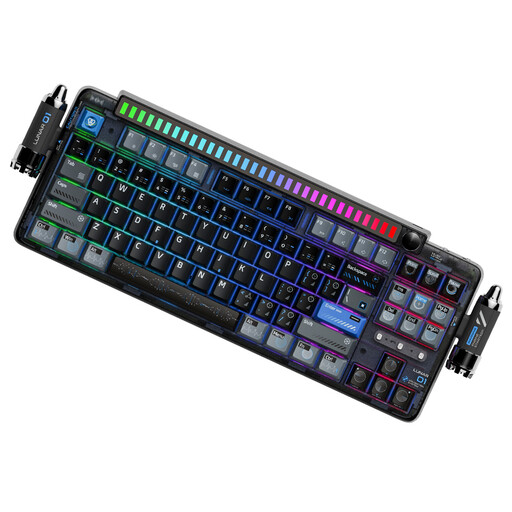
Why it stands out: The KEYSME Lunar 01 is a style statement. Its space-exploration-inspired design, complete with magnetic "rocket spinners," makes it a unique object. Here, acoustics are king, featuring a Gasket mount and multiple dampening layers designed for a deep and satisfying sound.
Pros:
Who is it for? For aesthetes and custom mechanical keyboard enthusiasts looking for a centerpiece for their desk that is as pleasing to look at as it is to use. It's an excellent wireless TKL keyboard for a setup that stands out from the crowd.
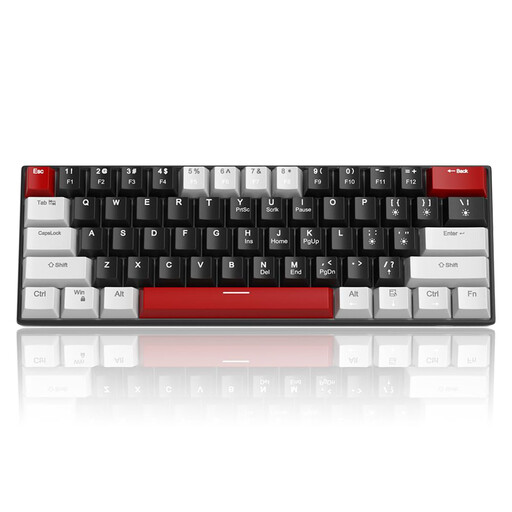
Why it stands out: Although it's wired, the MageGee STAR 61 earns its spot for its ultra-compact form factor and budget-friendly price. Its 60% layout frees up maximum desk space, and its detachable USB-C cable makes it easy to transport.
Pros:
Who is it for? For gamers (especially FPS players) and nomads on a tight budget. It's an ideal entry point into the world of mechanical keyboards, provided you can accept being tethered by a cable.
This selection is just a taste of what the market has to offer. The combinations of switches, materials, and designs are nearly endless, because every user is unique.
To discover an even wider range and find your perfect match, explore our complete category of USB-C keyboards.
Absolutely. For the vast majority of uses, including competitive gaming, the difference is non-existent. Modern keyboards using 2.4 GHz wireless (via their dongle) have such low latency (often 1 ms) that it is simply imperceptible. Bluetooth, while slightly slower, remains perfect for office work and most games.
A hot-swappable keyboard is one that allows you to change the mechanical switches yourself, without any soldering. Using a small tool that comes with the keyboard, you can pull out a switch and clip in a new one. This opens the door to complete customization of your keyboard's typing feel and sound.
RGB backlighting has a dual purpose. Aesthetically, it allows you to synchronize your keyboard with the rest of your setup for a flawless look. Practically, it's very useful for illuminating key groups (like the classic WASD for gaming), assigning colors to software profiles, or even serving as a visual notification system.