
Livraison le jour même ou le lendemain

Qualité garantie

Débloquez vos offres de bienvenue: Livraison GRATUITE | Jusqu'à -80 % | 30 jours d'essai gratuits à JoyPlus
Téléchargez l'application
A wireless home alarm system can secure a flat, house, garage or small office without major building work. However, with so many models available, it can be difficult to know what to look for. Product descriptions sometimes highlight secondary features at the expense of the functions that are genuinely useful in everyday life.
Before placing your order, there are three pitfalls to avoid:
A Wi-Fi home alarm kit should clearly state which accessories are compatible. Check the maximum number of supported sensors, the radio frequency used and the pairing procedure.
The additional KYF sensor designed for the KYF-ALARM-001 model, for example, works exclusively with this control panel. Powered by the supplied button batteries, it features a low-battery indicator and has a claimed battery life of around one year. It should therefore not be confused with a standalone alarm.
The sensor designed for the KYF-ALARM-009 system works on the same principle: it requires the corresponding control panel and transmits alerts up to 80 metres in open space, according to the manufacturer. Inside a home, walls, metal structures and electronic devices may significantly reduce this range.
A motion detector monitors an entire area, while a magnetic contact protects a specific access point. In a home made up of several rooms, it may be sensible to combine:
Install a PIR sensor away from radiators, windows exposed to strong sunlight, fans and moving curtains. Some models claim to be pet immune, but this feature depends in particular on the animal’s weight and behaviour.
A connected home alarm will generally allow you to arm or disarm the system and receive notifications via a mobile app. However, it remains dependent on Wi-Fi and mains power. A backup battery can keep the control panel running during a power cut, provided it is sufficiently charged.
For cameras, check:
Placing a camera behind a window can be a practical solution for renters, as it avoids drilling into a wall. However, you need to consider reflections, night-time lighting and how clean the glass is.
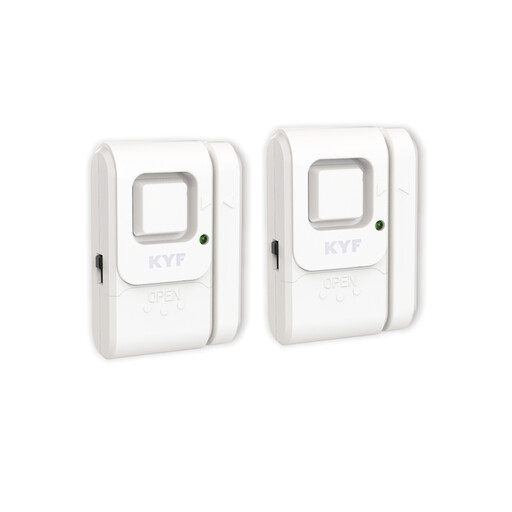
Why this choice suits this profile : These two standalone alarms are suitable for a flat or a few priority access points, with no control panel or wiring required. They offer a continuous alarm mode and a chime mode.
The product description clearly states that this is a standalone model, secured with the supplied adhesive and including LR44 batteries. There is therefore no need to check compatibility with a control panel.
105 dB claimed siren, two operating modes, adhesive-tape installation and a claimed battery life of around one year.
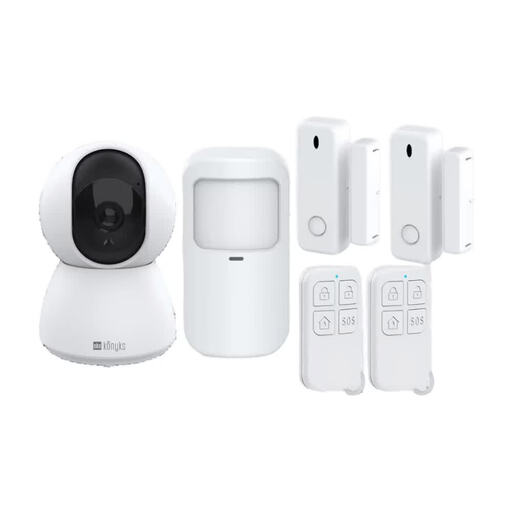
Why this choice suits this profile : This pack is designed for people who want to bring a camera, sensors and remote controls together in a single indoor solution that can be operated remotely.
The contents are clearly listed: one camera, two opening sensors, one motion detector and two remote controls. The product description also specifies that the camera is for indoor use only.
4 MP resolution, two-way audio, microSD card storage up to 256 GB and support for up to 32 additional sensors, as stated in the product description.
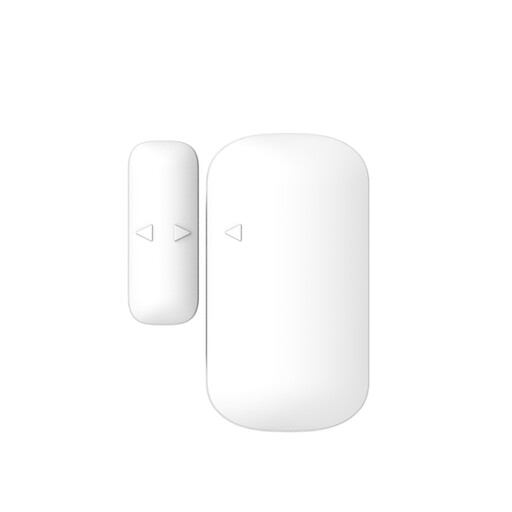
Why this choice suits this profile : It is suitable for homeowners and renters who want to start with several zones, then gradually add sensors to suit their property.
The 868 MHz radio frequency, 2.4 GHz Wi-Fi and claimed capacity of 30 accessories are listed separately. The 5 V 1 A mains adapter is not included.
90 dB claimed built-in siren, indicator light, 1,000 mAh backup battery, TuyaSmart app and instant notifications, according to the product description.
We have brought together a complete, real-time updated selection of products that meet these demanding criteria and the applicable European safety regulations.
An additional alarm sensor should be chosen according to the control panel being used, not simply its appearance or theoretical range. For a patio door, garage door or poorly monitored window, a magnetic contact can effectively extend your coverage.
Security does not stop at home. A glass breaker hammer with a seatbelt cutter can be kept in your car, somewhere that is easily accessible from the driver’s seat. The smosun models available are presented as suitable for side windows made from toughened glass. They are not suitable for windscreens, laminated windows or necessarily panoramic roofs. This accessory must remain securely fixed and within easy reach, without being covered by other items.
For motorbike journeys, protective trousers with armour at the hips, thighs and knees can complete your riding gear. Check the size, how securely the protectors stay in place, the quality of the stitching and any standards stated on the label. Protective clothing does not replace a helmet, gloves, suitable footwear or careful riding.
The day-to-day cost mainly depends on the batteries, microSD card and any cloud storage subscription. Some kits work without a subscription, using a local siren and card storage. Button batteries and AA batteries should be replaced when the low-battery alert appears or testing becomes less reliable.
Yes, some models can be secured with adhesive or removable mounts. Clean and dry the surfaces thoroughly before installation, then check your tenancy agreement for rules concerning fixtures and fittings. A camera placed behind a window can minimise building work, but it must be positioned in a way that respects privacy and the applicable regulations.
The advertised sound level is an indicator, not a guarantee of the system’s overall effectiveness. A built-in 90 dB siren may be perfectly suitable if mobile notifications, sensors and the power supply are configured correctly. After installation, test the volume, entry and exit delays, and every zone of your home.