
Livraison le jour même ou le lendemain

Qualité garantie

Débloquez vos offres de bienvenue: Livraison GRATUITE | Jusqu'à -80 % | 30 jours d'essai gratuits à JoyPlus
Téléchargez l'application
Rummaging through a dark closet early in the morning, searching for a forgotten spice in the back of a kitchen cabinet, finding the right pair of shoes in a poorly lit wardrobe… We've all been there. The wireless closet light emerges as the ideal solution: simple, installation-free, and incredibly effective. Yet, the market is flooded with models making enticing promises that often don't hold up once installed.
To help you see things more clearly, our editorial team has dissected the spec sheets and user reviews. Here are the 3 absolute pitfalls to avoid to make an informed choice and, most importantly, one you won't regret.
To avoid these disappointments, here are the technical specifications that truly make a difference.
Most high-performance models are rechargeable LED strips with a USB port. Prioritise USB-C, which is now the standard. The absolutely crucial point remains the battery capacity, expressed in milliampere-hours (mAh).
The heart of an automatic night light is its sensor. The most reliable and common technology is the passive infrared (PIR) sensor, which reacts to heat and motion. Two points are essential to check?:
ON (continuously on), OFF (off), and AUTO (motion detection). Some more advanced models even offer gesture control to turn on, off, or vary the light intensity.A well-designed mounting system is the key to hassle-free use. The cleverest systems combine an adhesive strip with a magnetic mount. The principle is simple: you stick a thin metal plate to your furniture, and the light attaches to it magnetically. This allows you to detach it for recharging without ever touching the adhesive. This versatility makes these lights as perfect for a cabinet light as for under-cabinet task lighting.
Rather than a soulless product catalogue, here are our targeted recommendations for different profiles, based on the criteria we've just reviewed.

Why we chose it : This two-pack of strips is perfect for outfitting multiple areas at once (e.g., a wardrobe and kitchen) with a consistent and reliable solution. It's the logical and efficient choice for a functional need.
Its 1100 mAh battery tackles the battery life problem head-on. Its PIR sensor, with a 3 to 5-metre range, ensures reliable detection, while the adhesive magnetic mount simplifies installation and recharging.
Three colour temperatures (warm, neutral, cool) to adjust the ambience. The two-pack format offers an excellent functionality-to-price ratio.
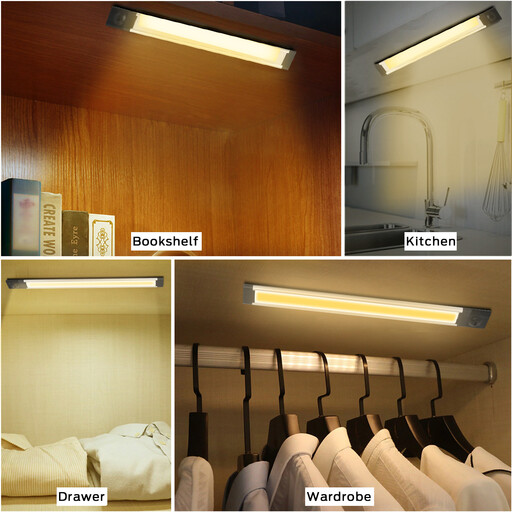
Why we chose it : For those who appreciate premium finishes and innovative features. Its aluminium body and gesture control place it well above standard all-plastic models.
Its dual mounting system (magnetic + hooks) offers unbeatable versatility and prevents both falls and damage to furniture. The gesture control puts an end to the whims of unresponsive buttons and sensors.
Variable light intensity (dimmable) with a simple gesture for customised visual comfort. Its aluminium and ABS finish is a guarantee of durability and elegance.
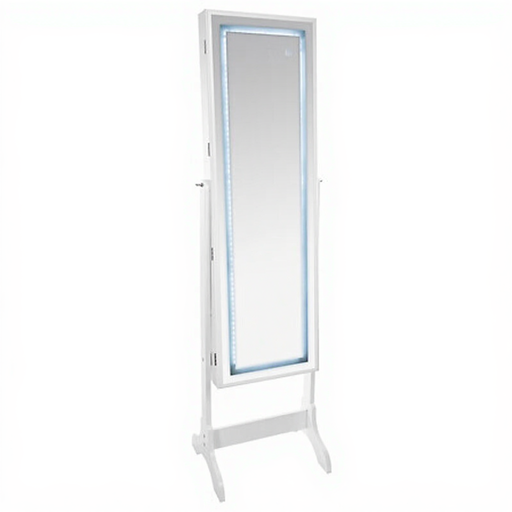
Why we chose it : For those looking for more than just a light: a complete, functional, and stylish storage solution. This piece of furniture combines a full-length mirror, jewellery storage, and integrated LED lighting.
This product takes the opposite approach to standalone lights and their limitations. Here, the lighting is directly integrated into the furniture and mains-powered, which immediately eliminates all battery, mounting, or sensor issues.
A 3-in-1 solution that combines optimised storage, a full-length mirror, and ambient lighting. Its sleek design fits elegantly into a contemporary bedroom or wardrobe.
Browse our complete selection of products tested and approved by our editors, meeting our criteria for quality and performance.
The lifespan depends on two factors?: the battery and the LEDs. A lithium battery can typically withstand between 300 and 500 full charge cycles. For average use, this represents several years of operation. As for the LEDs, their lifespan is so long (usually 20,000 to 50,000 hours) that they will almost never be the cause of failure.
It's rare with a quality PIR sensor, but it can happen. The culprits are often heat sources (radiator, heating duct), a sudden draught, or your pet walking by. To minimise this risk, avoid positioning the light opposite a known source of disturbance.
On most smooth, non-porous surfaces (melamine, varnished wood, metal), modern, high-quality adhesives are safe. However, be more cautious on fragile surfaces like wallpaper or raw wood. The advantage of magnetic models is that the adhesive doesn't move once it's applied. When in doubt, the golden rule is?: test it on a small, inconspicuous area.