
Livraison le jour même ou le lendemain

Qualité garantie

Débloquez vos offres de bienvenue: Livraison GRATUITE | Jusqu'à -80 % | 30 jours d'essai gratuits à JoyPlus
Téléchargez l'application
Wireless Bluetooth headphones can accompany you on your commute, during work calls, at the gym or while watching television in the evening. Yet specification sheets often list figures that are difficult to compare. Long battery life, “maximum noise reduction” or a newer Bluetooth version alone do not tell you whether the device will genuinely meet your needs.
Before buying, it is worth considering the format, comfort, compatibility and conditions in which you will use the headphones. Here are the key criteria to check to avoid disappointment, along with a selection of models suited to different types of user.
The stated battery life may sometimes be based on listening at a moderate volume, without active noise cancellation, or include the additional charges provided by the case. For Bluetooth earbuds, check the listening time on a single charge separately from the total battery life with the charging case.
Active noise cancellation, calls, high volume or use in low temperatures can reduce the battery life you actually experience. Long-battery-life Bluetooth headphones should also offer convenient charging — ideally via USB-C — and maintain a stable connection while you listen.
Passive isolation relies on the ear cushions or the shape of the ear tips. ANC, or active noise cancellation, uses microphones and electronic processing to reduce certain continuous sounds, such as the rumble of a train or aeroplane. It does not eliminate every noise and is often less effective against nearby voices or sudden sounds.
A noise-cancelling headset should therefore be chosen according to the environment in which you intend to use it: public transport, a shared office, at home or out on the street. Where available, transparency mode also lets you stay aware of announcements and hold a conversation without taking your headphones off.
A model that feels comfortable for a few minutes can become uncomfortable after an hour. In-ear earbuds with tips need to suit the shape of your ear, while on-ear headphones sit directly on your ears and are often more compact. Over-ear headphones completely surround your ears and can reduce pressure on the outer ear, but are generally bulkier.
For sport, check the fit, resistance to moisture and any securing features. An IP54 rating, for example, indicates a defined level of protection against dust and water splashes, but does not mean that the product can be submerged. Always check the exact IP rating rather than relying solely on the word “sport”.
A newer Bluetooth version can improve power consumption, stability or connection management, but it does not by itself guarantee better audio quality. Compatibility also depends on the profiles supported by your phone, computer or television.
If you regularly switch between a computer and a smartphone, multipoint connectivity saves you from having to pair the headphones again every time. For Bluetooth headphones for TV, check the outputs available on your television in particular: Bluetooth, optical output or a 3.5 mm jack socket.
Bluetooth earbuds with a microphone can be suitable for calls, meetings and voice commands, but quality varies according to the number of microphones, their position and how ambient noise is processed. If calls are a priority, look for specifications that clearly mention a built-in microphone and background-noise reduction features.
Compare the stated capacity with the listening time and charging duration. A fast-charging function can be useful before a journey, while a compact case makes TWS earbuds easier to carry. To help preserve the battery, avoid excessive heat, prolonged exposure to moisture, and damaged chargers or cables.
In France and the European Union, check for compliance information, identification of the manufacturer or importer, and safety warnings. Also remember to listen at a moderate volume and take breaks during prolonged use.
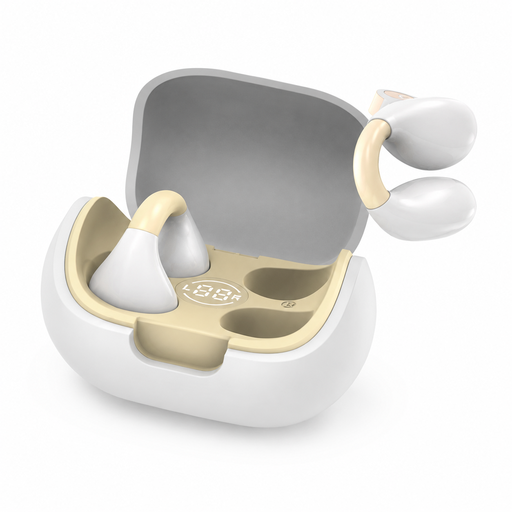
Why this choice suits this type of user : These earphones with ear hooks are suitable for calls, commuting and workouts alike. Their touch controls and case with digital display make them easy to use every day.
The specifications state approximately 5 to 7 hours of battery life, a range of up to 15 metres and a 300 mAh battery in the case. This provides sufficiently clear information about how they can be used, rather than relying on a vague promise.
Bluetooth 5.4, touch controls, ear-hook design and sound isolation stated in the product specifications.
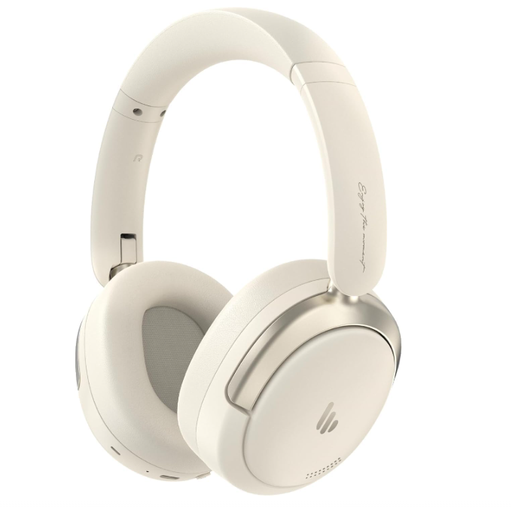
Why this choice suits this type of user : This foldable over-ear headset is designed for long listening sessions, work and travel. It combines active noise cancellation, customisable settings via an app and connection to two devices.
The specifications distinguish between active noise cancellation of up to -44 dB, battery life of up to 45 hours and high-resolution audio via wired USB-C. This makes the conditions of use much clearer.
40 mm dynamic driver, Bluetooth 5.4, built-in microphone, fast charging and dual connectivity.
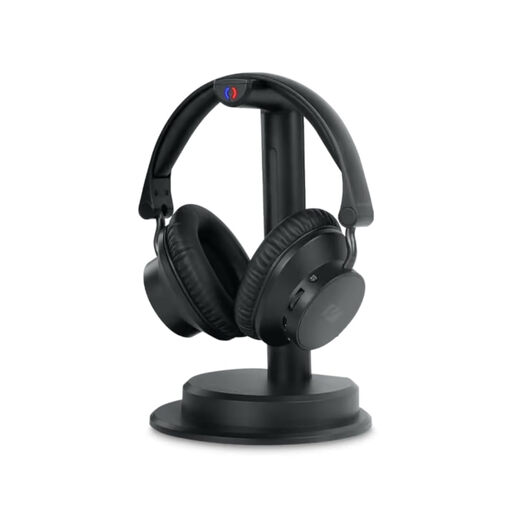
Why this choice suits this type of user : These Bluetooth headphones for TV let you watch programmes without relying directly on your television’s Bluetooth connection. The base transmits the sound and also recharges the headphones.
The specifications state the optical and auxiliary connections, 2.4 GHz transmission of up to 30 metres and battery life of up to 20 hours. You can therefore check compatibility with your television’s ports before buying.
Charging base, improved voice clarity, Bluetooth 5.3, optical cable and RCA-to-jack cable included.
We have brought together a complete, real-time selection of products that meet these exacting criteria while complying with European safety regulations.
Enable Bluetooth in your television’s audio settings, then put the headphones into pairing mode. If your television does not offer this function, you may need to use a Bluetooth transmitter connected to the optical output or jack socket. With models that have a dedicated base, connect the appropriate cable to the available output, then select the correct input.
This depends on the built-in battery, how often the headphones are used, heat and the number of charging cycles. The ear cushions, hinges and ear tips can also wear out before the electronic components. Check the warranty terms, store the headphones away from moisture and avoid leaving the battery completely discharged for an extended period.
Charging uses very little electricity, but you should monitor the condition of the battery and case. TWS earbuds generally come with a rechargeable case, while wireless headphones often offer longer battery life on a single charge. The cost of use mainly depends on how often the product needs replacing and how well it is maintained, rather than on charging itself.