
Livraison le jour même ou le lendemain

Qualité garantie

Débloquez vos offres de bienvenue: Livraison GRATUITE | Jusqu'à -80 % | 30 jours d'essai gratuits à JoyPlus
Téléchargez l'application
Wireless Bluetooth earbuds often look similar in photos, but they can be designed for very different uses. A model designed for office calls will not necessarily be suitable for swimming, while a pair made for sport will generally prioritise stability over sound isolation.
Before you buy, three common pitfalls are worth bearing in mind: confusing water resistance with genuine swimming compatibility, relying on the advertised battery life without checking how long the earbuds last on their own, and assuming that active noise cancellation removes every surrounding sound. By looking closely at the specifications, you can compare TWS earbuds, sports models and bone-conduction headphones with greater confidence.
Battery life is generally advertised in two ways: the listening time of the earbuds on their own and the total battery life including the charging case. For daily commutes or working from home, remember to check both figures separately.
A model claiming several dozen hours of battery life may still need frequent charging if you make lots of calls or regularly use noise cancellation or gaming mode. Fast charging can be especially useful in this situation: some earbuds provide several hours of listening after just a few minutes connected to the mains. Also check the connector type, particularly whether there is a USB-C port, as well as how long it takes to fully recharge the case.
Long-battery-life earbuds are ideal for travellers and people who switch between music, video calls and phone calls. For occasional use, however, a more modest capacity may be more than enough and help keep the cost down.
The IP54, IP55, IPX5, IPX7 and IPX8 ratings do not offer the same level of protection. The first digit generally relates to particles and dust, while the second indicates water resistance.
An IP rating does not guarantee that Bluetooth will work underwater. Bluetooth signals travel very poorly through water. For swimming, it is therefore better to choose earbuds with MP3 storage or a standalone playback mode, as found on some bone-conduction models.
In-ear earbuds generally stay securely in place and provide effective passive isolation, but they are not suitable for every ear shape. Open or bone-conduction models allow you to remain more aware of your surroundings, which can be useful when cycling or running outdoors.
For calls, look at the number of microphones, voice-noise reduction and compatibility with your phone. Bluetooth earbuds for Android and iPhone generally work with both systems, although some customisation options depend on the associated app.
The Bluetooth version indicates the generation of the connection, but it is not enough to predict range or sound quality. A stable connection, easy-to-reach controls and a secure fit remain essential. For mobile gaming, also look for a low-latency mode: it can reduce the delay between image and sound, but it cannot eliminate every delay caused by the phone or network.
The recommendations below are based on the specifications provided in the product listings. They help distinguish between different needs without presenting one solution as the best choice in every situation.

Why this choice suits this profile : These TWS earbuds combine Bluetooth 5.4, a claimed total battery life of 26 hours and a compact design. They are suitable for studying, commuting and everyday calls.
The listing clearly distinguishes total battery life from fast charging: 15 minutes of charging is claimed to provide around 1 hour 30 minutes of listening. However, the IP54 rating is intended for perspiration and limited splashes, not swimming.
13 mm dynamic driver, Edifier ConneX app and a claimed latency of 60 ms for mobile gaming.
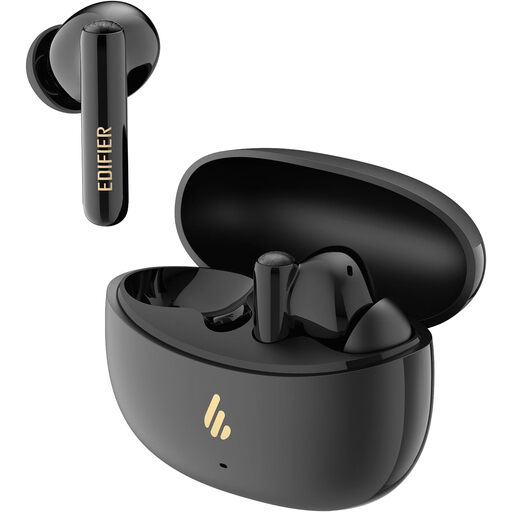
Why this choice suits this profile : Active noise cancellation, a customisation app and a microphone with a noise-reduction algorithm are aimed at travellers, remote workers and users who switch between music and calls.
The listing mentions hybrid ANC technology, but this should not be understood as total noise removal. The IP55 rating refers to the stated resistance to dust and splashes, not immersion.
Up to 7 hours of listening per charge and 31 hours with the case, Bluetooth 5.3 and charging that provides 1 hour of listening after 15 minutes.

Why this choice suits this profile : Its open bone-conduction design is aimed at swimmers, runners, cyclists and anyone who wants to remain aware of their surroundings.
The 32 GB internal storage allows you to play MP3 files without a phone, avoiding the limitations of Bluetooth in water. The charging port must be completely dry before charging.
Claimed IPX8 rating, built-in microphone and claimed battery life of approximately 8 to 10 hours depending on the configuration.
We have put together a complete, real-time updated list of products that fully meet these strict selection criteria and European safety regulations.
Charge the earbuds, open your phone’s Bluetooth settings, then select their name from the list of available devices. When pairing for the first time, you may need to press and hold the button on the case or earbuds. If the connection fails, switch Bluetooth off and back on, and check that the earbuds are not already connected to another device.
This depends on how often they are used, the number of charging cycles, exposure to moisture and how well they are maintained. The built-in battery is generally not designed to be replaced easily. Listening at a moderate volume, following the charging instructions and storing the earbuds in a dry place can help preserve their performance over time.
No. An IP rating alone is not enough to determine how a product will perform during a swimming session. Bluetooth works poorly underwater, and some models have no internal storage. For this use, explicitly check compatibility with swimming, as well as the immersion depth and duration specified in the user manual.