
Livraison le jour même ou le lendemain

Qualité garantie

Débloquez vos offres de bienvenue: Livraison GRATUITE | Jusqu'à -80 % | 30 jours d'essai gratuits à JoyPlus
Téléchargez l'application
A winter duvet should keep you warm without becoming too heavy, making washing difficult or hanging over the sides of the bed. With claims of “intense” warmth, comfort ratings that are difficult to compare and dimensions that can sometimes be misleading, a poorly considered purchase can quickly lead to disappointment.
Here are the main criteria to consider before choosing a warm duvet, a duck-down duvet or a synthetic model.
A very thick duvet is not necessarily the warmest or most comfortable. Warmth also depends on the fill weight, the type of filling and how evenly it is distributed. A polyester duvet weighing 400 g/m² cannot therefore be compared directly with a model filled with feathers and down.
An indication such as “5 cm” or “15 Tog” should be considered alongside the composition and weight of the filling. The warmth stated by a brand remains a commercial indication: it can vary depending on the room temperature, the pyjamas you wear and each person’s sensitivity to the cold.
On a bed measuring 140 or 160 cm wide, a 200 × 200 cm duvet may be suitable, depending on the mattress height and the desired overhang. For a wider bed, the 220 × 240 cm size provides more coverage over the sides.
Also remember to check the duvet cover size. A duvet that is too large for a narrow cover will not distribute properly, while an overly loose cover may leave empty areas.
The phrase “machine washable” does not necessarily mean that a duvet will fit in a standard household washing machine. A thick 200 × 200 cm model may require a machine with a capacity of at least 12 kg. Drying is just as important: natural filling must be completely dry to prevent odours and residual dampness.
A duck-down duvet generally combines down and feathers. Down provides soft, lofty comfort, while feathers give the duvet more structure. Check the proportions carefully: a model made up of 90% feathers and 10% down will not have the same loft as a duvet with a higher down content.
A hypoallergenic synthetic duvet is often filled with hollow polyester fibres. It may suit households looking for easy care and a product that is simple to wash. If you are sensitive to dust mites, check the properties claimed and the model’s certifications: a marketing statement is not a medical guarantee.
Expressed in g/m², fill weight indicates the quantity of filling in each square metre. It makes it easier to compare two duvets with a similar composition, but it is not enough on its own to predict how warm a duvet will feel.
Box construction or quilting limits movement of the filling and helps maintain an even distribution, including after repeated use. Also inspect the stitching and edging: reinforced finishes can reduce the risk of fraying and deformation.
Cotton percale offers a smooth feel and good durability. Polyester microfibre is generally lightweight and practical if the duvet needs to be washed regularly. For products displaying OEKO-TEX Standard 100, CertiPUR, Sanitized or ISO 9001 labels, check which certification actually applies to the model, along with the information provided by the manufacturer. These references do not replace checking the composition and care instructions.
The models below are presented based on the dimensions, materials and instructions provided for each product. They do not constitute medical advice or a promise of effectiveness.
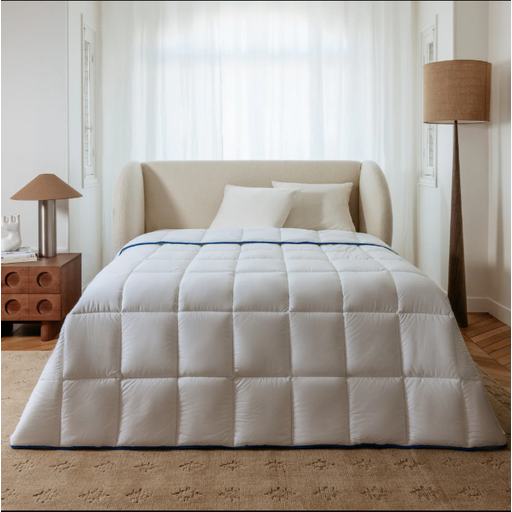
Why this choice suits this profile : Its 200 × 200 cm size and synthetic filling make it a versatile option for a main bedroom or occasional sleeping arrangement.
The composition and fill weight are clearly stated: 100% siliconised hollow polyester fibres, at 400 g/m². The product information recommends washing at 40 °C in a large-capacity machine.
A 100% cotton percale cover, synthetic filling and several certifications cited by the manufacturer: OEKO-TEX Standard 100, CertiPUR, Sanitized and ISO 9001.
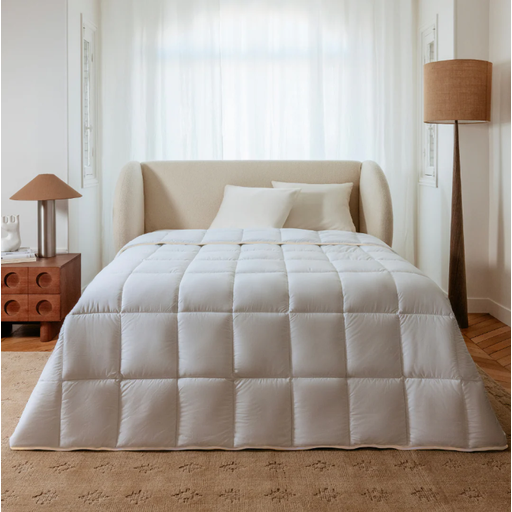
Why this choice suits this profile : This large natural duvet is designed for those who want generous coverage on a double bed and enjoy the feel of feathers and down.
The proportions are specified: 90% duck feathers and 10% down. The box quilting is designed to keep the filling evenly distributed.
A 220 × 240 cm size, an organic cotton sateen cover and washing at 40 °C, with gentle drying or professional cleaning.
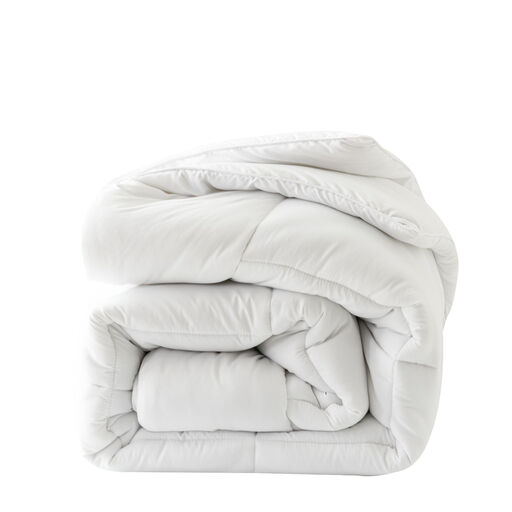
Why this choice suits this profile : Its double-bed size and microfibre filling are aimed at people looking for a synthetic winter duvet for regular use.
The title specifies the 15 Tog rating, microfibre material and box construction. This information makes it easier to compare with other warm duvets.
A 200 × 200 cm size, microfibre filling and a design presented as lightweight and warm. Check the product information to confirm the washing instructions.
We have brought together a complete, real-time updated selection of products that meet these selection criteria, as well as European safety requirements.
A 4-season duvet generally consists of two components that can be used separately or fastened together. It is suitable for households that want to adapt their bedding to changing temperatures, but you will need more storage space.
In summer, a lightweight duvet with a low fill weight, a summer duvet or a quilted bedspread may be sufficient. A bedspread protects your bedding and adds to the room’s décor, but it will not always replace a warm duvet in a poorly heated bedroom.
Before placing your order, check:
A 200 × 200 cm quilt may be suitable for a double bed, while a 140 × 200 cm model will generally be intended for a single bed. If you are sensitive to dust mites, choose machine-washable bed linen and air the bedroom regularly.
It all depends on the room temperature and your sensitivity to the cold. A higher fill weight or thermal rating will be more suitable for a poorly heated room. In a well-insulated home, a more moderate duvet may be more than adequate.
Start by reading the care label. Check that the drum is large enough, follow the recommended temperature and choose a suitable drying method. A duck-down duvet must be completely dry before it is stored. For bulky models, using a launderette with suitable equipment is often the simplest solution.
Its lifespan depends on the quality of the stitching, how often it is washed, drying and airing. It is time to replace it if the filling forms clumps, remains permanently flattened or if the fabric tears. Washing the cover regularly helps limit wear and the build-up of dirt.