
Livraison le jour même ou le lendemain

Qualité garantie

Débloquez vos offres de bienvenue: Livraison GRATUITE | Jusqu'à -80 % | 30 jours d'essai gratuits à JoyPlus
Téléchargez l'application
When temperatures drop, choosing the right winter duvet is often enough to make your nights more comfortable, without turning your bed into a furnace or making it unnecessarily heavy. Marketing claims such as ‘extra warm’, ‘all-season’ or ‘hypоallergenic’ are not enough on their own to compare models effectively. The filling, weight, dimensions and care requirements are far more revealing.
Before buying a warm winter duvet, start by considering your sleeping habits, bedroom temperature and mattress size. This simple check can help you avoid the most common mistakes.
A very thick duvet is not necessarily the warmest. Its insulating performance depends mainly on the type of filling, how evenly it is distributed and its weight. A lightweight but well-designed model may be more comfortable than a bulky duvet if it effectively traps air between its fibres.
Breathability matters too. A duvet that is too warm can create a damp sensation and even cause you to wake during the night, particularly in a properly heated bedroom.
Terms such as ‘premium’, ‘natural’ or ‘anti-dust-mite’ need to be considered in context. Check the exact composition, any relevant certifications and the care instructions. The OEKO-TEX Standard 100 certification, for example, confirms that certain undesirable substances have been checked for in certified textiles, but it is not a medical guarantee.
When choosing a hypoallergenic duvet, look for a product description that clearly explains the filling and any treatments used. People with sensitivities may also want to consider a washable microfibre duvet, which is generally easier to care for than a down model.
A duvet that is too narrow lets air in at the sides and provides less coverage for sleepers. Conversely, a model that is too large can be awkward to handle and difficult to wash.
For a single bed, a 140x200 cm duvet will generally suit a standard-width mattress. On a double bed, a 200x200 cm duvet may be suitable for a compact sleeping area, while a wider size will provide more overhang at the sides. Measure your mattress and check the duvet cover dimensions before placing your order.
Expressed in g/m², the weight indicates how much filling is present per square metre. However, it is not enough on its own to determine how warm a duvet will be: down, feathers, microfibre and hollow fibres all have different insulating properties.
A 400 g/m² model, such as the MORPHEA cotton and polyester duvet, is more suitable for cooler periods. For a poorly heated bedroom, you may want to look for a ‘winter’ warmth rating or a high TOG rating. However, only compare TOG values when the measurement method is clearly specified.
A winter duvet needs to be suitable for the care conditions available in your home. Some models require a large-capacity washing machine or even professional cleaning.
Check the maximum washing temperature, whether the duvet is suitable for tumble drying, and any restrictions on bleaching or ironing. After vacuum packaging, a duvet may need several hours to regain its loft. Air it and shake it out before putting it into its cover.
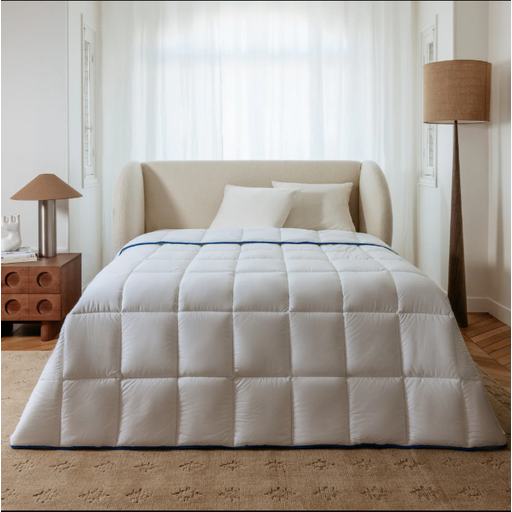
Why this choice suits this profile : Its single-bed size and 400 g/m² polyester filling make it a straightforward way to refresh your bedding without having to navigate a long list of technical criteria.
The composition, weight, dimensions and washing instructions are clearly stated, making objective comparison easier.
100% cotton percale cover, siliconised hollow-fibre filling and machine washing at up to 40 °C, according to the product details.

Why this choice suits this profile : This model is aimed at couples looking for a natural filling and a double-bed size suitable for a poorly heated bedroom.
The stated composition — 90% duck down and 10% feathers — lets you assess the filling precisely instead of relying solely on the word ‘natural’.
Organic cotton cover with a stated thread count of 129 threads/cm², stitching designed to distribute the filling and several sizes available, according to the product details.

Why this choice suits this profile : This set includes a duvet and two pillowcases, making it a practical way to quickly coordinate a family or guest bedroom.
The 100% microfibre composition and washing instructions at below 30 °C are clearly stated, reducing unpleasant surprises when it comes to care.
Three-piece set, microfibre filling as an alternative to down, and fixed stitching designed to minimise filling movement.
We have put together a complete, real-time updated list of products that fully meet these strict selection criteria and European safety regulations.
In a bedroom heated to between 18 and 20 °C, a winter duvet with a medium warmth rating may be sufficient. If the room is colder, choose a higher weight or a natural filling described as warm. When two people have different sensitivities to the cold, a 4-season duvet made up of two detachable layers offers greater flexibility.
People who tend to feel warm will often prefer a breathable cover and a less dense filling. A warm fleece blanket placed over the top can also help you adjust the temperature when needed, without having to change all your bedding.
A 140x200 cm duvet will generally suit a single bed that is 90 cm wide. Even so, check the exact width of the mattress and how much overhang you want at the sides. For a double bed, compare 200x200 cm, 240x220 cm or wider sizes, depending on the bed size and the amount of overhang you are looking for.
A duvet’s lifespan depends on its filling, how often it is washed, how it is dried and the quality of its stitching. Air it regularly, use a suitable cover and follow the manufacturer’s recommendations. It is time to replace it when the filling becomes uneven, the loft no longer returns or the cover shows signs of wear.
Always start by reading the care label. A polyester duvet can sometimes be machine-washed at 40 °C, while a down model generally requires particularly thorough and prolonged drying. Never store a duvet while it is still damp: allow it to dry completely to prevent unpleasant smells and reduce the risk of mould.