
Livraison le jour même ou le lendemain

Qualité garantie

Débloquez vos offres de bienvenue: Livraison GRATUITE | Jusqu'à -80 % | 30 jours d'essai gratuits à JoyPlus
Téléchargez l'application
A winter duvet isn’t something you should pick based purely on its thickness or a carefully staged photo. To sleep snug and warm without feeling like you’re suffocating, it’s worth comparing the warmth level, filling, cover fabric and dimensions. Your bedroom temperature, how easily you feel the cold, and your cleaning habits all play a part too.
A very fluffy duvet isn’t necessarily the warmest. Its insulating power depends largely on the amount of filling, its structure, and how it’s distributed. A 15 tog duvet, for example, offers a high level of insulation according to the tog scale used by some manufacturers. However, you should always check this on the product page and consider it alongside your bedroom temperature.
Conversely, a relatively thin duvet can work perfectly well in a well-heated room. The weight, given in grams per square metre – for instance 400 g/m² – is another useful benchmark for comparing models made from the same material.
The filling often gets all the attention, yet the cover directly affects the feel and breathability. Cotton percale is generally appreciated for its matte finish and good airflow. A microfibre duvet is often light and soft, while a polyester duvet can be easier to care for and more budget-friendly.
Feathers and duck down offer a different sensation, with natural loft and a more enveloping feel. However, anyone sensitive to feathers should carefully check the composition and care instructions before ordering.
A duvet that doesn’t overhang the mattress enough risks letting cold air in at the sides. For a double bed, the most common sizes include 200 x 200 cm and 220 x 240 cm. The latter offers more overhang for a couple, provided the bed width and your preferences allow for it.
For a single bed, 140 x 200 cm and 135 x 200 cm formats can be considered, depending on the mattress width and how much coverage you want.
In a poorly heated bedroom, or for someone who gets cold quickly, a thick winter duvet – or a warm duvet – can be a sensible choice. In a room kept at a comfortable temperature, an all-season duvet or a mid-weight model will help prevent overheating.
A lightweight summer duvet, often between 200 and 250 g/m² for some synthetic models, is better suited to mild nights. It can be paired with a winter duvet to create an all-season duvet solution, but first check that both models are designed to be fastened together.
The term hypoallergenic duvet shouldn’t be taken as a medical guarantee. Instead, look at the composition, any certifications, how easy it is to wash, and your own tolerance to different materials.
A machine-washable duvet is practical for everyday use, but its weight and volume when wet may require a large-capacity washing machine. Several models featured here need a machine of at least 12 kg and a 40 °C wash. Always follow the instructions on the product page and label.
Mentions of STANDARD 100 by OEKO-TEX, CertiPUR, Sanitized or ISO 9001 don’t all mean the same thing. Check the specific scope of each certification on the product page, rather than treating them as a general guarantee of comfort or thermal performance.
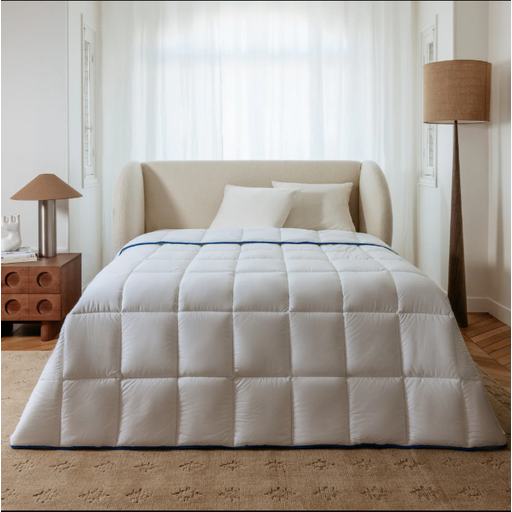
Why this suits this profile: Its size works well for a single bed, and the composition is straightforward for a first purchase.
The product page states a 400 g/m² polyester filling and a 40 °C wash – two concrete details rather than a vague promise of warmth.
Cotton percale cover, siliconised hollow fibres and certifications listed on the product page.

Why this suits this profile: Its double size and natural filling are aimed at those seeking a more enveloping feel for cold nights.
The stated proportion is precise: 90% duck feathers and 10% down. You can compare it with other compositions.
Organic cotton sateen cover, box-stitch quilting and care at 40 °C with gentle tumble drying or professional cleaning.
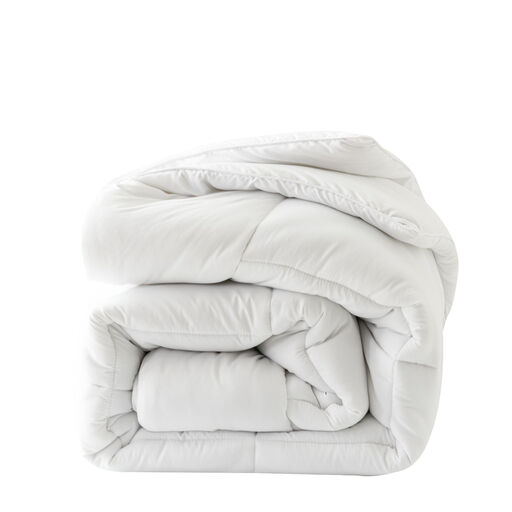
Why this suits this profile: Its stated 15 tog level and large size suit cooler bedrooms and those who like a duvet with plenty of presence.
The product name specifies the 15 tog level and box-stitch quilting, rather than relying solely on the word ‘winter’.
Microfibre filling, described as soft to the touch, several sizes available and designed for winter use.
Why this suits this profile: The 220 x 240 cm size generously covers a double bed, while the synthetic composition makes care simple.
The product page details the cover, 400 g/m² weight, dimensions and washing conditions – giving you concrete facts to compare models.
Cotton percale, siliconised hollow fibres, 40 °C wash and certifications mentioned by the manufacturer.
We’ve put together a comprehensive, real-time updated selection of products that meet these exacting criteria as well as European safety standards.
Start by comparing the stated warmth level, weight and material. A 15 tog duvet or a winter filling of around 400 g/m² can work well in a poorly heated room. However, the feeling of warmth also depends on your bedding, humidity levels and your personal sensitivity to the cold.
For a double bed, the 200 x 200 cm size suits those who prefer a fairly snug fit. The 220 x 240 cm offers more overhang and can be more comfortable for a couple, especially with a wide mattress or if you both tend to move around during the night.
The lifespan depends on the filling, how often it’s washed, drying methods and the duvet’s overall condition. It’s time to replace it if the filling clumps unevenly, if it permanently loses its loft, or if it no longer suits your bedroom temperature. A protective cover and washing according to the instructions will help preserve its qualities for longer.