
Same-day & Next-day Delivery

Quality Guaranteed

Unlock Your Welcome Offers: FREE Delivery | Up to 80% OFF | Free 30-day JoyPlus trial
Download the APP
When the nights get cooler, the call of a warm winter duvet is hard to ignore. But how do you navigate the jungle of options? Between marketing jargon and confusing technical specs, finding the perfect duvet can often be a headache. As a product recommendation expert at Joybuy, my mission is to guide you. Together, let's break down the pitfalls to avoid and the essential criteria for a successful purchase, ensuring you finally enjoy cosy nights.
To prevent disappointment and restless nights, let's start by debunking three persistent myths.
To get it right, focus on these three key points.
This is what determines the warmth level, breathability, and weight of your duvet.
Fill weight, expressed in grams per square metre (GSM), measures the density of the filling. Here are some guidelines for a winter duvet:
Some manufacturers also use a warmth rating, often on a scale of 1 to 4. For winter, a rating of 3 (warm) or 4 (very warm) is highly recommended, especially for those who feel the cold more or if your bedroom isn't overheated (which is advisable anyway!).
To avoid fighting over your share of the duvet and prevent chilly draughts, size is crucial. Allow for a comfortable overhang of at least 20 to 40 cm on each side. For a standard double bed (140x190 cm), a 220x240 cm duvet is the perfect size for a 2-person winter duvet.
The stitching (box, wave...) is not just for aesthetics: it is essential for keeping the filling evenly distributed and preventing the formation of dreaded "cold spots".
To put theory into practice, here are a few products that tick all the right boxes, each meeting a specific need.

Why we recommend it: Perfect for a couple, especially if one of you is more sensitive to the cold. The natural filling (90% feathers, 10% down) provides enveloping warmth while perfectly regulating temperature. No more nightly thermostat battles! Its 220x240 cm size is ideal for a double bed.
It proves that the quality of the natural filling is more important than the weight. The result: high-performance insulation without the "heavyweight" feel. It is also Oeko-Tex certified.
Natural thermal comfort and excellent breathability. For nights that are warm, but never clammy.
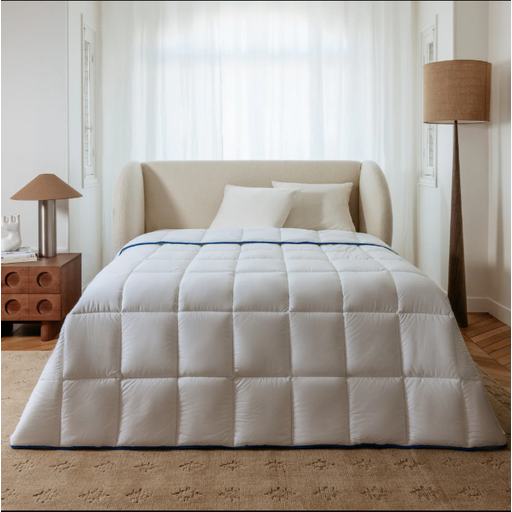
Why we recommend it: With its 100% polyester siliconised hollow-fibre filling, this duvet is the perfect solution for people prone to allergies. Its cotton percale cover ensures a soft and cool touch, while its thickness provides comfortable warmth for winter.
It embraces its status as a synthetic duvet by focusing on the essentials: an effective anti-dust mite treatment and reassuring certifications (Oeko-Tex, CertiPUR). Health comes first.
Hypoallergenic, incredibly easy to care for (a quick spin in the machine is all it takes), and certified free of harmful substances.
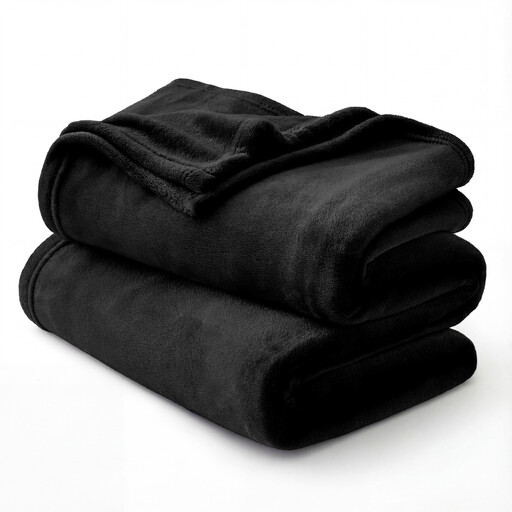
Why we recommend it: Sometimes, the best ally isn't a duvet, but a good throw blanket. For Netflix nights that stretch on or as an extra layer on the bed, this microfibre flannel model is a versatile must-have. Its ultra-soft texture and large size (150x200 cm) are an invitation to snuggle up.
It doesn't try to pass itself off as a duvet. It's a complementary throw that owns its function, with the added bonus of Oeko-Tex certification—a safety guarantee too often overlooked for this type of product.
Incredibly soft, an XL size perfect for snuggling up (alone or with a partner), and the peace of mind that comes with an Oeko-Tex certification.
Explore our full selection of duvets and throws that meet our quality criteria and the strictest safety standards.
It all depends on the filling! For a synthetic duvet, aim for over 400 GSM for intense warmth. For a natural down duvet, 270 GSM can be sufficient thanks to its superior insulating power. Our advice: rely on the warmth rating (when provided) and the quality of the filling, rather than just the fill weight number.
A natural duvet requires a bit more attention. Professional dry cleaning is ideal to preserve the loft of the filling. If the label allows, washing at 30 or 40°C is possible in a large-capacity machine with a mild detergent. The crucial step is drying: use a low-temperature setting in the dryer with dryer balls (or tennis balls) to properly separate and fluff up the down.
Yes, without a doubt. The STANDARD 100 by OEKO-TEX label is one of the most rigorous in the world. It guarantees that every component of the duvet, from the thread to the filling, has been tested and certified free of harmful substances. Choosing an Oeko-Tex duvet means you can be sure you're sleeping in a healthy cocoon, safe from potentially irritating or dangerous chemicals.